
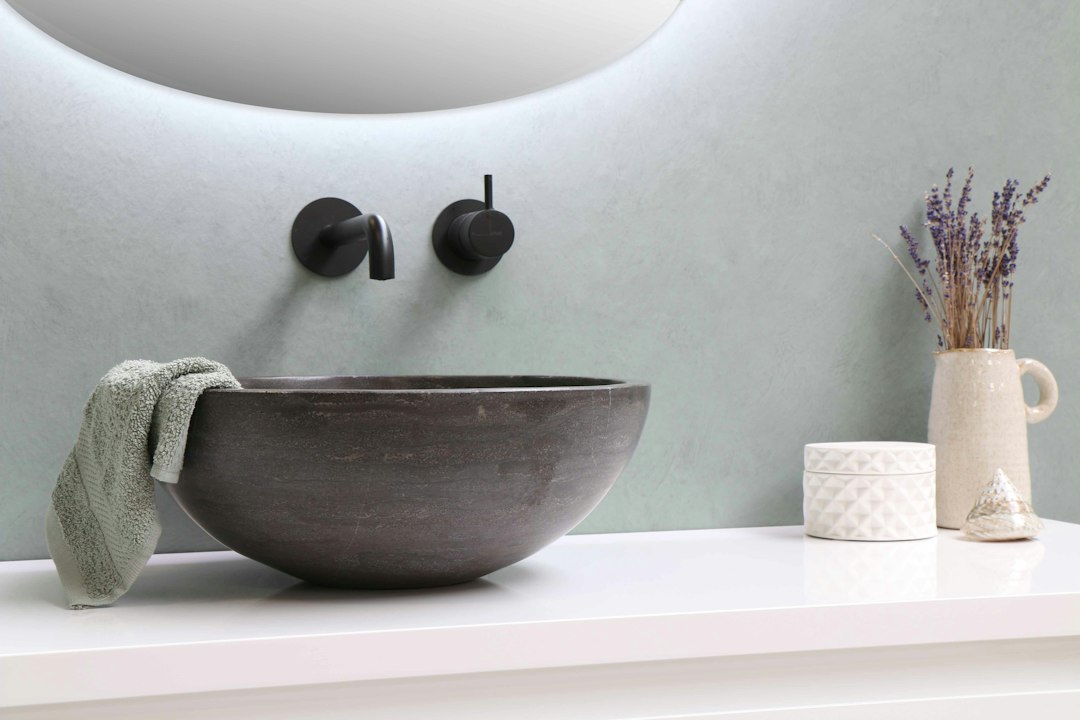
Vessel sinks sit on top of the counter rather than within it, so the bowl reads as an object in its own right: a stone basin, a ceramic bowl, a slab of glass. They are popular in hotel-inspired bathrooms and in Japanese and minimalist interiors, where a single well-made bowl on a plain timber or stone top makes the whole composition.
Because the bowl sits higher, a vessel sink changes the dimensions and fittings around it. Counter height, tap type, the waste and the way water splashes all need rethinking. This guide explains how to plan for one, which materials suit a humid bathroom, and where the problems usually arise. For the wider family of basin types, see our main guide to the bathroom basin.
What makes vessel sinks different
A conventional basin is recessed into the counter or hung from the wall, so its rim sits close to the counter surface. A vessel bowl adds its full height above the top. That one change has knock-on effects:
- The rim is higher, so the counter usually needs to be lower than for an undermount basin.
- The tap must reach over the rim, so it is either a tall deck-mounted mixer or a wall-mounted spout.
- Most vessel bowls have no overflow, so the waste fitting must be the type designed for bowls without one.
- The base of the bowl meets the counter in a joint that collects water and grime.
None of these is a reason to avoid a vessel bowl, but they need to be decided together, before the vanity is made.
Getting the height right
The working height that matters is the rim of the bowl, not the counter. If you place a tall vessel on a vanity built to the height usually used for an undermount basin, the rim ends up uncomfortably high, particularly for children and shorter adults, and water runs down forearms when washing.
The solution is to set the counter height after choosing the bowl. Measure the bowl’s height, decide on a comfortable rim height for the main users, and subtract. This is one advantage of a floating vanity: its height is not fixed by a floor-standing carcass, so it can be hung at exactly the level the bowl requires.
Shallow, low-profile vessels are easier to live with than deep, tall ones. Semi-recessed designs, which sit partly in the counter, are a compromise that keeps the look while lowering the rim.
Taps and splash
Tall deck-mounted mixers
A tall mixer mounts on the counter beside the bowl and rises above the rim. It is simple to install, but its body is exposed to splashes and the base on the counter collects water. Choose one whose spout reaches well into the bowl and whose height suits the bowl’s depth.
Wall-mounted spouts
A wall-mounted spout keeps the counter clear and looks clean. The valve body sits concealed in the wall, behind the tiles and inside the waterproofed zone, so plan it carefully: the spout projection must place the stream near the centre of the bowl, and the concealed body should be of a type that allows cartridge replacement from the front. Opening a tiled wall later to repair a valve is costly.
Splash is more pronounced with vessel sinks because the stream falls from a height into a shallow bowl. A flow straightener or aerator that gives a soft, laminar stream helps, as does matching spout height to bowl depth. Basin taps in Singapore fall under PUB’s water efficiency labelling, so check the rating when choosing.
Waste, overflow and drainage
Most vessel bowls have no overflow hole. They need an unslotted waste, often a push-to-close or free-flowing grid type. Using a slotted waste meant for an overflow basin leaves an open slot that leaks into the cabinet.
Without an overflow, a plugged bowl can be overfilled. Many households simply use a grid waste with no plug, which avoids the risk. The waste passes through the counter, so the hole in the top must be sized and sealed so water cannot run down the waste body into the vanity.
The narrow waste of a vessel bowl traps hair and soap quickly. Choose a waste that can be removed for cleaning, and leave access to the trap underneath. Our guide to drain cleaning covers methods that do not harm fittings.
Materials for vessel sinks
- Vitreous china and ceramic. The most common choice: glazed, non-porous and easy to clean. Can chip if struck.
- Natural stone. Marble, granite, travertine and river stone bowls are striking but vary in porosity. Softer and more porous stones need sealing and react to acidic products. Our article on natural stone explains the differences between stone types.
- Glass. Visually light but shows water marks and soap residue readily in hard or mineral-laden water.
- Metal. Copper and stainless steel bowls are durable; copper develops a patina unless lacquered.
- Solid surface and cast resin. Warm to the touch and repairable, but more easily stained and scratched.
- Timber. Rare and demanding. In a humid bathroom it needs a high-performance finish and constant care.
Heavy stone bowls add significant load to the counter, and if the vanity is wall-hung, to the wall fixings as well. Check the bowl’s weight and make sure the top is supported directly beneath it.
The counter beneath
A vessel sink shows off the counter, so the top material is part of the design. It must also be durable around the bowl, where water gathers. Sealed stone, solid surface, porcelain slab and well-finished timber all work, provided the base of the bowl is bedded on a flexible sealant to stop water creeping underneath.
Leave space between bowl and wall for cleaning, and enough counter on each side for soap and daily items; otherwise they end up balanced on the bowl rim. Our guide to bathroom vanity design covers counter depths and proportions.
Common problems
- Water around the base. Splash runs down the outside of the bowl and pools at the joint. Seal the base and wipe daily.
- Leaks into the cabinet. A wrong waste type or poorly sealed counter hole.
- Bowl movement. Inadequate bedding or a missing fixing ring lets the bowl rock, eventually breaking the seal.
- Discomfort. A rim set too high for the users, usually because the counter height was not adjusted.
Frequently asked questions
Are vessel sinks practical for everyday use?
They are practical when the counter height, tap and waste are chosen together, but they splash more than recessed basins and need the joint around the base wiped regularly.
Do vessel sinks need a special tap?
Yes, they need either a tall deck-mounted mixer that rises above the rim or a wall-mounted spout, because a standard basin mixer will not reach over the edge of the bowl.
Why does water leak into the cabinet under my vessel sink?
The usual causes are a slotted waste fitted to a bowl without an overflow, or a poorly sealed hole in the counter that lets water run down the waste body into the cabinet.
Can a vessel sink sit on a wall-hung vanity?
Yes, and the vanity can be hung lower to suit the raised rim, but heavy stone bowls add load to the wall fixings, so the fixing and the wall should be checked for the full weight.
Related reading
- Ceiling Fans with Lights: Choosing a Light Ceiling Fan
- Modern Kitchen Design: Origins, Principles and Details
- Porcelain Countertops: Slabs, Edges, Support and Care
- Soapstone Countertops: Properties, Patina and Upkeep
Planning a bathroom with a heavy stone bowl or wall-hung vanity? Talk to our consultancy or get in touch.