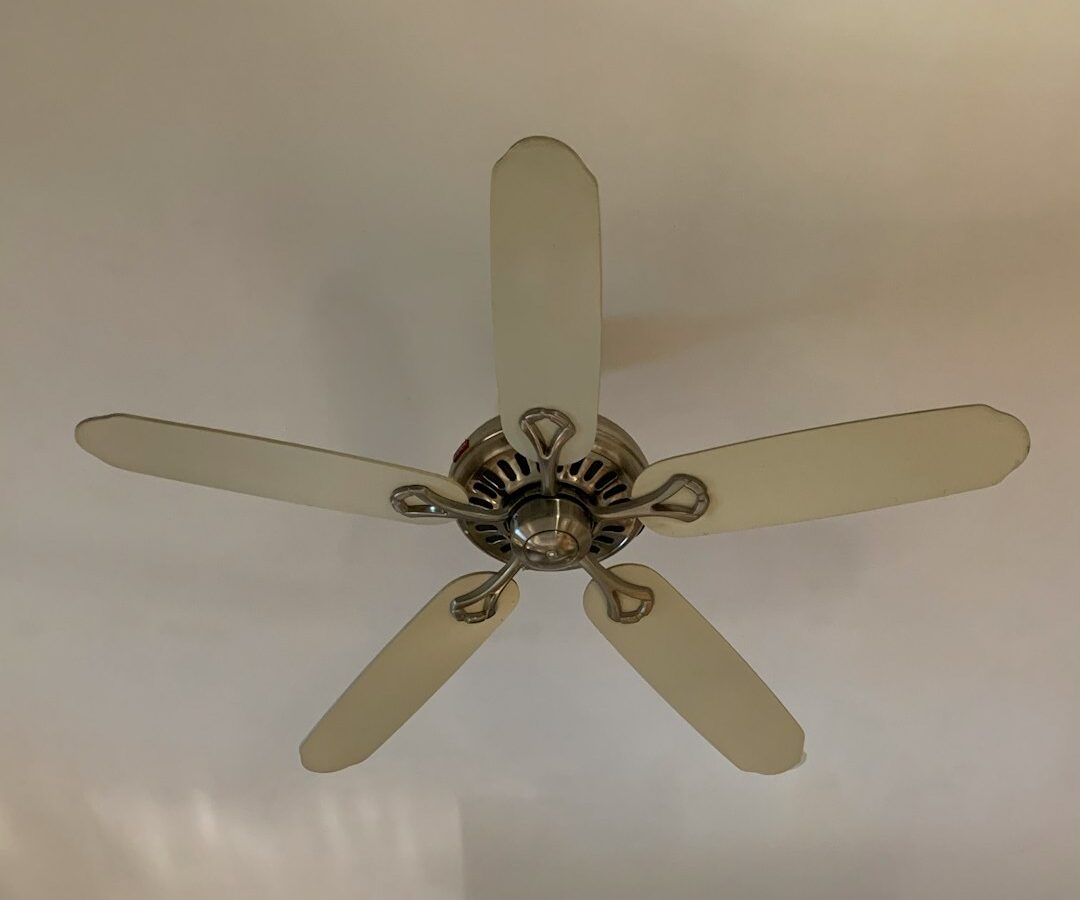
A ceiling fan with an integrated light, often searched for simply as a light ceiling fan, combines two fittings in one ceiling point. In Singapore homes it is one of the most practical fixtures there is: it moves air through the year, reduces how hard the air-conditioner needs to work, and lights the room from the centre without a second fitting competing for the same ceiling.
It is also a rotating, vibrating load hung from the ceiling, sometimes under a false ceiling, and sometimes from a slab you should not drill casually. This guide covers the choices that affect comfort and lighting, and the installation points that affect safety: clearance, motor type, light quality, how the fan is fixed, and who may wire it. For the wider lighting plan of a home, see our guide to home lighting design in Singapore.
Why a ceiling fan suits a humid climate
A ceiling fan does not cool the air. It increases air movement across the skin, which improves evaporative cooling and makes a room feel cooler at the same temperature. In Singapore’s warm, humid climate that matters, because sweat evaporates slowly in moist, still air.
Used on its own, a fan can make a naturally ventilated room comfortable for much of the year. Used with air-conditioning, it allows a slightly higher thermostat setting for the same comfort, which reduces energy use. It also helps distribute cool air evenly rather than leaving it pooled near the unit. Our article on natural ventilation explains how air movement and cross-ventilation work together.
Ceiling height, clearance and mounting style
The key dimension is the clearance between the blades and the floor. A widely used guideline is around 2.1 metres from floor to blade tips, so that a raised arm or a tall person cannot reach them. Many apartments in Singapore have modest floor-to-ceiling heights, especially under false ceilings and bulkheads, so this needs checking before choosing a model.
- Flush or hugger mounts hold the fan close to the ceiling. They suit lower ceilings, at the cost of somewhat reduced airflow because the blades sit near the ceiling surface.
- Downrod mounts drop the fan on a rod. Better airflow, but only appropriate where the ceiling is high enough to keep safe clearance.
Also keep blades clear of walls, cabinets, curtains and tall furniture, and avoid placing the fan so close to a wardrobe or door that they can be struck when opened.
Choosing a light ceiling fan: motor, size and controls
AC and DC motors
Traditional fans use AC motors with a wall regulator. Many newer fans use DC motors, which are generally more energy-efficient, quieter and offer more speed settings, usually operated by remote control or an app. DC fans contain more electronics, which brings their own reliability considerations in humid conditions.
Blade size and room size
Larger blade spans move more air at lower speeds and suit larger rooms; small rooms need compact fans that do not crowd the ceiling. Blade pitch and motor design affect airflow as much as diameter, so compare airflow data where manufacturers publish it rather than relying on size alone.
Controls
Fan and light should be controllable separately, so the light can be off while the fan runs at night. Remote and app controls are convenient, but a wall switch to isolate the unit is still useful. Our guide to smart lighting covers integration with home automation.
The light itself
Most fans with lights now use integrated LED modules beneath the motor housing. Consider:
- Brightness. A single central light may be enough for a bedroom but rarely for a living room. Plan supplementary light, such as cove or task lighting.
- Colour temperature. Warm white suits bedrooms; some fans offer adjustable colour temperature.
- Dimming. Useful in bedrooms, but the dimmer and the LED driver must be compatible.
- Replaceability. An integrated LED module that cannot be replaced separately may mean replacing the whole fan when it fails.
One effect is often overlooked: if downlights are installed above the plane of the fan blades, the turning blades cut through the light and create a distracting strobe-like flicker on the floor and walls. Keep other ceiling lights outside the blade sweep, or rely on the fan’s own light below the blades.
Fixing the fan: slab, false ceiling and hidden services
A fan is not just a weight. When running, it produces vibration and twisting forces, and if a blade is unbalanced, a cyclic load that works at the fixing. The fan must be fixed to a structural element designed to carry it, normally the reinforced concrete slab above, with a purpose-made hook or bracket and anchors suitable for the concrete.
Several points deserve care:
- False ceilings. Plasterboard and its light framing are not designed to carry a fan. Fix the fan to the slab above, using a drop rod or a structural support that passes through the false ceiling. Our guide to false ceilings in Singapore explains how those ceilings are hung.
- Concealed conduits. Electrical conduits are often cast into slabs. Drilling into them can damage cables. The existing fan or lighting point usually indicates where conduit runs.
- Post-tensioned slabs. Some condominium and commercial floor slabs are post-tensioned, with high-strength steel tendons under very high stress. Drilling into a tendon can be dangerous and seriously damage the slab. If you are unsure, check with the management corporation or a professional engineer before drilling.
- Balance and fixing checks. Wobble indicates an unbalanced blade or loose fixing. Address it promptly rather than tolerating it.
Wiring and licensed work
In Singapore, electrical installation work, including adding a new ceiling point, relocating one or extending a circuit, must be carried out by an EMA Licensed Electrical Worker. Replacing a fan on an existing point is simpler, but the connection and earthing must still be correct, and the circuit should be protected by residual current protection. Our article on electrical wiring explains how home circuits are arranged.
For balconies and covered outdoor areas, choose a fan rated for damp or outdoor locations, as humidity and wind-driven rain will corrode standard fans and their electronics.
Frequently asked questions
How low can a light ceiling fan hang?
A widely used guideline keeps the blades around 2.1 metres above the floor, so in rooms with lower ceilings a flush or hugger mount is usually the safer choice than a downrod.
Can a ceiling fan be installed on a false ceiling?
The fan should not be carried by the false ceiling board or framing; it should be fixed to the concrete slab above using a drop rod or structural support passing through the false ceiling.
Are DC ceiling fans better than AC fans?
DC fans are generally quieter, more energy-efficient and offer more speed settings, while AC fans are simpler and use a wall regulator, so the choice depends on budget, controls and preference.
Why do my downlights flicker when the fan is on?
Downlights mounted above the plane of the blades are interrupted by the turning blades, creating a strobe-like flicker, so other ceiling lights should be placed outside the blade sweep.
Do I need a licensed electrician to install a ceiling fan with light?
Any new or relocated electrical point must be installed by an EMA Licensed Electrical Worker, and even a replacement on an existing point needs a correct, earthed and protected connection.
Related reading
- Mirrored Bathroom Cabinets: Recessed, Surface and Fixing
- Acoustic Ceiling Design: Types, Ratings and Practical Uses
- Mass Loaded Vinyl: How MLV Soundproofing Really Works
- Lux Levels for Homes and Offices: Lux Lighting Systems
Unsure whether your slab can be drilled for a ceiling fan? Talk to our consultancy or get in touch.