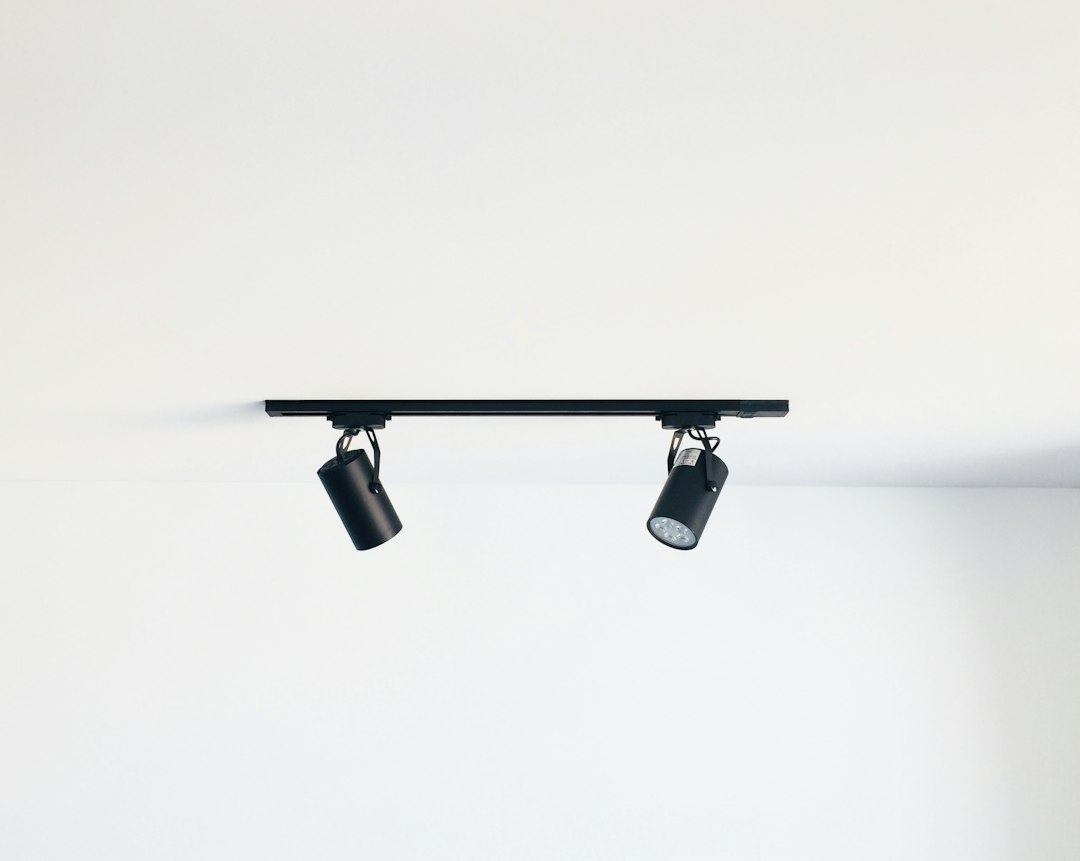
A track light ceiling is one of the most adaptable ways to light a room. Instead of fixing each luminaire to its own point in the ceiling, a continuous conductive rail carries power along its length, and spotlights or pendants clip on wherever they are needed. Move a painting, rearrange the furniture or change the use of a room, and the lights can follow without new holes or new wiring.
This guide explains how track systems work, the main types, how to plan a layout that does not glare or clutter, and the practical points of mounting and wiring them. It is written from the perspective of a practising engineer who sees lighting at the point where it meets the ceiling structure and the building’s electrical installation.
How a track system works
A lighting track is an extruded profile, usually aluminium, with insulated copper conductors running inside it. Each luminaire has an adaptor that twists or slides into the track and makes contact with those conductors. Power enters the track through a feed connector at one end or along its length, and every adaptor along the run draws from the same supply.
The appeal is that the electrical connection becomes a mechanical one. Once the track is installed and tested, adding, removing or sliding a spotlight is a plug-in operation rather than wiring work. That is why galleries, shops and showrooms have relied on track for decades: the display changes often, and the lighting has to change with it.
Tracks are joined with straight, L, T and X connectors to form longer runs and simple shapes. The connectors carry both the conductors and the mechanical alignment, so a well-built run reads as one continuous line.
Types of track lighting
Single-circuit track
The simplest track carries one live circuit. Every luminaire on it switches and dims together. It suits a kitchen run or a corridor where all the lights do the same job.
Three-circuit track
Common in commercial work, a three-circuit track has three separate live conductors sharing a neutral and earth. Each adaptor can be set to draw from one of the three circuits, so a single track can carry, for example, general display lighting, accent lighting and night lighting, each switched or dimmed independently.
Low-voltage and magnetic track
Many residential systems now run at extra-low voltage, typically 24 or 48 volts DC, supplied by a driver hidden in the ceiling. Luminaires attach magnetically and can be lifted off and repositioned by hand. Because the voltage on the track is low, these systems are thin, often recessed flush with the ceiling, and can accept linear modules, small spots and pendants on the same rail. The driver must be sized for the total load and placed where it can be reached for maintenance.
Monorail and cable systems
Bendable monorails and tensioned cable systems are variations on the same idea. They allow curves and long spans, but they need careful support because their geometry depends on fixings and tension rather than a rigid profile.
Surface, suspended or recessed: choosing a track light ceiling
How the track meets the ceiling changes both the look and the work involved. A surface-mounted track is screwed directly to the soffit or ceiling board. It is the quickest option and suits renovations where the ceiling is not being rebuilt, but the track and the feed are visible.
A suspended track hangs on rods or wires below a high ceiling. It brings the light closer to the task in double-volume spaces and lofts, and it lets the track cross a room independently of the ceiling grid. A recessed track sits in a channel within a plasterboard ceiling, so only a slot is visible. This is the cleanest result and pairs naturally with the minimal look of profile lights, but it needs a false ceiling with enough depth for the track body and the driver.
A recessed track light ceiling should be planned before the ceiling framing is set out, because the channel has to align with the runners and avoid services such as air-conditioning ducts and sprinkler pipes. Retrofitting a recessed channel into an existing ceiling usually means cutting and making good large sections of board.
Planning the layout
Track is easiest to misuse by placing it where it is convenient rather than where the light should land. A few principles help:
- Light the object, not the floor. Spotlights work best aimed at walls, artwork, shelves and worktops. Track is a poor substitute for even ambient light in a large room.
- Mind the angle. For wall-mounted art, an aiming angle of roughly 30 degrees from vertical is a common starting point. It lights the surface without casting long shadows from frames or reflecting straight back into the viewer’s eyes.
- Keep the run parallel to what it lights. A track that follows a wall at a consistent offset produces even washes and is visually calm. Diagonal runs across a ceiling are rarely worth the visual noise.
- Allow for the future. Make the run longer than today’s needs. Empty track costs little and gives room to add fittings later.
Track works best as one layer in a scheme that also includes ambient and task light. Our guide to home lighting design sets out how those layers combine, and our comparison of downlights and cove lighting covers the ambient options that sit alongside track.
Glare, colour and dimming
Spotlights on track are directional by nature, so glare control matters more than with diffuse fittings. Look for deep-set light sources, honeycomb louvres or snoots, and narrow enough beam angles that light does not spill sideways into people’s eyes. In living rooms, keep spots away from seating sightlines and aim them so that the bright part of the fitting is not visible from the sofa.
Colour temperature and colour rendering should be consistent along a run. Mixing fittings from different product lines often produces visible differences in whiteness on the same wall. For homes, warm white is usual; a high colour rendering index helps timber, textiles and artwork look natural.
Dimming needs to be specified as a system: the driver, the dimmer and the fittings must be compatible. With low-voltage magnetic tracks, the dimming method is set by the driver, so it is worth confirming the protocol before buying. Integration with smart lighting controls is straightforward when the driver supports it.
Mounting and electrical safety
A track looks light, but it carries a moving load: people pull and push spotlights to re-aim them, and pendants on track add weight at a single point. Fixings should go into the ceiling framing or the slab with appropriate anchors, not into plasterboard alone. Suspended tracks need rods or wires rated for the full fitted weight with a margin, and long runs need intermediate supports at the spacing the system specifies.
Fixing into a concrete slab is normally routine, but drilling should avoid the reinforcement and any embedded conduits, and post-tensioned slabs must never be drilled without the tendon layout being confirmed. If you are unsure what your soffit is, our article on types of ceilings explains what usually sits above the board.
In Singapore, connecting a new lighting point, feed or driver to the fixed installation is electrical work that must be carried out by a Licensed Electrical Worker (LEW) licensed by the Energy Market Authority. The LEW will confirm the circuit’s capacity, the protective devices and the earthing, and test the installation. Clipping a luminaire onto a track that is already installed and tested is user-level, but the track itself, its feed and any driver belong to the LEW.
Frequently asked questions
Is track lighting suitable for a living room?
Yes, as an accent layer. A track light ceiling run along a feature wall, shelving or artwork adds flexibility and depth, but it should be combined with softer ambient light so that the room does not feel lit only by spotlights.
What is the difference between single and three-circuit track?
A single-circuit track switches all its fittings together. A three-circuit track has three live conductors, so fittings can be assigned to separate circuits and switched or dimmed independently on the same rail.
Can track lights be installed on a concrete ceiling without a false ceiling?
Yes. A surface-mounted track can be fixed directly to a concrete soffit with suitable anchors, with the feed run in surface conduit or trunking. Drilling should avoid reinforcement and embedded services, and post-tensioned slabs need the tendon layout checked first.
Are magnetic track lights safe to adjust by hand?
Extra-low-voltage magnetic tracks are designed to be repositioned by the user once installed. The driver and its connection to the mains must still be installed by a licensed electrical worker and kept accessible for maintenance.
How far apart should track spotlights be?
It depends on ceiling height, beam angle and what is being lit. As a starting point, space spots so that their beams overlap slightly on the target surface; test the aim on site before fixing the final positions.
Related reading
- Lighted Bathroom Mirrors: Light Quality, IP Zones, Wiring
- Vessel Sinks: Counter Height, Taps, Waste and Materials
- Floating Bathroom Vanity: Wall Fixing and Design Guide
- Bathroom Cabinets: Types, Materials and Humidity Risks
Planning a recessed track or heavy suspended run in an existing ceiling? Talk to our consultancy or get in touch for advice on fixings and the ceiling structure.