
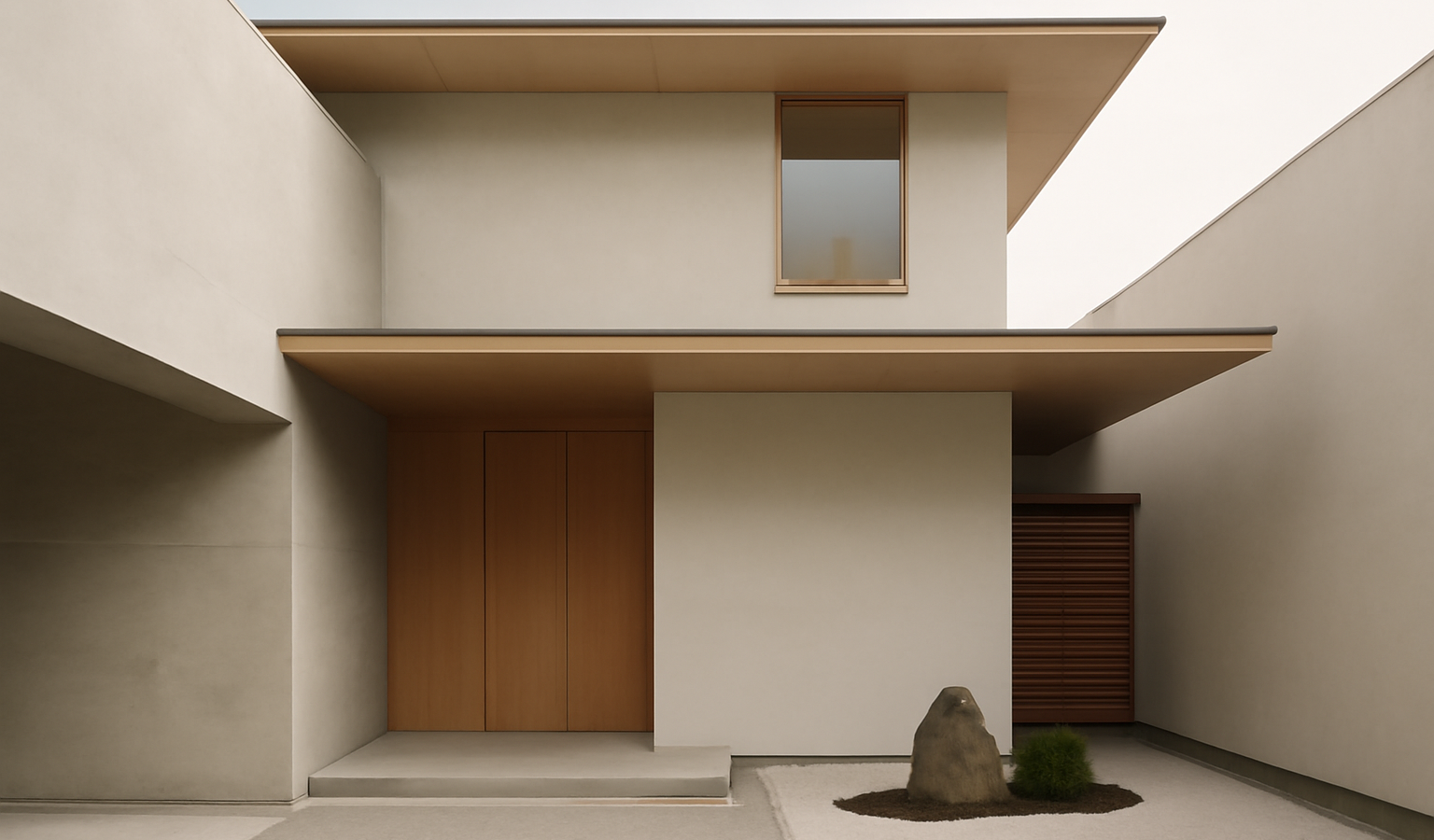
Contemporary Japanese architecture is among the most admired and influential in the world. Over the past half-century, Japan has produced an extraordinary concentration of celebrated architects, several of them recipients of the profession’s highest honours, and a body of work that has shaped design far beyond its borders. Contemporary Japanese architecture is notable for combining deep tradition with restless innovation.
This overview draws together the figures and themes we explore in this series — the recurring concerns, the leading architects, and the reasons Japanese design carries such global weight today. It builds on our wider writing about architectural styles and principles and the traditional Japanese house from which much of it descends.
A remarkable concentration of talent
Few countries can match Japan’s density of internationally celebrated architects in recent decades. The lineage runs from the postwar generation, anchored by Kenzo Tange, through to a remarkable group of later figures: Tadao Ando, with his serene concrete; Toyo Ito, with his inventive, fluid structures; SANAA’s Kazuyo Sejima and Ryue Nishizawa, with their weightless transparency; Shigeru Ban, with his inventive materials and humanitarian work; and Kengo Kuma, with his devotion to natural materials.
Several of these architects have received the Pritzker Architecture Prize, the field’s most prestigious international honour — an unusually high count for a single country. We profile each of them individually in this series, and together they represent one of the strongest national contributions to recent architecture anywhere in the world.
Recurring themes
Despite their differences, the leading Japanese architects share a set of recurring concerns that give the work a family resemblance. Several stand out:
- Lightness and transparency — a frequent ambition to dissolve heaviness and make architecture feel airy and open, seen vividly in SANAA’s glass-walled buildings and Ito’s fluid structures.
- Material honesty — a respect for the true character of materials, whether Ando’s exposed concrete, Kuma’s timber or Ban’s engineered paper.
- Relationship to nature — a persistent concern with light, garden, sky and the softening of the boundary between inside and outside.
- Restraint — a refusal of ornament and excess, descended from deep traditions of simplicity.
These themes are not arbitrary. They reach back to the values of traditional Japanese building — naturalness, simplicity, attention to light and material — reinterpreted in contemporary form rather than imitated.
Tradition reinterpreted, not copied
What makes contemporary Japanese architecture so distinctive is the way it keeps tradition alive without reproducing it literally. The architects rarely build mock-traditional houses; instead they absorb the underlying logic of the tradition — the discipline of proportion, the framing of nature, the honesty of timber and structure, the value placed on emptiness and light — and express it through wholly modern means.
This is why a glass pavilion by SANAA or a timber lattice by Kuma can feel deeply Japanese without resembling an old building at all. The continuity is in the sensibility, not the appearance. It is the same instinct that animates the traditional Japanese house, carried forward into glass, steel, concrete and engineered timber.
This way of holding onto tradition is one of the most instructive lessons of the contemporary Japanese scene. Many cultures struggle to reconcile heritage with modernity, treating the two as opposites — either preserving old forms unchanged or discarding them entirely. Japanese architects have charted a third path, keeping the underlying values alive while letting the forms evolve freely. The result is an architecture that feels both rooted and entirely contemporary, and it offers a model that designers elsewhere continue to study and learn from.
Structure and craft at the centre
A striking feature of the best contemporary Japanese work is how central structure and craft remain. Whether it is Ando’s exacting concrete, Ban’s engineered paper tubes, Ito’s structure-driven forms or Kuma’s intricate timber assemblies, these architects treat the way a building is made and stands up as inseparable from how it looks and feels. Lightness and refinement are achieved through rigour, not in spite of it.
That marriage of design ambition and technical discipline is exactly the territory of structural engineering. As our explainer on what a structural engineer does makes clear, the most refined architecture depends on careful structural thinking behind the scenes — a partnership that Japanese architects have raised to a high art.
The global influence of contemporary Japanese architecture
Contemporary Japanese architecture has shaped taste and practice worldwide. Its influence is visible in the global appetite for minimalism, for natural materials, for lightness and transparency, and for a calmer, more considered relationship between buildings and their surroundings. Japanese architects build internationally and are studied everywhere, and their ideas circulate well beyond the profession into interiors, product design and the wider culture.
For readers drawn to Japanese design, the contemporary scene is the living edge of a very long tradition. It demonstrates that the deepest values of that tradition — restraint, naturalness, craft and care — remain powerfully generative today. We hope this series, and our wider writing on Japanese design, helps you read these buildings with a sharper, more appreciative eye.
Frequently asked questions
Who are the leading contemporary Japanese architects?
Leading figures include Tadao Ando, Toyo Ito, Kengo Kuma, Shigeru Ban, and SANAA’s Kazuyo Sejima and Ryue Nishizawa, building on the postwar legacy of Kenzo Tange. Several have received the Pritzker Architecture Prize, the field’s highest international honour.
What themes define contemporary Japanese architecture?
Recurring themes include lightness and transparency, material honesty, a strong relationship to nature and light, and restraint or refusal of ornament. These reach back to traditional Japanese values of simplicity and naturalness, reinterpreted in contemporary form.
How does it relate to traditional Japanese building?
It keeps tradition alive without copying it literally. Architects absorb the underlying logic — proportion, framing of nature, honesty of structure, value of emptiness and light — and express it through modern materials, so the continuity lies in sensibility rather than appearance.
Why is Japanese architecture so influential globally?
Its influence shows in the worldwide appetite for minimalism, natural materials, lightness and a calmer relationship between buildings and their surroundings. Japanese architects build internationally and are widely studied, and their ideas spread into interiors and design culture.
Why is structure so important in this work?
The best contemporary Japanese architecture treats structure and craft as inseparable from how a building looks and feels. Lightness and refinement are achieved through rigorous engineering, not in spite of it, making structural thinking central to the work.
Related reading
- Minka: The Japanese Folk House Explained
- Machiya: The Japanese Townhouse Explained
- Seijaku: Tranquility in Japanese Design
- Urushi: Japanese Lacquerware Explained
Inspired by Japanese design and planning a project of your own? Talk to our consultancy or get in touch.


