The Little India shophouses along Serangoon Road and its side streets form one of Singapore’s most vivid historic districts. Their façades carry the same shophouse forms seen in Chinatown and Kampong Glam, but the district’s life, from spice traders and goldsmiths to flower-garland sellers and temple processions, gives them a very different character. The area is protected as a conservation area, and its buildings tell a story of how a community shaped a part of the city it was never originally allocated.
This article explains how Little India developed, how to read its shophouse styles, what makes its street pattern unusual, how URA’s conservation rules apply and what owners should know before renovating. It draws on URA’s conservation portal and the National Library Board.
How Little India grew
URA notes that the area was not designated by Raffles for any particular community, yet it became the heart of Singapore’s Indian community from the mid-1800s. Serangoon Road is one of the island’s earliest roads, shown on Lieutenant Jackson’s 1828 town plan as “The Road Leading Across the Island”. The Rochor Canal was built in 1836 to serve farms in the area, and a race course opened in the early 1840s, with the first racing season in 1843.
Cattle trading was central to the early economy, drawing Indian workers and traders to the area; the name Kerbau Road comes from the Malay word for buffalo. As that trade declined, shophouses and commerce filled the streets, and by the 1940s, URA records, the district was a commercial and residential area with a large Indian population. Many residents moved out in the 1960s and 1970s, slums were cleared in the 1970s and public housing was built in the 1980s.
Conservation status
Little India was gazetted as a conservation area on 7 July 1989, as one of the first ten conservation areas in Singapore. URA’s portal records that additional buildings were conserved along Desker Road on 25 October 1991, Syed Alwi Road on 21 January 2008 and Jalan Besar on 23 November 2010. The conservation area is bounded by Serangoon Road, Sungei Road and Jalan Besar.
Within the area are two National Monuments, the Sri Srinivasa Perumal Temple and the Abdul Gaffoor Mosque, as well as conserved landmarks including the Sri Veeramakaliamman Temple, Kampong Kapor Methodist Church and the Shree Lakshminarayan Temple. Tekka Market and the Indian Heritage Centre anchor the district’s daily and cultural life.
Reading the Little India shophouses
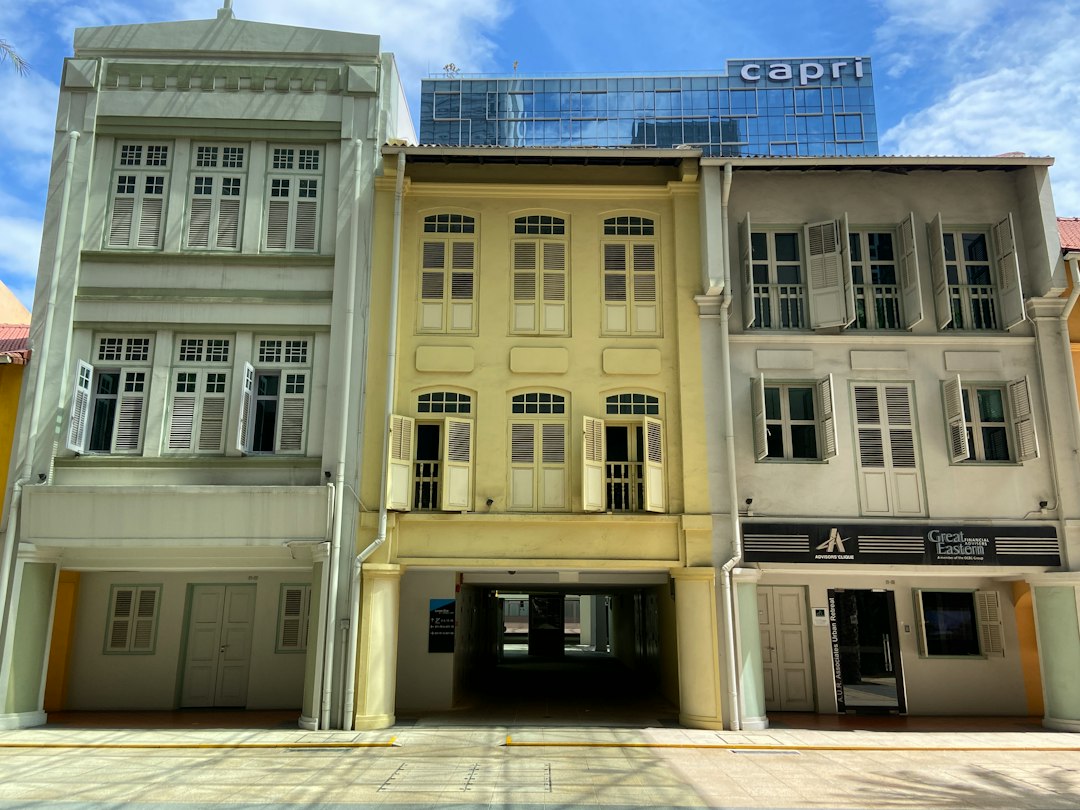
URA’s portal states that the area consists mainly of shophouses in the Early (about 1840 to 1900), First Transitional, Late (about 1900 to 1940), Second Transitional and Art Deco (about 1930 to 1960) styles. In practice, a walk along Serangoon Road shows the full range:
- Early shophouses: low two-storey buildings with simple façades and one or two windows above.
- Transitional shophouses: taller, with three windows on the upper floor and more ornament.
- Late shophouses: richly decorated with pilasters, plaster mouldings and glazed tiles, sharing the Straits Eclectic vocabulary of the Peranakan shophouse.
- Art Deco shophouses: geometric ornament, vertical fins and dated parapet plaques, as discussed in our article on Art Deco architecture.
URA’s records for a row at 42 to 54 Serangoon Road note 26 pre-war shophouses restored in the mid-1990s, with the Hastings Road row dated to 1913 from its pediments. A plaque at the corner of 42 Serangoon Road includes an animal head believed to be a cow, a reminder of the area’s cattle-trading past.
Colour and signage
Many Little India shophouses are painted in strong colours, and the street is dense with signage, awnings and goods spilling onto the five-foot way. URA’s guidelines regulate signage, colour schemes and additions on conserved buildings to keep the architecture legible while allowing the commercial life that sustains the district.
An unusual street grid
One of the district’s less obvious features is its street pattern. URA observes that many side streets meet the main roads at acute angles, probably because they began as private lanes leading to bungalows rather than as a planned grid. The result is a series of wedge-shaped blocks and irregular plots, which shophouse builders filled with buildings of varying widths and depths. Corner shophouses on these sites often have splayed or rounded façades that make the most of the junction.
For anyone working on these buildings, irregular plots mean irregular structures. Party walls may not be parallel, rear walls may be angled, and later infill can make the structural arrangement hard to read without a survey.
Renovating a Little India shophouse
Like other pre-war shophouses, those in Little India are typically built with load-bearing brick party walls, timber floors and timber roof structures on shallow foundations. Common issues include:
- Timber beams and joists weakened by termites or by moisture where they bear into masonry.
- Roof leaks and blocked gutters leading to rot in roof timbers and ceilings.
- Cracking in party walls and façades from settlement, nearby excavation or earlier alterations.
- Overloading of upper floors when the use changes, for example to storage, a restaurant or a hostel.
Any structural change, including new staircases, lifts, mezzanines or heavier floor uses, should start with a survey and an assessment by a Professional Engineer. URA conservation permission is needed before works, following its principles of maximum retention, sensitive restoration and careful repair. Our guide to shophouse renovation in Singapore covers the approval steps.
Why Little India matters
Little India shows that a district’s identity comes from people and uses as much as from architecture. The same shophouse forms found elsewhere in Singapore are animated here by temples, markets and festivals that make the streets unmistakable. Conservation has kept the buildings; the community keeps them alive. For students of the city, the Little India shophouses are also a record of how an unplanned, organically grown district can become one of its most valued places.
Frequently asked questions
When was Little India conserved?
Little India was gazetted as a conservation area on 7 July 1989, with additional buildings along Desker Road, Syed Alwi Road and Jalan Besar conserved in 1991, 2008 and 2010.
What styles are the Little India shophouses?
URA records shophouses in the Early, First Transitional, Late, Second Transitional and Art Deco styles, spanning roughly the 1840s to the 1960s.
Why do Little India’s side streets meet Serangoon Road at angles?
URA suggests that many side streets began as private lanes leading to bungalows rather than as part of a planned grid, which produced acute-angled junctions and irregular plots.
Do I need approval to renovate a shophouse in Little India?
Yes. Works on a conserved shophouse need URA conservation permission, and structural changes need a Professional Engineer’s design and the relevant building approvals.
Related reading
- National Gallery Singapore Architecture: Old Into New
- Notable Singapore Architects: Pioneers to Present Day
- Board of Architects Singapore: What It Regulates and Why
- Singapore Institute of Architects (SIA): History and Role
Converting or restoring a shophouse and need to know what the structure can take? Talk to our consultancy or get in touch.