For many residents, the phrase japanese garden singapore brings one place to mind: the Japanese Garden on its island in Jurong Lake. It is the country’s best-known example of the tradition, and after several years of redevelopment it reopened in 2024 as part of Jurong Lake Gardens. Its story also raises a broader design question: how should a garden tradition shaped by four seasons and temperate plants be adapted to an equatorial city?
This article covers the history of the Jurong garden, what changed in its recent rejuvenation, and the principles a designer or homeowner should keep in mind when creating a Japanese-inspired garden in Singapore’s heat, rain and humidity.
Seiwaen: the Japanese Garden at Jurong
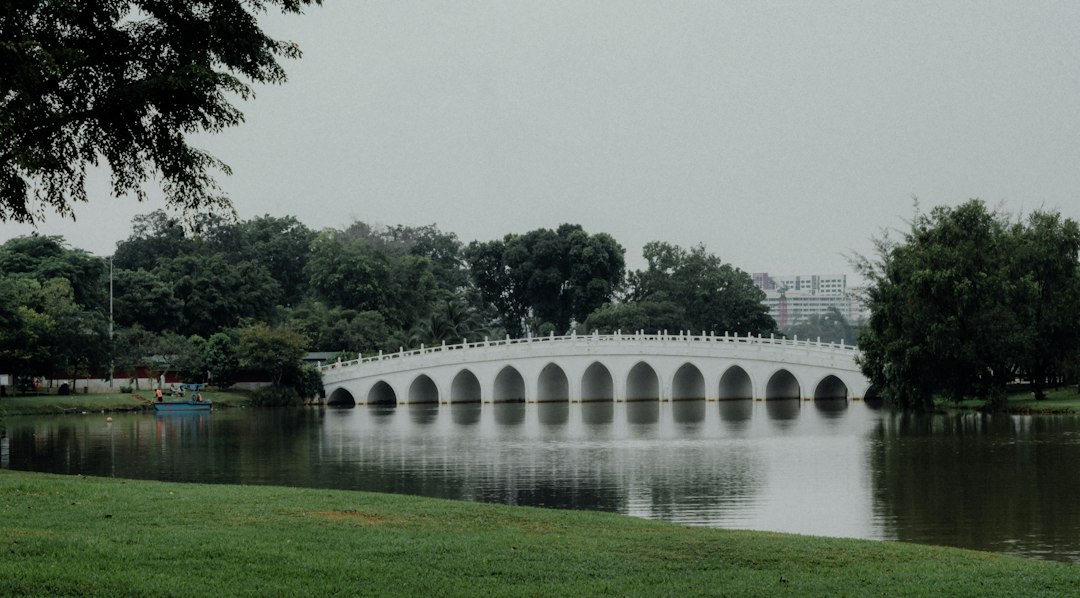
The Japanese Garden at Jurong, known as Seiwaen, was one of Singapore’s early landmark gardens. National Heritage Board records describe it as designed by the Japanese garden and landscape artist Kinsaku Nakane, built on a man-made island in Jurong Lake from 1968 and opened in February 1973, with Dr Goh Keng Swee, who had initiated the project, officiating. Funding came largely from the Singapore and Japanese governments and the local Japanese community.
Those records describe a garden that drew on Japanese landscape techniques of roughly the fourteenth to sixteenth centuries, with a karesansui dry rock garden at the entrance, stone lanterns, summer houses, bridges and waterfalls arranged as a sequence of scenes. Visitors followed paths around ponds and islands, the classic stroll-garden format in which views open and close as one walks.
The neighbouring Chinese Garden, built in the same period, gave the two gardens a shared identity, and for decades the pair were a fixture of school excursions and wedding photographs in western Singapore.
The rejuvenation within Jurong Lake Gardens
The Chinese and Japanese Gardens closed for rejuvenation works from 2019 as part of the larger Jurong Lake Gardens project led by the National Parks Board. NParks announced the opening of the rejuvenated Chinese and Japanese Gardens on 8 September 2024, completing Jurong Lake Gardens, which together with Lakeside Garden covers about 90 hectares.
According to NParks, several familiar landmarks and features at both gardens were retained or enhanced following public feedback, while new elements were added. At the Japanese Garden these include a Japanese-inspired floral garden, a water lily garden, a sunken garden with green walls and a water feature, a ridge trail of flowering trees, and a guesthouse hall built of mass-engineered timber, alongside a guest pavilion and teahouse.
The rejuvenation illustrates a recurring tension in heritage landscapes. A garden is a living thing, and some change is inevitable as trees mature, structures age and expectations shift. The challenge is to renew the garden’s infrastructure and programmes while keeping the qualities that people remember, such as the stroll routes, the stone features and the relationship to the water.
Principles of Japanese garden design
Whether at the scale of a public park or a terrace house courtyard, a Japanese garden rests on a few enduring principles. Our guides to Japanese garden design and Japanese garden elements cover them in more depth, but the essentials are these:
- Asymmetry and natural composition. Rocks, plants and water are arranged to suggest nature rather than geometry.
- Miniaturised landscape. Rocks may represent mountains or islands, and raked gravel may stand for water.
- Framed views. Gardens are composed to be seen from particular positions, such as a veranda, a window or a bend in a path.
- Restraint. A limited palette of materials and plants, and the value of empty space, are central.
- Change over time. Moss, weathered stone and maturing trees are part of the design intent.
These ideas are independent of climate. What changes in the tropics is the palette used to express them.
Japanese garden Singapore design: adapting to the climate
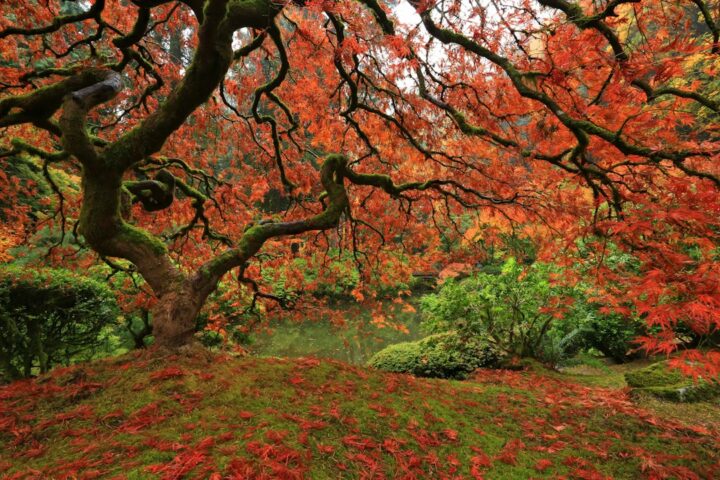
Singapore’s climate is hot, wet and humid all year, without the cool winter that many Japanese garden plants need. Classic species such as Japanese maples, cherries and many conifers tend to struggle in the lowland tropics, a point we discuss in our article on the Japanese maple. A successful Japanese garden Singapore designers create today keeps the composition and replaces the planting.
Planting
Designers typically choose tropical plants with a similar form or texture: fine-leaved shrubs that can be clipped into rounded mounds, small trees with layered branches, ferns, and low ground covers in place of temperate moss in sunny areas. The aim is to recreate the structure and mood rather than the exact species list. A local horticulturist is invaluable here.
Water and drainage
Heavy tropical downpours test any garden. Dry gravel gardens need a stable sub-base and positive drainage, or the gravel will wash out and puddles will form. Ponds need overflow routes, filtration and circulation to manage algae and mosquito breeding. Our guide to koi pond design covers the practical requirements.
Materials
Stone weathers quickly in warm, wet conditions, acquiring algae and lichen that can be attractive but may make paths slippery. Timber structures such as bridges, gates and pavilions must be chosen and detailed for humidity and termites, with good ventilation and separation from the ground.
Japanese gardens in homes and developments
Most examples of the Japanese garden in Singapore today are private: courtyards in landed houses, roof terraces, condominium landscapes and small spaces beside HDB flats. Each scale has its own constraints. A courtyard garden can be designed to be seen from the living room, in the manner of a tsuboniwa. A roof garden must respect the loads that soil, stone and water impose on the slab. A condominium landscape must balance aesthetics with maintenance budgets and safety.
The structural side of these gardens is easy to underestimate. Saturated soil, boulders and water features are heavy, and placing them on a roof or a transfer slab without checking capacity can lead to cracking, deflection or waterproofing failure. Large rocks also need safe lifting and placement during construction.
Frequently asked questions
Is the Japanese Garden in Jurong open?
The rejuvenated Chinese and Japanese Gardens were opened by NParks on 8 September 2024 as part of Jurong Lake Gardens, following redevelopment works that began in 2019. Check NParks for current visitor information.
Who designed the original Japanese Garden in Singapore?
National Heritage Board records name Kinsaku Nakane, a Japanese garden and landscape artist, as the designer of Seiwaen, the Japanese Garden at Jurong, which opened in February 1973.
Can Japanese garden plants grow in Singapore?
Many temperate species, such as Japanese maples and cherries, struggle in Singapore’s lowland tropical climate. Designers usually substitute tropical plants with a similar form, texture and scale to recreate the character of the garden.
How do I make a small Japanese garden at home in Singapore?
Start with a framed view from a window or seating area, use a restrained palette of stone, gravel and clipped planting, and plan drainage carefully for heavy rain. Choose termite-resistant materials for any timber.
Can I build a Japanese garden on my roof terrace?
Often yes, but soil, stones and water are heavy, especially when wet. The roof slab’s capacity and waterproofing should be checked by a qualified engineer before the garden is built.
Related reading
- Shunmyo Masuno: Zen Priest and Garden Designer Profile
- Arita Porcelain (Arita-yaki): History, Styles and Use
- Ryokan: The Architecture of the Japanese Inn Explained
- Hoshinoya Tokyo: A Ryokan in an Office District
Planning a roof garden, pond or heavy stone feature on an existing slab? Talk to our consultancy or get in touch.