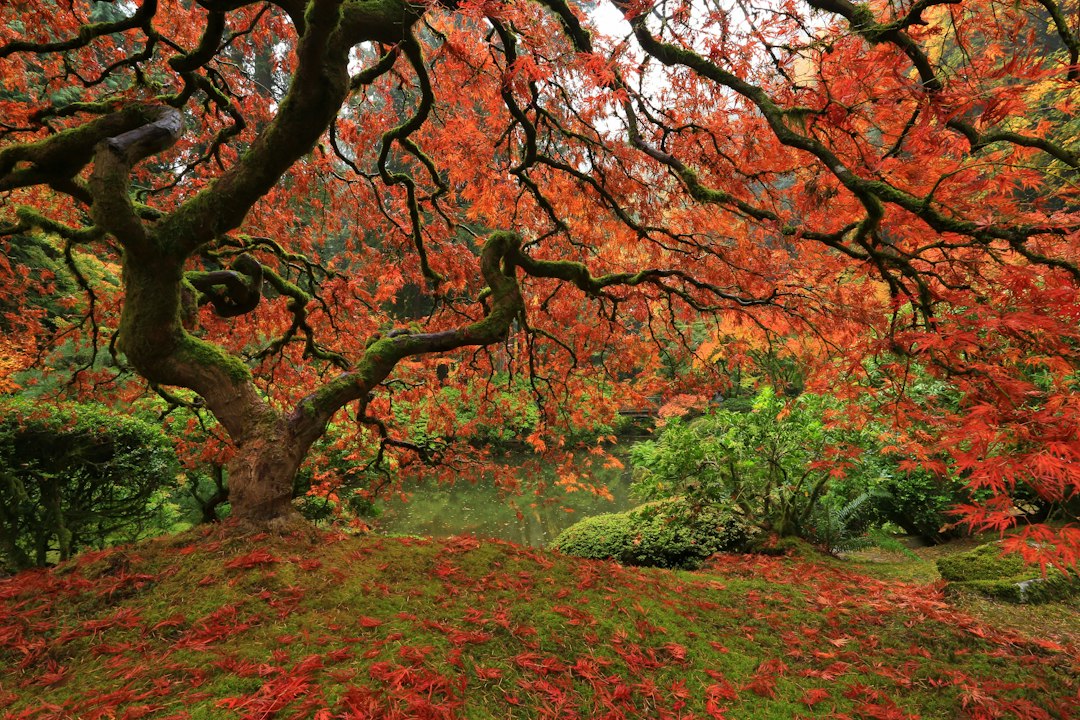
The Japanese maple is probably the single tree most associated with the Japanese garden. Its fine, hand-shaped leaves, layered branches and dramatic autumn colour have made it a fixture of temple gardens, tea gardens and courtyards in Japan, and a favourite of garden designers worldwide. Used well, a single tree can define the character of a whole space.
This article looks at the tree from a designer’s perspective rather than a nursery catalogue. We cover the main forms, how maples are placed in relation to architecture, water and stone, how they change through the seasons, and the honest climatic limits that anyone hoping to grow one in Singapore should understand.
What is a Japanese maple?
The name usually refers to Acer palmatum, a small deciduous tree native to Japan, Korea and parts of China. A related species, Acer japonicum, is also sometimes called Japanese maple. In Japan, maples are commonly called momiji, and the seasonal viewing of autumn foliage, momijigari, is a cultural tradition in its own right.
Over centuries of cultivation, gardeners in Japan and elsewhere have selected a very large number of cultivars. They differ in leaf shape, size, colour and habit. Some have deeply divided, lace-like leaves; others have broad, simple lobes. Some are green in summer and turn red, orange or yellow in autumn; others hold purple or red foliage through the growing season. A few are grown for coloured bark in winter.
The main forms and how designers use them
For design purposes it is useful to think in terms of form rather than cultivar names.
Upright, tree-form maples
Upright maples develop a trunk and a broad, layered canopy. In a garden they act as small shade trees and as a vertical accent, often placed so that their branches spread over a path, a stone basin or a pond edge. Their silhouette in winter, when the branch structure is visible, is valued as much as their foliage.
Cascading, lace-leaf maples
The dissected forms, with finely cut leaves, tend to grow into low, mounding or weeping shapes. They are used beside water, at the top of a rock outcrop, or near a veranda where their texture can be seen at close range. Their delicate leaves are easily damaged by wind and strong sun, so placement matters.
Container and bonsai maples
Maples are among the most popular subjects for bonsai, and they are also grown in large containers on terraces and in courtyards. Containers allow the tree to be moved to shelter, but they also expose the roots to heat and drought more quickly than open ground.
Placing a maple in a Japanese garden
In Japanese garden design, a maple is rarely planted as an isolated specimen in the middle of a lawn. It is placed in relationship to other elements so that it contributes to a composed scene.
- Against a plain backdrop. A white plaster wall, dark timber fence or evergreen hedge makes the leaf texture and colour read clearly.
- Over water. Branches leaning over a pond or stream create reflections and drop leaves onto the water surface in autumn.
- With stone. A maple beside a stone lantern or water basin is a classic pairing of soft and hard, changing and permanent.
- Framed from inside. A tree positioned to be seen through a window, an engawa or an open shoji turns the garden into a picture from the room.
- Among evergreens. Maples are often planted with pines, moss and clipped shrubs, so that the seasonal change stands out against a constant green structure.
Light is part of the composition. Maples seen with the sun behind them glow, particularly in autumn, so designers often place them to be viewed against the low afternoon light.
Seasonal character
The Japanese garden is designed to be experienced across the year, and the maple is one of its main seasonal markers. In spring, new leaves often emerge in soft reds or bright greens. In summer, the canopy provides dappled shade. In autumn, the foliage turns, which is the moment most associated with the tree. In winter, the bare branches reveal the tree’s structure.
This cycle is the reason maples are so valued in temperate Japanese gardens and also the reason they are difficult to replicate in the tropics. The seasonal changes depend on a pattern of warm summers, cool autumns and cold winters that the equatorial climate does not provide.
Can you grow a Japanese maple in Singapore?
This is the question we are asked most often, and the honest answer is that it is very difficult in Singapore’s lowland climate. The species evolved in a temperate climate with a distinct cold season, and it is generally understood to need a period of winter dormancy to grow well over the long term. Singapore has none. Constant heat, intense sun and high humidity also stress the delicate foliage.
Some gardeners keep maples alive for a period in shaded, sheltered positions or under controlled conditions, and conservatories with cooled climates can display them. But a tree that thrives and colours reliably in an outdoor garden here should not be expected, and it is wise to treat any attempt as an experiment rather than the backbone of a design.
For a Japanese-inspired garden in Singapore, the better strategy is to capture the qualities a maple provides using tropical plants: fine or layered foliage, a light, open canopy, seasonal flushes of coloured new leaves, and a sculptural branch structure. A local horticulturist can suggest suitable species. Our guide to plants for a Japanese garden discusses alternatives.
Practical considerations near buildings
In temperate gardens, maples are relatively well behaved near buildings because they are small and slow growing. Still, the usual principles apply. Allow space for the mature canopy so that branches do not rub against walls or gutters. Keep falling leaves away from roof drains and balcony outlets, which can block during heavy rain. Avoid planting directly against foundations or over buried services.
On roof terraces and podium gardens, any tree, maple or tropical, adds load from the soil, the planter and water. Saturated soil is heavy, and the slab and its waterproofing must be designed or checked for it. Planters also need drainage so that water does not pond against the membrane.
Frequently asked questions
What is a Japanese maple?
A Japanese maple is usually Acer palmatum, a small deciduous tree native to Japan, Korea and parts of China. It is prized for its finely shaped leaves, layered branches and autumn colour, and many cultivars exist.
Why are Japanese maples used in Japanese gardens?
They mark the seasons, provide delicate texture against stone and evergreens, and frame views from buildings. Autumn foliage viewing, momijigari, is a long-standing tradition in Japan.
Can a Japanese maple survive in Singapore?
It is very difficult in Singapore’s lowland climate, which lacks the cold season the tree needs and brings constant heat and strong sun. Tropical plants with similar form and texture are usually a more reliable choice.
Where should a Japanese maple be planted?
In suitable climates, maples do best in sheltered positions with protection from harsh afternoon sun and wind. In design terms they are placed against plain backdrops, over water or beside stone so their form reads clearly.
Can I plant a tree on my roof terrace?
Often yes, but soil, planters and water add significant load. The slab capacity and waterproofing should be checked by a qualified engineer before planting.
Related reading
- Shunmyo Masuno: Zen Priest and Garden Designer Profile
- Arita Porcelain (Arita-yaki): History, Styles and Use
- Japanese Garden Singapore: From Seiwaen to Jurong Lake
- Hoshinoya Tokyo: A Ryokan in an Office District
Planning a roof garden or heavy planters on an existing structure? Talk to our consultancy or get in touch.