Choosing plants for a Japanese garden is less a matter of building a shopping list than of deciding what each plant is for. In a traditional garden every tree, shrub and patch of moss has a job: framing a view, implying distance, marking the seasons or softening a stone edge. The palette is deliberately narrow, and much of the effect comes from what is left out.
This guide looks at the main plant groups used in Japanese gardens, the design role each one plays, how they are shaped and maintained as part of the composition, and how the principles carry over to a tropical climate such as Singapore’s, where many of the classic temperate species struggle.
Plants as structure, not decoration
A Japanese garden is composed in much the same way as a building is planned. There is a framework of permanent elements, a set of secondary layers, and a small amount of seasonal accent. Stones, water and paths form the bones, and plants are used to reinforce that structure rather than compete with it. The broader logic is set out in our guide to Japanese garden design; planting is where that logic becomes visible from one season to the next.
Three ideas guide most planting decisions. The first is restraint: a limited number of species, repeated, reads as calm and coherent. The second is evergreen dominance: most gardens are built on a background of evergreens so that the composition holds through winter. The third is seasonal punctuation: a single maple or flowering cherry placed where it will be seen against that evergreen ground carries far more weight than a mixed border.
Seen this way, plants function like walls, screens and openings. A dense hedge closes a view; a single open-branched tree filters it; low moss keeps the ground plane quiet so that stones read clearly. It is a spatial vocabulary, and the same thinking runs through the wider set of Japanese garden elements.
Evergreen trees: pine and its companions
The pine (matsu, 松) is the defining tree of the Japanese garden. Two native species dominate: the black pine (kuromatsu, Pinus thunbergii), associated with coastal landscapes and strength, and the red pine (akamatsu, Pinus densiflora), softer in outline and associated with inland hills. Both are trained over many years by candle-pinching, needle thinning and branch placement, so that the tree reads as an old, weathered specimen in miniature.
Pines are usually placed as focal points: leaning over water, framing a gate or anchoring a group of stones. Their horizontal, layered branches carry a strong sense of age, and their year-round needles provide the stable dark mass against which everything else is read.
Supporting evergreens include Japanese cedar (sugi), hinoki cypress, Japanese yew, and broadleaf evergreens such as camellia (tsubaki), Japanese holly and osmanthus. These are often used as background planting, boundary screening or clipped masses rather than as individual features.
Deciduous accents: maples, cherries and plums
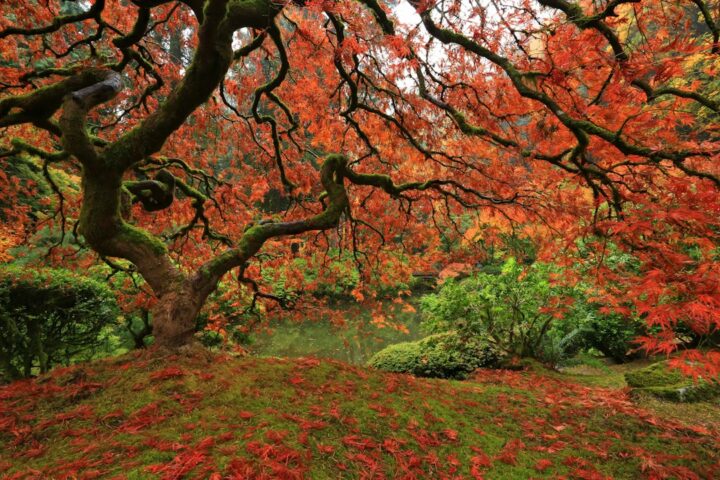
Seasonal change is expressed mainly through a few deciduous species. The Japanese maple (momiji, Acer palmatum) is the most important. Its fine leaves and open branching filter light in summer, and its autumn colour is the classic seasonal moment. Maples are often planted near water or on slopes where their reflection or silhouette can be read from the main viewing point.
The flowering cherry (sakura) and the Japanese apricot, usually called plum (ume), mark spring. Ume flowers in late winter, when little else is moving, and is often associated with tea gardens and scholarly retreats. Cherries are more commonly planted at the margins or in larger landscapes, because their blossom is brief and their form less sculptural for most of the year.
The principle with all three is economy. One well-placed maple seen across a pond, or a single ume beside a path, carries the season. Planting several of each tends to dilute the effect.
Clipped shrubs, moss and ground layers
Okarikomi and tamamono
Clipped evergreen shrubs give the Japanese garden much of its sculptural quality. Okarikomi (大刈込) refers to large masses of shrubs pruned into flowing, hill-like forms, while tamamono (玉物) are individual shrubs clipped into rounded shapes. Satsuki and other azaleas (tsutsuji), boxwood and Japanese holly are common choices. These forms can suggest hills, waves or islands, and they let the designer control mass and height precisely.
Moss
Moss (koke, 苔) is often treated as the ideal ground surface: soft, even, and slow-changing. Hair-cap moss (sugigoke) is widely used. Moss requires shade, humidity and freedom from foot traffic, so its presence is as much a consequence of the garden’s microclimate as a planting choice. Where moss will not establish, low groundcovers such as mondo grass (Ophiopogon) are used to achieve a similar continuous plane.
Ferns, grasses and edge plants
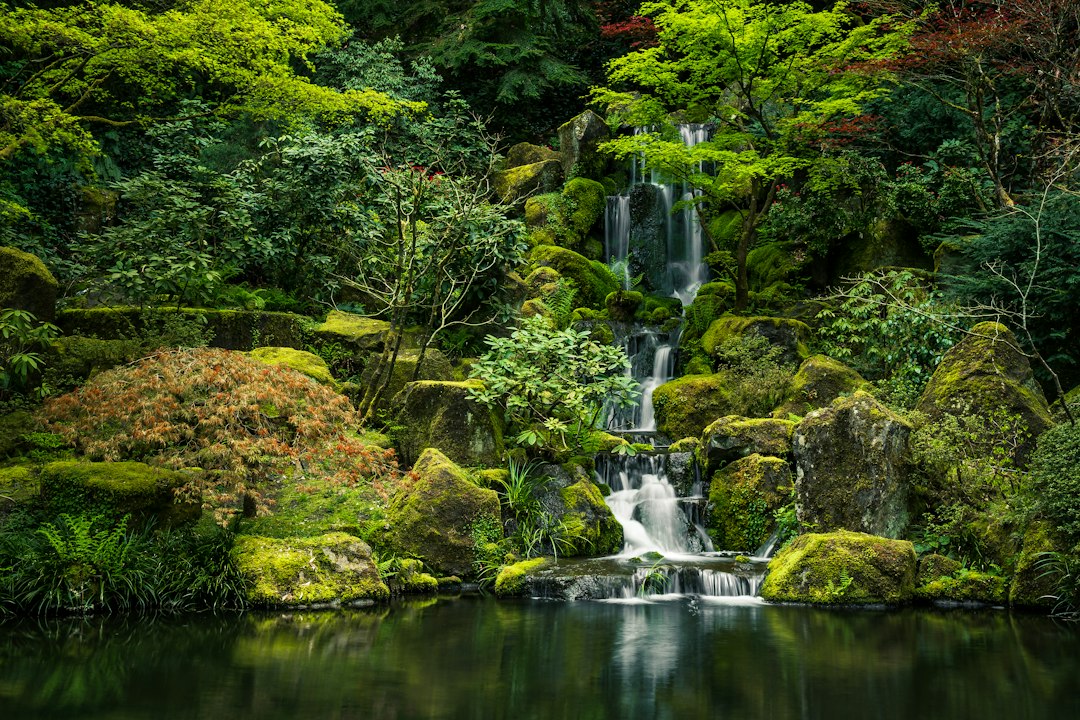
Ferns, sedges and small herbaceous plants (kusamono) soften the joint between stone and soil, at the base of a water basin or along a stream. They are placed sparingly, almost like the grout lines of the composition.
Bamboo, and why containment matters
Bamboo (take, 竹) appears in two ways: as living plants and as material for fences, spouts and gates. As a planting, bamboo provides vertical rhythm and moving light, and a grove can turn a narrow boundary into a sense of depth. Smaller, clumping and dwarf species are used as groundcover or under-planting.
Running bamboos spread aggressively through underground rhizomes. In a residential garden, particularly near foundations, drainage lines or a neighbour’s boundary, they should be contained with a proper root barrier or replaced with a clumping species. This is one area where a planting decision has genuine building consequences: rhizomes and roots can exploit joints in paving, retaining walls and shallow services. The fences built from cut bamboo are a separate subject, covered in our article on the Japanese fence.
Arranging plants: asymmetry, layering and borrowed views
Planting in a Japanese garden follows the same compositional rules as stone setting. Groups are asymmetric, often based on odd numbers and scalene triangles of tall, medium and low. Plants are layered from foreground to background so that the eye reads depth, and larger, coarser-leaved plants are often kept nearer the viewer while finer textures recede, exaggerating distance.
Where the site allows, planting may frame a distant hill or tree outside the boundary, a technique called shakkei (借景), or borrowed scenery. In a tight urban plot, the same effect is achieved by screening an unwanted view and opening a narrow slot toward something worth seeing. In a dry garden such as a karesansui, plants are reduced to a few clipped shrubs and moss so that gravel and stone carry the composition.
Maintenance is part of the design. Japanese gardens are not planted and left; pines are thinned, shrubs clipped, and moss weeded so that each plant stays at the scale intended. A garden that looks effortless usually reflects consistent, skilled care.
Adapting plants for a Japanese garden to the tropics
Many classic species, particularly Japanese maples, cherries and black pines, are adapted to cold winters and do poorly in Singapore’s constant heat and humidity. A faithful copy of a Kyoto planting list is therefore rarely the right answer. The better approach is to translate the role of each plant into a species that thrives locally.
- For the pine’s sculptural evergreen role, designers often use tropical species that take clipping and shaping well, such as Podocarpus or Ficus varieties trained into layered forms.
- For the maple’s fine, filtered canopy, small-leaved tropical trees with open branching can provide similar light quality, though not autumn colour.
- For clipped masses, hardy tropical shrubs that tolerate regular pruning can stand in for azaleas and box.
- For moss, shaded, well-drained areas with consistent moisture can support moss in Singapore, but many gardens use low groundcovers instead.
Any such substitution should be checked with a horticulturist familiar with local conditions. The design aim is to keep the structure, the restraint and the layering; the exact species can change. Plant selection for these plants for a Japanese garden should also respect the building: large trees placed too close to a house, a boundary wall or a basement can affect foundations, drainage and waterproofing over time.
Frequently asked questions
What are the most traditional plants for a Japanese garden?
The core palette is pine (black and red), Japanese maple, flowering cherry and ume, camellia, clipped azaleas and other evergreen shrubs, bamboo, ferns and moss. Most gardens rely on a background of evergreens with a few deciduous trees placed to mark the seasons, rather than a wide variety of species.
Can I grow Japanese maples and black pines in Singapore?
They are generally difficult to keep healthy in Singapore’s hot, humid climate without seasonal temperature change. Many local Japanese-style gardens instead use tropical trees and shrubs that can be shaped to play the same visual role, keeping the composition and restraint while accepting that the exact species differ from those in Japan.
Why are Japanese garden plants clipped so heavily?
Pruning keeps each plant at the scale and form the composition needs. Clipped masses such as okarikomi suggest hills or waves, thinned pines read as old trees, and controlled growth keeps views open. The pruning is part of the design itself, not just tidying, and it is carried out regularly over many years.
Is bamboo a problem near a house?
Running bamboo can spread widely through underground rhizomes and push into paving joints, drains and boundary walls. If you want bamboo close to a building or a neighbouring property, choose a clumping species or install a proper root barrier, and keep planting clear of shallow services and waterproofed elements.
How many different plants should a Japanese garden have?
Fewer than most people expect. A small garden may rely on a handful of species repeated with care. Restraint makes the stones, water and space read clearly, and it allows a single seasonal tree to stand out against the evergreen background.
Related reading
- Katsura Imperial Villa: Architecture, Garden and Plan
- Japanese Garden Bridge Types: Meaning and Construction
- Japanese Gate Types (Mon): Temple, House and Garden
- Torii Gate: Meaning, Types and How Shrine Gates Are Built
Planning a garden that sits close to a house, boundary wall or basement and want the structural side considered properly? Talk to our consultancy or get in touch.