
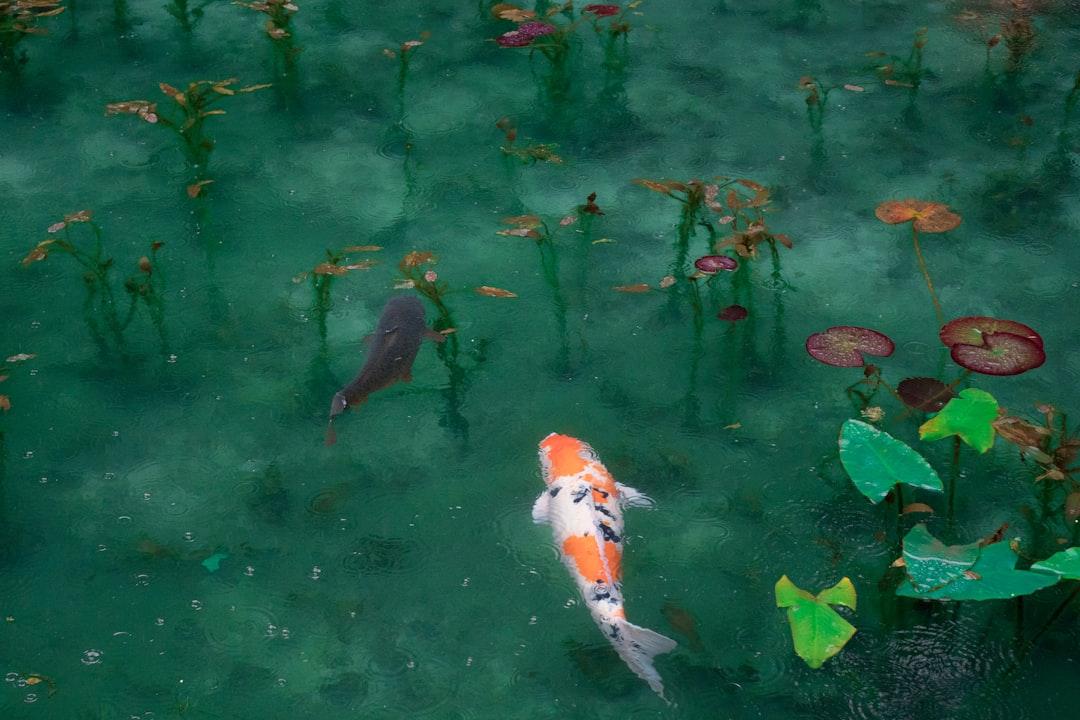
A well-made koi pond sits at the heart of many Japanese gardens, but it is as much a piece of engineering as it is a feature of the landscape. Good koi pond design has to satisfy two demanding clients at once: the fish, which need clean, oxygenated, stable water, and the eye, which wants a pond that looks settled and natural in its setting.
This guide covers the principles that matter — depth and volume, filtration, edge and bottom treatment, planting and placement — so you can understand what separates a healthy, handsome pond from an ornamental puddle that struggles. It pairs naturally with our wider look at the elements of a Japanese garden.
Why a koi pond changes the rules
An ornamental pond and a koi pond are not the same thing. Koi are large, long-lived fish that grow substantially and produce a heavy biological load. A pond that would happily hold a few small fish will quickly foul if you stock it with koi. That single fact drives almost every decision in koi pond design: you size the volume, the filtration and the depth for the fish you intend to keep, not for the size of the hole you wanted to dig.
Because koi are valuable and visible, the pond also has to keep them safe — from temperature swings, from predators, and from poor water that stresses their immune systems. The discipline involved is not unlike sizing a structure for its loads: you design for the demand, with margin, rather than for the look alone. Our piece on designing for real loads reflects the same mindset.
Depth and volume
Depth is the single most important variable. A shallow pond heats and cools rapidly, leaving koi exposed to stressful temperature swings, and it offers no refuge from herons and other predators. A deeper pond holds a more stable temperature and gives the fish somewhere to retreat. As a general rule, koi ponds are built considerably deeper than ornamental ponds — often well over a metre — with the precise figure depending on climate and the number of fish.
Volume follows from depth and surface area, and more volume almost always means a more forgiving, more stable pond. A larger body of water dilutes waste, resists temperature swings and recovers more gracefully from mistakes. If you are unsure whether to build bigger or smaller, bigger is nearly always the safer choice for the fish.
Filtration and water movement
Filtration is what makes keeping koi possible, and it works on two fronts. Mechanical filtration removes solid waste — uneaten food, debris, fish solids — before it breaks down and clouds the water. Biological filtration uses colonies of beneficial bacteria to convert the ammonia koi excrete into less harmful compounds. Both must run continuously; a koi pond is effectively a managed aquatic system, not a still pool.
Water movement supports this. A pump circulates the pond through the filter and back, and features such as a waterfall or a stream add oxygen as well as sound and movement to the garden. A bottom drain helps draw settled waste toward the filter rather than leaving it to rot on the floor of the pond. The aim is a pond that turns over its full volume often enough to stay clear and healthy.
Edge, bottom and construction
How the pond is built shapes both its health and its look. The edge treatment is where engineering meets aesthetics. A coping of natural stone set just over the water hides the liner or wall, frames the pond and gives a clean line; planting pockets and a shallow shelf can soften part of the perimeter so the pond reads as part of the landscape rather than a tank dropped into it.
- Liner ponds use a flexible waterproof membrane over a shaped excavation — flexible and relatively economical.
- Concrete ponds are formed and rendered, giving a permanent, rigid structure that can take heavy stone coping and complex shapes.
- Bottom contour matters too: a gentle slope toward the drain helps waste collect where the filtration can reach it.
Whatever the method, the structure has to be watertight and stable. A concrete pond in particular needs to be detailed and cured properly to avoid the kind of cracking we describe in our guide to concrete cracks.
Planting and placement in the garden
Planting around and within a koi pond is balanced against the fish, because koi will graze on and uproot many soft plants. Marginal plants in the shallows, a few water lilies for surface cover and shade, and structural planting on the banks all help the pond settle into the garden. Some shade over part of the water keeps temperatures down and limits algae.
Placement is a composition decision as much as a practical one. A pond is usually sited where it can be seen and approached but not in full blazing sun all day, and its outline is shaped with inlets and a promontory so the edge is never a plain circle. Stepping stones, a stone bridge or a viewing point give the visitor a place to stand and watch the fish — the moment the whole design exists to serve.
Maintenance and the long view
A koi pond is a long-term commitment. Filters need cleaning, water quality should be checked regularly, and the system has to be managed through seasonal changes. Designing for maintenance from the start — accessible filters, a bottom drain, room to work at the edge — saves years of frustration. A pond that is easy to look after is a pond that stays healthy.
Approached this way, koi pond design becomes a satisfying blend of craft and engineering: a living feature that, well built, can outlast its makers and only grows more beautiful as the planting matures and the fish reach their full size. It is one of the most rewarding elements you can add to a Japanese-inspired garden.
Frequently asked questions
How deep should a koi pond be?
Koi ponds are built considerably deeper than ornamental ponds — often well over a metre — so the water stays at a stable temperature and the fish have a refuge from predators and heat. The exact depth depends on climate and how many koi you intend to keep.
Do koi ponds need a filter?
Yes. Koi produce a heavy biological load, so a koi pond needs continuous mechanical and biological filtration to remove solid waste and convert harmful ammonia. Without proper filtration the water fouls quickly and the fish become stressed and unwell.
Can I keep koi in a small pond?
It is risky. Koi grow large and need volume to stay healthy; a small pond fouls fast, swings in temperature and limits the number of fish you can keep safely. If in doubt, build bigger — more water is almost always more forgiving.
Should a koi pond be in sun or shade?
A mix is ideal. Some shade — from planting or a structure — keeps the water cooler and limits algae, while a pond in full sun all day can overheat and turn green. Siting the pond with partial shade gives the most stable conditions.
Concrete or liner for a koi pond?
Both work. Liner ponds are flexible and economical, using a waterproof membrane over a shaped excavation. Concrete ponds are rigid and permanent, suit heavy stone edging and complex shapes, but must be detailed and cured well to avoid cracking.
Related reading
- Shigeru Ban: Architect Profile and Humanitarian Work
- Kengo Kuma: Architect Profile and Philosophy
- Kenzo Tange: Architect Profile and Legacy
- Tadao Ando: Architect Profile and Philosophy
Building a pond or garden feature that needs to be watertight and structurally sound? Talk to our consultancy or get in touch.


