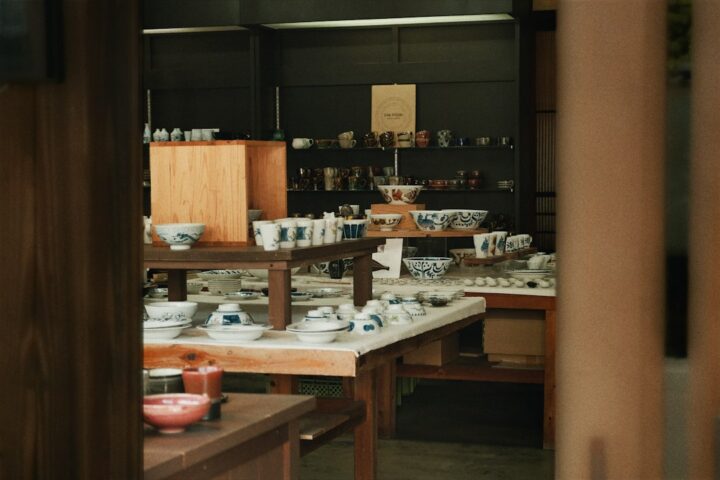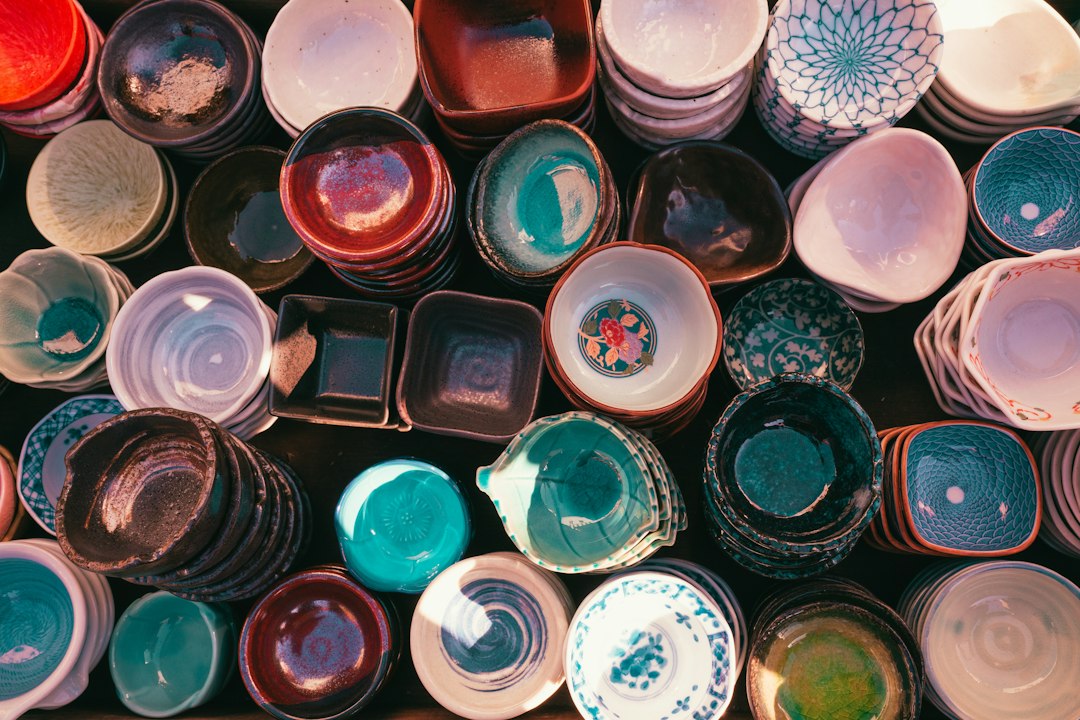
Japanese ceramics span more than ten thousand years, from the cord-marked pottery of the Jōmon period to the porcelain of Arita, the tea bowls of the Raku family and the clay roof tiles that still cover temples and houses. For anyone interested in Japanese design, ceramics are not a side subject. They carry the same values as the architecture: respect for material, acceptance of irregularity, and close attention to how an object is made and used.
This guide gives a clear overview of the main traditions, then looks at where ceramics meet buildings, in roof tiles, wall and floor tiles, and the interiors of tea rooms and homes.
Jōmon to medieval: earthenware and stoneware
Japan’s ceramic history begins with the Jōmon period, whose hand-built earthenware vessels are among the oldest known pottery anywhere. The name means “cord-marked”, after the patterns pressed into the clay with twisted cord. Later Jōmon pots developed elaborate, sculptural rims that are still striking today.
Over the following centuries, influences arriving from the Korean peninsula and China brought the potter’s wheel, higher-temperature kilns and glazes. By the medieval period, a number of regional kilns were producing durable, high-fired stoneware for everyday storage and use. Six of these are grouped today as the Six Ancient Kilns:
- Seto (Aichi), historically associated with early glazed wares.
- Tokoname (Aichi), one of the oldest and largest, known for large storage jars and later for pipes and tiles.
- Echizen (Fukui), robust unglazed storage vessels.
- Shigaraki (Shiga), with coarse, feldspar-flecked clay and warm fire colours.
- Tamba (Hyōgo), with natural ash glazes from long wood firings.
- Bizen (Okayama), unglazed high-fired stoneware whose surface comes entirely from the kiln.
Much of the character of these wares comes from the kiln rather than from applied decoration: wood ash melting onto the surface, flame marks and colour variations from the position of each pot in the firing. That reliance on process and material is what later tea masters came to value.
Tea ceramics and the wabi aesthetic
From the sixteenth century, the tea ceremony transformed the status of ceramics. Tea masters began to prize rustic, irregular local wares over polished imported Chinese pieces. Sen no Rikyū is closely associated with this shift. He worked with the potter Chōjirō in Kyoto, who from around the 1570s made hand-built, low-fired tea bowls without a wheel. These became known as Raku ware, a tradition the Raku family has continued for many generations.
This taste for imperfection is the ceramic expression of wabi-sabi. A bowl’s slightly uneven rim, a glaze that pooled and crawled, or a crack repaired with lacquer and gold, the practice explained in our article on kintsugi, are valued rather than hidden. The same sensibility shaped the architecture of the Japanese tea house, where earthen walls, rough timber and a single ceramic vessel in the alcove set the mood of the room.
Porcelain: Arita and beyond
Porcelain production in Japan began in the early seventeenth century around Arita in Saga Prefecture, after deposits of suitable porcelain stone were found nearby. Tradition credits a Korean potter, Yi Sam-pyeong, with the discovery in 1616, although historians note that this account was written down much later and that other immigrant potters may have been making porcelain in the area slightly earlier.
Arita porcelain, often called Imari after the port it was shipped from, became a major export to Europe in the seventeenth and eighteenth centuries, valued for its fine white body and blue-and-white or brightly enamelled decoration. Porcelain, fired at very high temperature from refined materials, is dense, hard and translucent when thin, very different from the earthy stonewares of the medieval kilns.
Mingei and modern Japanese ceramics
In the 1920s the thinker Yanagi Sōetsu and potters including Hamada Shōji and Kawai Kanjirō developed the idea of mingei, the “folk craft” of anonymous makers producing useful, honest objects for daily life. Mingei celebrated regional pottery and influenced designers worldwide, including the studio pottery movement in Britain.
Today Japanese ceramics range from historic kilns still producing in traditional ways to contemporary studio potters and industrial tableware manufacturers. Many designers in Japan and abroad draw on mingei principles when specifying ceramics for interiors: materials that age well, forms that follow use, and surfaces that show the hand.
Ceramics in Japanese architecture
Ceramics meet architecture most visibly on the roof. Fired clay roof tiles, kawara, came to Japan with Buddhism from the Korean kingdom of Baekje in the late sixth century. Records describe tile-makers arriving in 588 to help build Asuka-dera, the temple where many of Japan’s oldest roof tiles have been excavated.
Kawara roofs became the standard for temples, castles, wealthy houses and, over time, ordinary urban homes. Their main components include:
- Pan and cover tiles (hiragawara and marugawara), overlapping to channel rain.
- Combination tiles (sangawara), a later S-shaped design that simplified roofing for houses.
- Ridge and end tiles, including the decorative onigawara at ridge ends, often bearing faces or crests.
Our guide to Japanese roof styles covers how these tiles shape the classic roof forms.
The structural side of a tiled roof
Clay tiles are durable, fire-resistant and good at shedding heavy rain, but they are heavy. Traditionally they were bedded on a thick layer of clay, which added further weight. A heavy roof increases the seismic forces on a building, because earthquake loads are proportional to mass, and many collapses of older timber houses in Japanese earthquakes have been associated with heavy tiled roofs on weak frames. Modern practice uses lighter dry-fixing systems, mechanically secures tiles against wind and earthquake, and checks the supporting structure properly.
The same principle applies to anyone adding a heavy ceramic roof, a tiled terrace or large-format stone or ceramic finishes to an existing building. The added dead load must be carried by the structure below, and on a roof or suspended slab it should be checked by an engineer. Our consultancy regularly reviews such loads for renovation projects.
Tiles inside the home
Ceramic and porcelain tiles are now ubiquitous in kitchens and bathrooms. Handmade Japanese tiles, with their glaze variations and soft edges, bring the character of traditional ceramics to modern interiors. For the practical differences between materials, see our comparison of porcelain versus ceramic tiles.
Frequently asked questions
What are the Six Ancient Kilns of Japan?
The Six Ancient Kilns are Seto, Tokoname, Echizen, Shigaraki, Tamba and Bizen. They are long-established regional centres of high-fired stoneware whose production continues today.
What is the difference between Japanese pottery and porcelain?
Pottery usually refers to earthenware and stoneware made from clays fired at lower or moderate temperatures, often with visible texture. Porcelain is made from refined materials fired at very high temperatures, giving a dense, hard, white and sometimes translucent body, as in Arita ware.
Why do Japanese ceramics often look imperfect?
Many traditions, especially those connected with the tea ceremony, value irregularity, natural kiln effects and signs of the maker’s hand. This reflects the wabi-sabi aesthetic, which finds beauty in the simple, rustic and imperfect.
When did Japan start using clay roof tiles?
Clay roof tiles were introduced from Baekje in Korea in the late sixth century along with Buddhism. Tile-makers are recorded as arriving in 588 to help build Asuka-dera, where some of Japan’s oldest tiles have been found.
Are heavy tiled roofs a problem in earthquakes?
A heavy roof increases the seismic force a building must resist. Traditional clay-bedded tile roofs on weak timber frames have performed poorly in strong earthquakes, so modern practice uses lighter fixing systems and checks that the structure can carry the roof safely.
Related reading
- Japandi Kitchen Design: Materials, Layout and Detailing
- Sou Fujimoto: From House NA to the Expo Grand Ring
- Junya Ishigami: Thin Structures and Architecture as Air
- Tatami Bed Guide: Construction, Sizes and Humidity
Adding a tiled roof, heavy finishes or a new terrace to an existing building? Talk to our consultancy or get in touch.