A water feature brings sound, movement and reflection into a garden. A wall spout masks traffic noise, a still pool doubles the sky, a channel draws the eye along a path. In the tropics, water also suggests coolness, and many of the region’s finest gardens are organised around it. Behind the effect, however, every water feature is a small piece of engineering: a watertight container, a pump and pipework, electrical supply, overflow and drainage, and a structure strong enough to carry the weight of water.
This article explains the main types of garden water feature, how they are built, and the practical issues of waterproofing, weight, safety and mosquito control that matter in Singapore.
Types of water feature
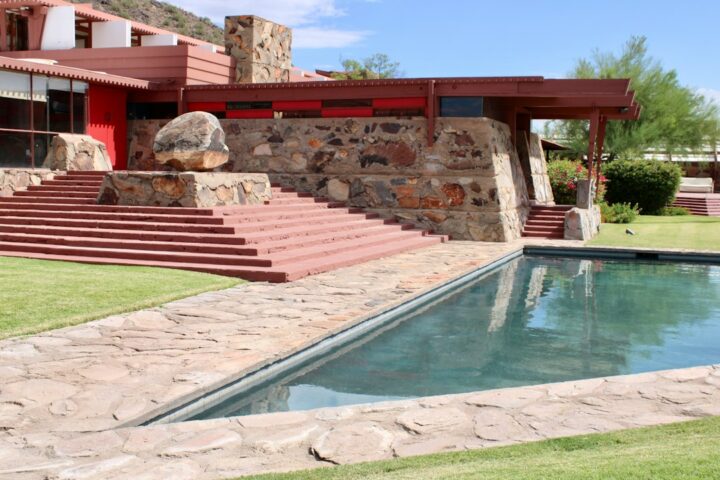
- Reflecting pools — shallow, still basins designed to mirror the sky and surrounding architecture. Their effect depends on a dark base, a level edge and clean water.
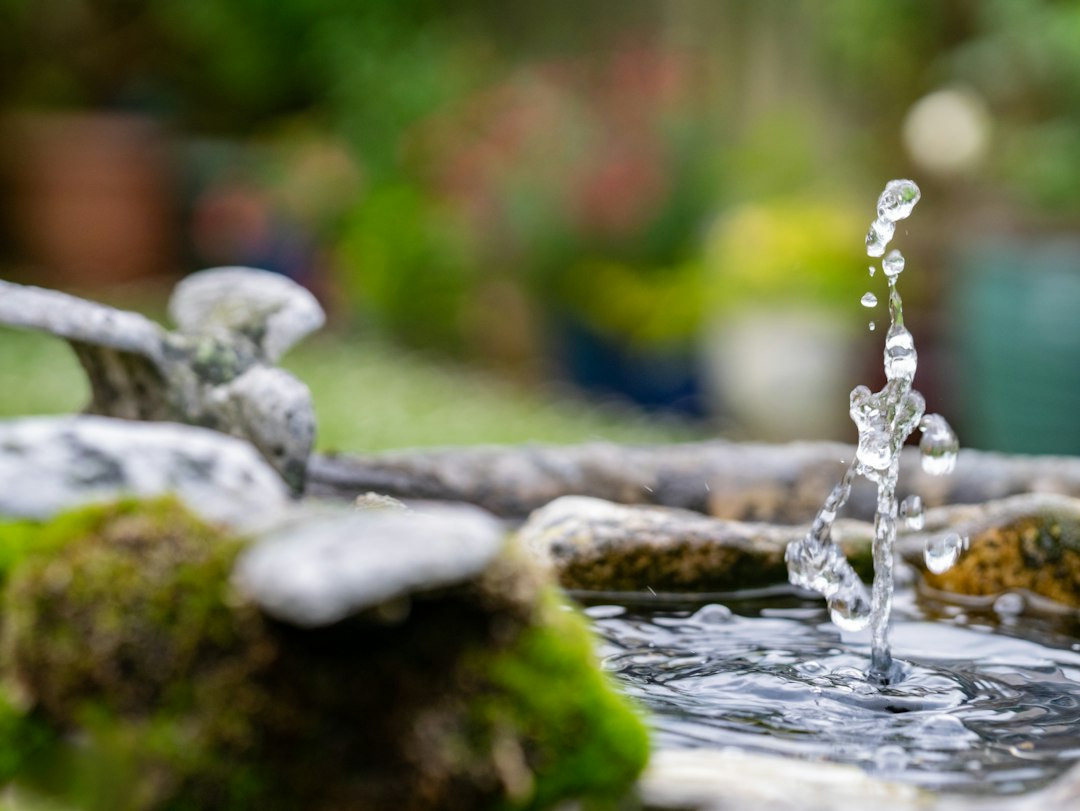
- Fountains and jets — water pumped upward through nozzles, from a gentle bubbler to a tall jet.
- Wall features and spouts — water falling from a spout or over a wall face into a trough or basin below. Well suited to small gardens and courtyards.
- Cascades and waterfalls — water flowing over rocks or weirs between levels.
- Rills and channels — narrow, linear watercourses, common in formal and Islamic garden traditions.
- Ponds — larger bodies of water, often planted and stocked with fish. Our article on koi pond design covers the special requirements of fish ponds.
- Pondless features — water falls into a buried reservoir filled with gravel or covered by a grille, so there is no open pool. Safer for children and easier to keep free of mosquitoes.
In the Japanese tradition, water is often represented as much as used: a tsukubai basin fed by a bamboo spout, or a dry riverbed of stones. Our article on Japanese garden elements explores these ideas.
How a water feature works
Most recirculating features share the same components:
- A reservoir or basin that holds the water when the pump is off.
- A pump, submersible or external, sized for the flow and the height the water must be lifted.
- Pipework and outlets — spouts, nozzles or weirs that shape the water.
- Filtration, from a simple pre-filter for a small feature to mechanical and biological filters and UV clarifiers for a pond.
- Top-up and overflow — a means of replacing evaporated water and an overflow to drainage when rain fills the basin.
The reservoir must be large enough to hold the water in transit when the pump stops. If it is too small, the basin overflows every time the feature is switched off and runs dry when it is switched on. Evaporation is significant in a hot climate, especially from falling water and thin sheets, so automatic top-up is useful on larger features.
Waterproofing and construction
A water feature must hold water indefinitely, often while exposed to sun, temperature change and root growth around it. Common construction methods are:
- Preformed basins of plastic, fibreglass or metal for small features.
- Flexible liners laid over a protective underlay in an excavation, used for informal ponds.
- Reinforced concrete or masonry basins with a waterproofing system, used for built, architectural features and anything integrated with paving or walls.
For concrete features, watertightness depends on dense concrete, crack control, careful detailing at pipe penetrations and lights, and a suitable internal waterproofing system beneath finishes. Penetrations are the most common leak points. Our article on waterproofing in construction compares systems. Stone and tile finishes on a wall feature must also be fixed with adhesives and grouts rated for continuous immersion; ordinary products can fail and stain.
Structural weight and location
Water is heavy: each cubic metre weighs about a tonne, and a basin 300 mm deep imposes roughly 3 kN/m² from the water alone, before the weight of the basin, stone and any rock work. On natural ground, a feature needs a firm, level base so it does not settle and tilt, which would show immediately at a level edge.
On a balcony, terrace, podium or roof, the structure beneath must be designed or checked for the feature. A modest-looking stone wall feature with a filled trough can impose a concentrated load well above what a light roof terrace was designed for, and a leak above occupied space is costly to trace. If you are planning a feature over a slab, a structural check is a sensible early step.
Electrical safety
Pumps and lighting bring electricity into contact with water. In Singapore, outdoor electrical installations must be carried out by an Energy Market Authority licensed electrical worker. Equipment in or near water should be of an appropriate ingress protection rating, supplied through residual current protection, and connected using fittings and cable routes designed for wet locations. Low-voltage lighting and pumps can reduce risk in features that people touch.
Mosquitoes and water quality
In Singapore, mosquito control is a design requirement, not an afterthought. Aedes mosquitoes, which transmit dengue, breed in small amounts of still, clean water, and the National Environment Agency treats mosquito breeding on private premises as an offence under the Control of Vectors and Pesticides Act. A water feature should be designed so that it never provides that habitat:
- Keep water moving whenever possible, and avoid dead corners where it is still.
- Do not leave basins, troughs or reservoirs standing when the pump is off for long periods.
- Cover reservoirs and make sure overflow and drain points do not hold water.
- Maintain filtration and clean out leaves and debris that clog outlets.
- Drain and dry features that are taken out of use.
Pondless designs and features with fully covered reservoirs are the lowest risk. Ponds stocked with fish and kept with good circulation are generally better than neglected bowls of still water.
Designing a water feature for the tropics
In a hot, wet climate, water features need to cope with heavy rain as well as evaporation. Basins should have an overflow sized for storms, connected to the garden’s drainage. Leaf fall from tropical trees is constant, so features under trees need easy cleaning access and robust pre-filters. Algae grow quickly in warm, sunlit water; shade, circulation and filtration help control them.
The best tropical water features are often small and well-placed: a spout in a shaded courtyard, a still pool at the end of a view, a channel beside a path. Our article on tropical garden design shows how water fits within the wider composition.
Frequently asked questions
Do water features attract mosquitoes?
Still, shallow water can breed mosquitoes, but a well-designed feature that keeps water moving, has no stagnant corners, covers its reservoir and is regularly maintained greatly reduces the risk. Pondless features are among the safest options in Singapore.
How heavy is a garden water feature?
Water weighs about a tonne per cubic metre, so even a shallow basin imposes significant load, before adding the weight of concrete, stone and rocks. Features on balconies, terraces or roofs should be checked by a structural engineer.
Can I install a water feature pump myself?
Plug-in features designed for outdoor use can be set up by owners, but any fixed outdoor electrical installation in Singapore must be carried out by a licensed electrical worker, with appropriate residual current protection and wet-location fittings.
Why does my water feature keep losing water?
Evaporation, splash and wind loss are normal, especially in hot weather. A steady loss beyond that usually indicates a leak at a pipe penetration, a liner fault or a crack in the basin, which should be traced and repaired before it damages surrounding structure.
Related reading
- Garden Path Design: Layout, Materials and Construction
- Planter Box Design: Structure, Drainage and Waterproofing
- Outdoor Kitchen Design: Layout, Materials and Services
- Infinity Pool Design: How the Vanishing Edge Works
Planning a water feature on a terrace, podium or roof? Talk to our consultancy or get in touch.