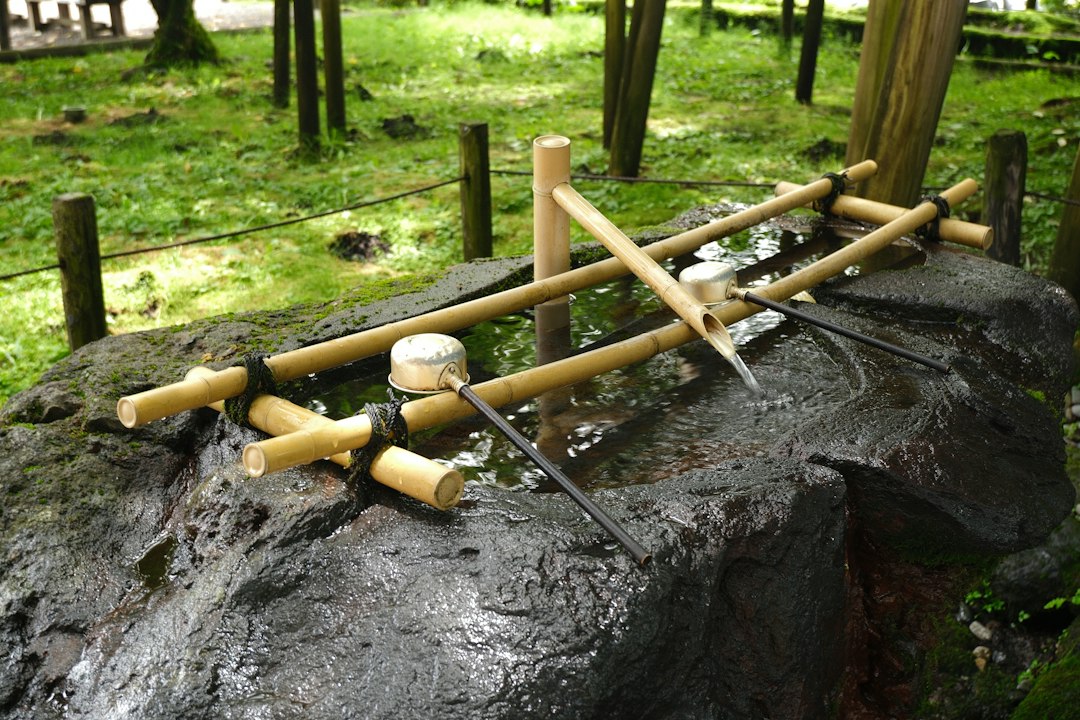
A tsukubai (蹲踞) is a low stone water basin, set close to the ground in a Japanese tea garden, where guests wash their hands and rinse their mouths before entering the tea room. The name comes from the verb tsukubau, to crouch: the basin is placed so low that you must stoop to use it. That small physical act of lowering yourself is the point. It turns a practical wash into a moment of humility and quiet before the tea gathering.
This article explains the purpose of the tsukubai, the arrangement of stones around it, the main types of basin, and the practical construction details, from water supply to drainage, that make one work in a modern garden.
Purpose: purification before tea
The custom of washing before entering a sacred or ceremonial space is old in Japan. At a shrine, visitors purify themselves at a water pavilion before approaching the sanctuary, as described in our guide to Shinto shrine architecture. The tea garden adapted this practice. On the way through the inner garden to the tea room, the guest stops at the tsukubai, takes water with a bamboo ladle, rinses each hand, rinses the mouth from a cupped palm, and finally tips the ladle so the remaining water runs down its handle.
Within the roji tea garden, the tsukubai is one of the defining elements, along with the stepping-stone path, the waiting bench and the stone lantern. Its placement marks the guest’s final transition before the small entrance of the teahouse. Water basins at standing height, more common near house verandas, are generally called chōzubachi (手水鉢); the tsukubai is the low, crouching form associated with tea.
The stones of a tsukubai
A full tsukubai is not just a basin but a composition of stones, each with a role. These functional stones are collectively called yaku-ishi (役石), “role stones”:
- Chōzubachi — the basin itself, a stone with a carved or natural hollow holding the water.
- Mae-ishi (前石) — the flat front stone on which the guest crouches to reach the basin.
- Teshoku-ishi (手燭石) — a flat-topped stone to one side for setting down a hand-held candle during evening tea.
- Yuoke-ishi (湯桶石) — a stone on the other side for a bucket of warm water, provided in cold weather.
- Umi (海) — the “sea”, the low area between the stones, covered with gravel or pebbles, which receives spilled water and drains it away.
Which side the candle stone and bucket stone occupy varies with tea school and site, and sources describe both arrangements. Simpler tsukubai may have only a basin and a front stone, which is thought to be an early form. A stone lantern is often placed nearby to light the basin, as explained in our guide to the Japanese stone lantern.
Water supply: the kakei
Water traditionally reaches the basin through a kakei or kakehi (筧), a bamboo pipe that delivers a thin, continuous trickle. The sound of the falling water is part of the experience, and the flow keeps the basin fresh. In a host’s preparations, the basin would also be filled and the surrounding stones sprinkled with water just before guests arrived, so that everything appeared freshly cleansed.
Some basins stand alone without a pipe and are filled by hand. In modern gardens, the kakei is usually fed by a concealed pipe from mains water or by a small recirculating pump hidden in a sump below the umi, which returns the water to the spout.
Types of basin
Basins are commonly grouped by their origin. Natural stone basins use a boulder with a natural or slightly worked hollow and are valued for their rustic quality. Mitate-mono (見立物) are basins made by repurposing other stone objects, such as the base of a pagoda, a bridge post or a temple foundation stone, a practice admired by tea masters for its ingenuity and sense of history. Created basins are carved specifically as water basins, often with distinctive forms such as round, square or coin-shaped designs.
The best-known example is the coin-shaped basin associated with Ryōan-ji in Kyoto. Its square central hollow combines with surrounding characters to read as a phrase usually translated as “I know only contentment”, a Zen-inflected reminder against greed. There is also the oritsukubai, a basin set below the surrounding ground level and reached by stone steps, which deepens the sense of descent.
Building a tsukubai
A tsukubai is a small project, but it involves water, heavy stones and drainage, and most problems come from neglecting one of the three. The basin and the yaku-ishi must sit on firm, compacted bedding so they do not settle unevenly, especially the mae-ishi, which takes a person’s weight every time it is used. Basins are heavy, and the stones should be placed with appropriate lifting equipment rather than by hand.
The umi needs a real drainage path. Traditionally the gravel overlies a soakaway; in a modern garden it is usually a lined sump with an overflow to a drain, or the reservoir for a recirculating pump. In Singapore, standing water is a mosquito-breeding risk, so a tsukubai should either have continuous flow or be designed so that no water collects and stays still in the basin, the sump or the gravel. Pumps, cables and access for cleaning should be planned from the start, not added later.
Where a tsukubai sits on a roof garden, balcony or podium slab, the weight of stones, saturated gravel and water, and the waterproofing beneath, need checking. Our structural engineering consultancy can confirm the slab capacity and detailing before heavy stonework goes in.
Frequently asked questions
What is the difference between a tsukubai and a chozubachi?
Chozubachi is the general term for a water basin used for washing hands. A tsukubai is a low arrangement, associated with the tea garden, where the basin is set near the ground so the user must crouch, and where it is accompanied by role stones such as the front stone, candle stone and bucket stone.
How do you use a tsukubai?
Crouch on the front stone, take water with the bamboo ladle, rinse your left hand and then your right, pour a little water into your cupped hand to rinse your mouth, and finally tilt the ladle upright so the remaining water runs down the handle to clean it. Practice varies a little between tea schools.
What is the umi in a tsukubai?
The umi, meaning sea, is the low area between the basin and the surrounding stones. It is usually covered with gravel or pebbles and receives the water that spills from the basin or the ladle, draining it away so the area stays clean.
Can I have a tsukubai in a Singapore garden?
Yes, provided it is designed for the climate. It needs continuous or recirculating flow, or a design that leaves no still water, to avoid mosquito breeding, a proper drainage sump, and firm bedding for the stones. On a balcony or roof terrace, the slab capacity and waterproofing should be checked first.
What does the inscription on the Ryoan-ji basin mean?
The coin-shaped basin associated with Ryoan-ji combines four characters with the square central hollow, which serves as a shared element, to form a phrase usually translated as I know only contentment. It is read as a Zen reminder that the person who knows contentment is rich.
Related reading
- Japanese Bedroom Design: Principles, Layout and Materials
- Kokedama: Moss-Ball Planting in Japanese Interiors
- Bonsai in Japanese Garden and Interior Design
- Ikebana and the Japanese Interior: Flowers as Space
Adding a water feature or heavy stonework to a roof garden, terrace or podium? Talk to our consultancy or get in touch.