
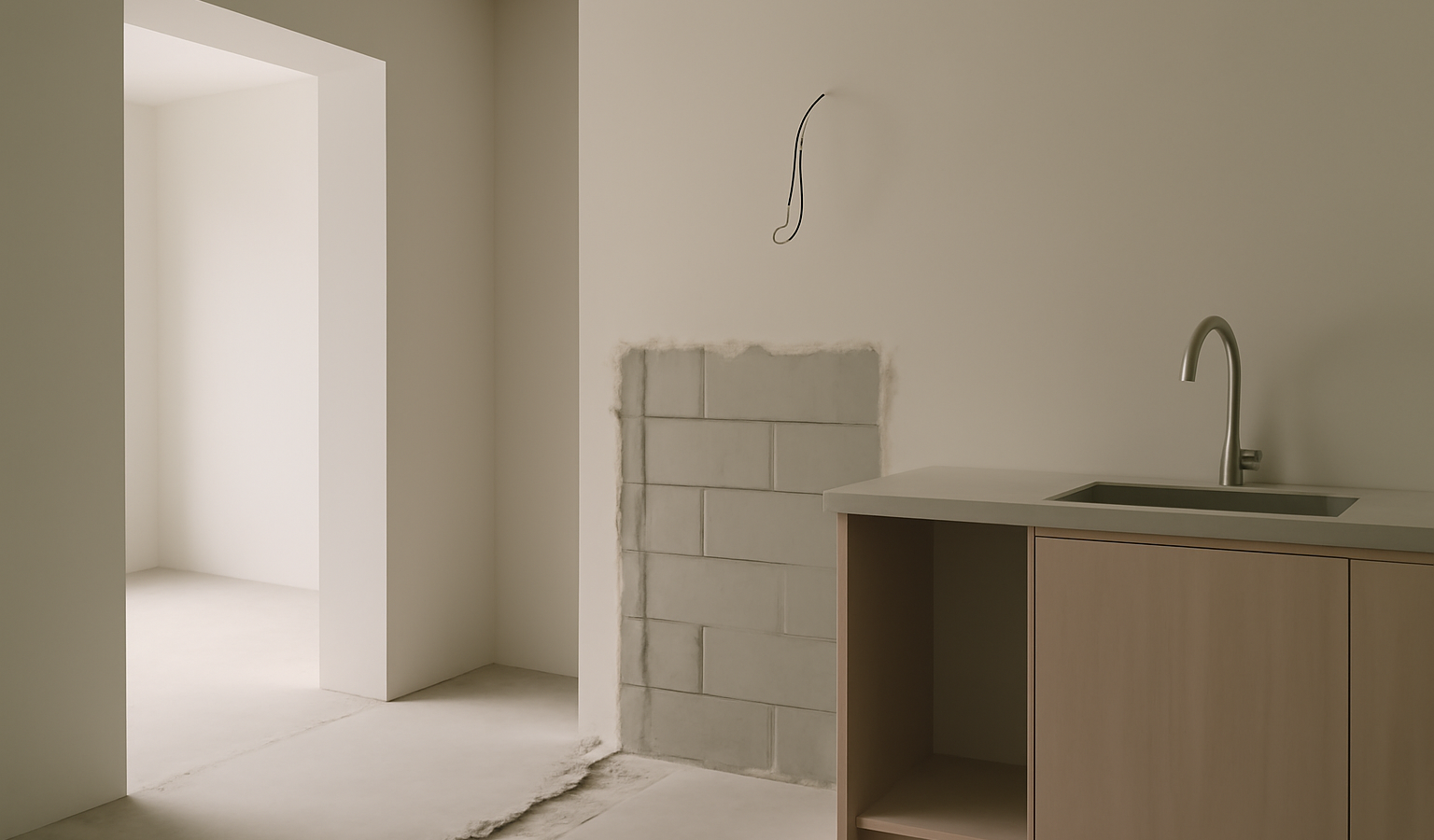
Most expensive lessons in home renovation are entirely avoidable. The same renovation mistakes recur in Singapore homes year after year — not because the work is uniquely hard, but because homeowners make a handful of predictable errors at the planning stage that only surface as cost, delay, or risk much later.
This guide collects the mistakes worth knowing before you commit, grouped by where they bite: budget, contracts, scope, structure, and the handover. None of it requires technical expertise to act on. It mostly requires slowing down at the points where the temptation is to speed up.
Underestimating the budget and contingency
The first mistake is treating the headline quotation as the final cost. Real projects accumulate variation orders, upgraded material choices above the quoted allowances, and excluded items like lighting, curtains, and appliances. Homeowners who budget to the exact quotation figure are routinely caught short.
Set aside a contingency on top of your quoted figure for the unexpected, and read your quotation’s allowances and exclusions carefully so you know where overruns will come from. Our guide to renovation cost in Singapore explains the main drivers, so you can pressure-test whether your budget is realistic before, not after, you sign.
Choosing purely on the lowest price
Picking the cheapest quotation is one of the most common and most costly errors. A low total usually signals a narrower scope, cheaper materials, or costs deferred to provisional sums and exclusions that reappear later. The cheapest quote frequently becomes the most expensive once the gaps are added back.
Compare quotations on a like-for-like basis by normalising their scope, and weigh licensing, references, and clarity of documentation alongside the number. A firm that quotes vaguely tends to build and bill vaguely. Confirm too that the firm is on HDB’s Directory of Renovation Contractors before you commit to any flat works.
Skipping permits and ignoring HDB rules
Assuming small works do not need approval is a mistake that can mean rectification at your own cost. HDB requires a renovation permit for works affecting structure, layout, or common property — including hacking, relocating wet areas, and certain electrical and plumbing changes. Works must also stay within permitted hours and methods.
Do not rely on a contractor’s casual assurance that “no permit is needed.” Confirm it. The permit is usually submitted by the contractor, but the obligation to ensure works are properly authorised sits with you as the flat owner, and unauthorised works can have to be reinstated.
Hacking walls without checking the structure
This is the mistake with the most serious consequences. Open-plan layouts are popular, and removing a wall is often presented as routine demolition. It is not. Structural walls cannot be hacked, and any structural alteration requires a Professional Engineer (PE) and approval from HDB or BCA.
Never accept a verbal “it’s fine to remove” from a tradesman. Confirm whether a wall is load-bearing first — our explainer on load-bearing walls sets out how to tell, and you can read what a PE actually does in our overview of the structural engineer’s role. If there is any doubt, talk to our consultancy for a proper assessment before anything is demolished.
Poor planning of layout and electrical points
Many regrets are not faults at all — they are decisions made too quickly. Too few power points, switches in awkward places, lighting that does not suit how a room is used, and storage that ignores daily habits are all locked in early and expensive to change later.
- Walk your daily routine in each room and place sockets and switches where you will actually reach for them.
- Plan lighting in layers — ambient, task, and accent — rather than a single ceiling fixture.
- Design storage around your belongings, not around a generic cabinet run.
An hour spent imagining real use prevents the most common “I wish I had” moments after move-in.
Chasing trends over durability
Highly fashionable finishes can date quickly and may not wear well in Singapore’s humidity and heavy daily use. Trend-led choices in permanent elements — flooring, built-in carpentry, feature walls — are costly to undo, so they deserve more caution than soft furnishings you can swap cheaply.
A sensible rule is to keep permanent, expensive elements relatively neutral and durable, and express personality through items that are easy and cheap to change. This keeps the home feeling current for longer without committing you to another major renovation.
Rushing the handover and defects check
The final mistake mirrors the first in spirit: speeding up at exactly the wrong moment. Eager to move in, homeowners sign off handover without a proper defects inspection and release final payment, only to find faults that are then far harder to get fixed.
Insist on a defects liability period and a retention sum in your contract, run a methodical room-by-room inspection, document every defect with photos, and withhold final acceptance until each item is rectified and re-checked. The leverage you have at handover never returns once the contractor is paid in full.
Frequently asked questions
How much contingency should I budget for a renovation?
Rather than a fixed figure, set aside a sensible buffer on top of your quoted total to absorb variation orders, upgraded allowances, and excluded items, then read your quotation’s exclusions so you know where overruns are likely to come from.
Is the cheapest quotation ever the right choice?
Only if it is genuinely like-for-like on scope and materials, because a low total often hides a narrower scope or deferred costs that make it the most expensive option once the gaps are added back.
Do small HDB renovations really need a permit?
Works affecting structure, layout, or common property require an HDB renovation permit, so confirm the requirement rather than assuming small works are exempt, as unauthorised works can have to be reinstated at your cost.
Can I remove a wall to open up my flat?
Only non-structural walls can be removed, because structural walls cannot be hacked and any structural alteration requires a Professional Engineer and HDB or BCA approval before work begins.
What is the most common electrical planning mistake?
Installing too few power points and placing switches in awkward locations, both of which are locked in early and expensive to change, so walk your daily routine in each room before finalising positions.
Why should I not rush the handover?
Because the leverage to get defects fixed is strongest before final payment, so a methodical, documented defects check at handover protects you in a way that chasing the contractor afterwards rarely does.
Related reading
- Wet Works in Renovation Explained: The Messy Foundation
- Ceiling Leak in Singapore: Causes and How to Fix It
- Window Replacement in HDB Flats: The Rules Explained
- Bathroom Waterproofing for HDB Flats: A Practical Guide
Planning works that touch structure? Talk to our consultancy or get in touch.


