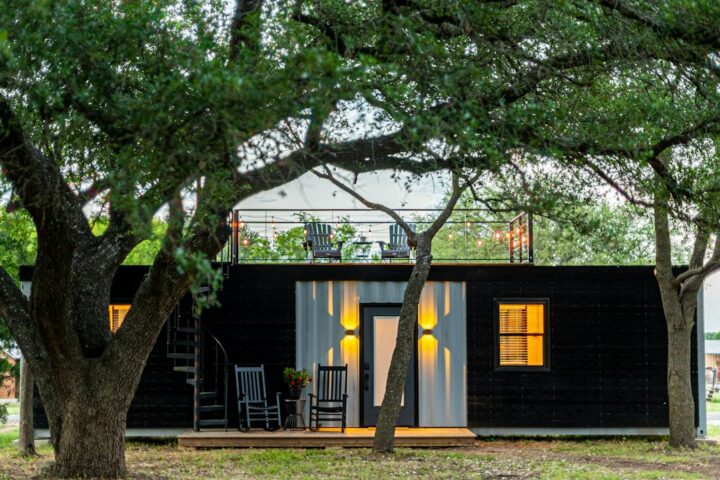
Landscape lighting is the lighting of outdoor spaces after dark: gardens, paths, façades, trees, water and the approach to a building. Done well, it makes a garden usable and beautiful at night, guides people safely and lets the house be read as part of its setting. Done badly, it produces glare, wasted energy, light spilling into neighbours’ windows and a garden that looks flatter at night than by day.
In a hot climate the evening is often the main time people use their gardens, which makes good outdoor lighting particularly valuable. This article explains the principles of landscape lighting design, the main techniques and fittings, and the practical and safety issues of outdoor installation.
Principles of landscape lighting
Light what you want to see
The most common mistake is to light everything evenly. At night, the eye is drawn to the brightest objects, so landscape lighting is an act of selection: a specimen tree, a wall, a water feature, a path. Darkness between lit elements gives the scene depth.
Layers of light
Designers usually think in three layers:
- Accent — highlighting focal points such as trees, sculptures and features.
- Task and safety — lighting paths, steps, entrances and level changes so people can move safely.
- Ambient — soft fill light that makes outdoor rooms comfortable, often reflected off walls, canopies and foliage.
Hide the source
The best landscape lighting shows the effect, not the fitting. Fittings are shielded, recessed, or placed behind planting so that people see a lit tree rather than a bright point of light.
Light from the view
Design for the places people will look from: the living room, the terrace, the entrance. A garden seen through glass at night needs enough light outside to overcome reflections in the window.
Lighting techniques
- Uplighting — fittings at ground level directed upward into a tree canopy or onto a wall. Dramatic and widely used for palms and specimen trees.
- Downlighting and moonlighting — fittings mounted high in trees or on structures, casting soft light and leaf shadows on the ground below, like moonlight.
- Grazing — light placed close to a textured wall to emphasise stone, timber or planting.
- Washing — broad, even light over a wall or hedge to create a backdrop.
- Silhouetting — lighting a wall behind a plant so the plant stands out in dark outline.
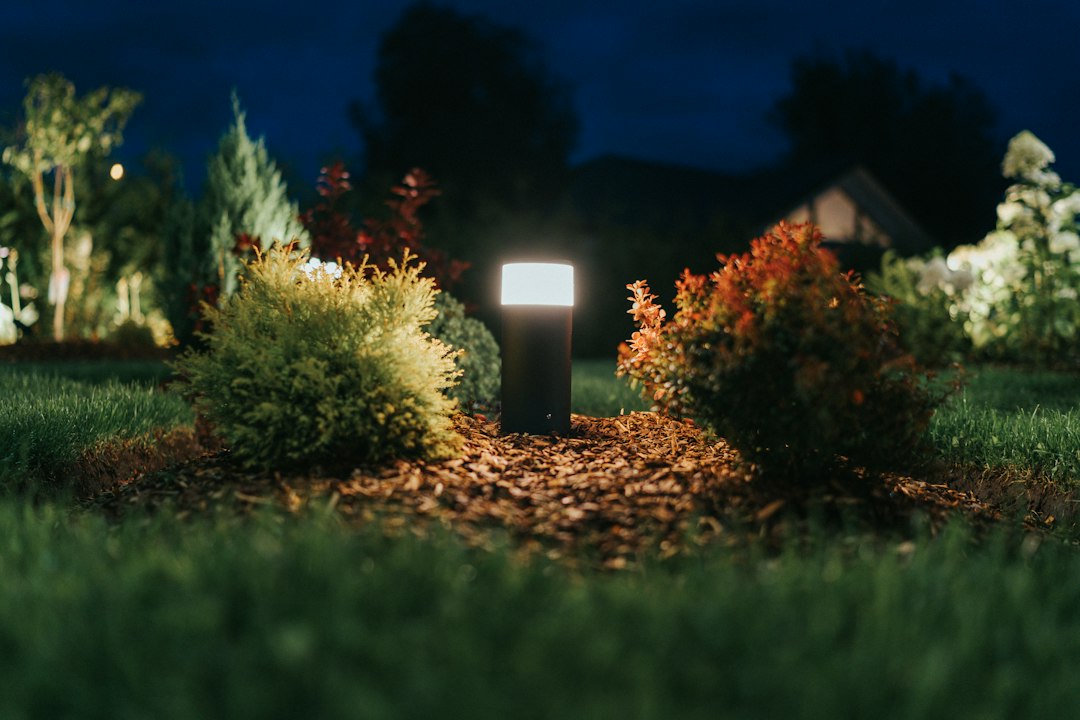
- Path and step lighting — low-level fittings, including bollard lights, recessed step lights and spike lights.
- Underwater lighting — fittings in pools and ponds that make water glow, or that light falling water from below.
For broad, high-output lighting of large areas, such as driveways or sports courts, flood lights are used, but they need careful aiming to avoid glare and light spill. Our article on garden lighting collects practical ideas for residential gardens.
Colour temperature, output and control
Most landscape lighting today uses LEDs, which are efficient, long-lived and available in a wide range of colour temperatures and beam angles.
- Colour temperature. Warm white light suits planting, timber and stone and feels relaxed; cooler white can suit modern architecture and water. Consistency across a scheme matters more than the exact figure.
- Colour rendering. Good colour rendering shows the true greens of foliage; poor rendering makes planting look grey.
- Beam angle. Narrow beams reach up tall trunks and palms; wide beams wash walls and broad canopies.
- Output. Outdoor lighting usually needs far less light than people expect, because the surroundings are dark. Over-bright fittings cause glare and flatten the scene.
- Control. Separate circuits, dimming, timers and photocells let the scheme change through the evening and avoid lights burning all night.
Light at the blue end of the spectrum tends to attract more flying insects, so warmer light near seating areas can be more comfortable in the tropics.
Fittings for a tropical climate
Outdoor fittings in Singapore face heavy rain, constant humidity, heat, ultraviolet light and, near the coast, salt. Look for:
- Appropriate ingress protection. The IP rating, defined in IEC 60529, describes protection against solids (first digit) and water (second digit). In-ground and exposed fittings need high ratings; underwater fittings need ratings for continuous immersion.
- Corrosion-resistant housings such as marine-grade stainless steel, copper or suitably finished aluminium, with stainless fixings.
- Heat management, since LED life is shortened by heat, and in-ground fittings in sun-baked paving run hot.
- Sealed cable entries and connections, the most common point of water ingress.
Wiring, safety and coordination
Outdoor electrical installations combine electricity, water and digging. In Singapore, electrical installation work must be carried out by an Energy Market Authority licensed electrical worker, in accordance with the Code of Practice for Electrical Installations, SS 638. Outdoor circuits should have residual current protection, cables should be of a type suited to burial or run in ducts, and junctions should be in accessible, sealed enclosures.
Low-voltage systems, which use a transformer to step down the supply, are common in gardens because they are safer to work around and allow small fittings. Their cable runs and voltage drop need to be designed so that distant lights are not dimmer than near ones.
The best time to plan landscape lighting is during the landscaping works, so ducts can be laid under paving and through planting before they are finished. Retrofitting cables across a completed garden is disruptive. Fixing fittings to façades, pergolas or structures may also need coordination with the architect and, for heavy items, the structural engineer.
Being a good neighbour
Light that spills across boundaries, shines into bedrooms or lights up the sky is wasteful and unwelcome. Aim fittings down and inward where possible, use shields and louvres, choose modest outputs and turn lights off when they are not needed. In condominiums and strata developments, management rules may also govern external lighting.
Frequently asked questions
What is the most effective landscape lighting technique?
Uplighting a specimen tree or textured wall usually has the greatest impact for the least equipment, especially when combined with low-level path lighting and darkness between lit elements to give depth.
What IP rating do outdoor lights need?
It depends on the location. Fittings exposed to rain need protection against water jets, in-ground fittings need protection against dust and water ingress, and fittings in pools or ponds need ratings for continuous immersion. Check the manufacturer’s rating for the intended use.
Is low-voltage landscape lighting safer?
Low-voltage systems reduce the risk of electric shock and are common in gardens, but the transformer and its supply must still be installed by a licensed electrical worker with appropriate protection, and the system must be designed to manage voltage drop.
Which colour of light is best for gardens?
Warm white light generally suits foliage, stone and timber, and attracts fewer insects than cooler light. Consistent colour temperature and good colour rendering across a scheme matter more than any single figure.
Related reading
- Small Garden Ideas for Compact Tropical Homes and Terraces
- Garden Landscaping for Tropical Homes: A Practical Guide
- Rooftop Garden Design: Structural Loading and Waterproofing
- Landscape Design Principles: A Practical Guide for Homes
Fixing lighting to façades, pergolas or structures? Talk to our consultancy or get in touch.