Flood lights are high-output fittings that spread a broad beam of light over a large area: a driveway, a car park, a sports court, a building façade or a construction site. They are the workhorses of outdoor lighting. They are also the fittings most often installed badly, pointed too high, mounted too low or chosen far brighter than necessary, which produces glare, dark shadows and light spilling into neighbouring homes.
This article explains the types of flood light, how beam angle and output are chosen, where to place and aim them, and the practical matters of weatherproofing, structural fixing and electrical safety. It complements our broader article on landscape lighting.
What a flood light is
A flood light is a luminaire designed to light a wide area evenly, as opposed to a spotlight, which concentrates light on a small target. Most flood lights today use LEDs, which have largely replaced older halogen and metal halide lamps because they are more efficient, last longer and can be dimmed and controlled.
A typical flood light has a robust, sealed housing, a heat sink to dissipate heat from the LEDs, optics or a reflector that shapes the beam, and an adjustable bracket for aiming. The quality of the optics determines how evenly the light is spread and how much spills where it is not wanted.
Types of flood light
- General area flood lights — wall- or pole-mounted fittings for driveways, yards and car parks.
- Façade flood lights — used to wash or graze a building elevation, often with narrow or asymmetric beams to reach upper floors. Lighting a façade also brings the façade’s fixings and materials into the design; see our article on façade engineering.
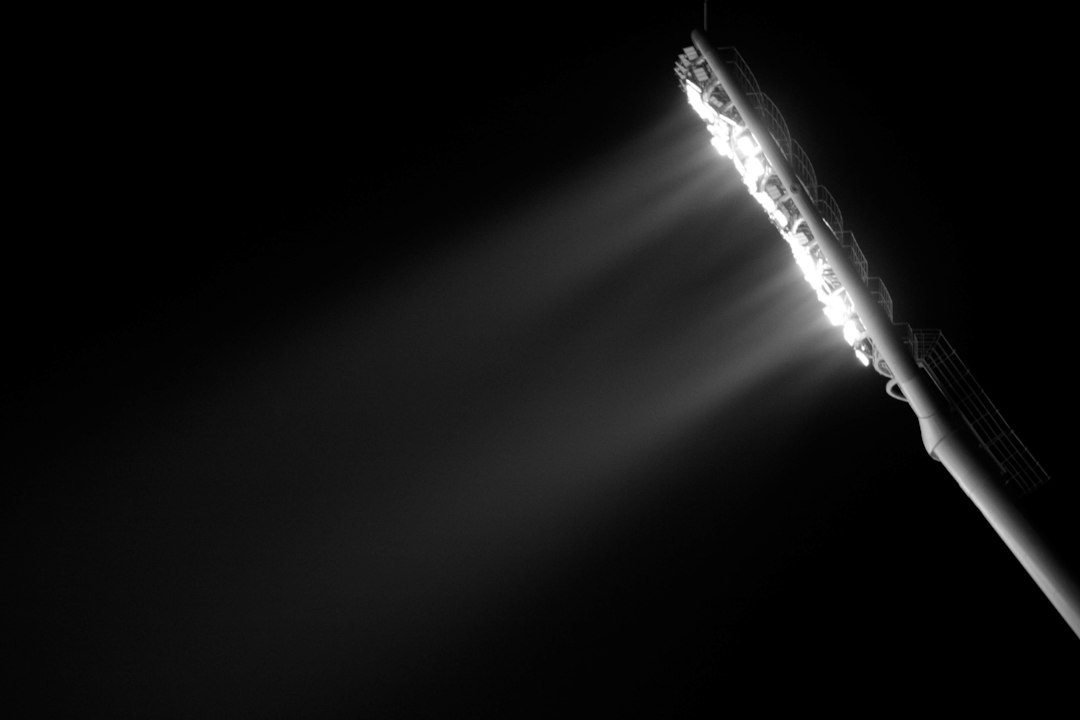
- Sports flood lights — high-output fittings on tall masts with precise optics for even illuminance on a playing surface.
- Security flood lights — often combined with motion sensors, used at entrances and perimeters.
- Temporary site flood lights — portable towers and fittings used on construction sites, which fall under workplace safety requirements.
- Landscape flood lights — smaller ground- or tree-mounted units for washing walls, hedges or large trees.
Beam angle and output
Two choices decide what a flood light does: how wide the beam is and how much light it produces.
Beam angle
Wide beams spread light over a broad area close to the fitting, such as a yard or a wall seen from nearby. Narrow beams throw light further, such as up a tall façade or across a large car park from a mast. Many flood lights are available with interchangeable optics, and asymmetric optics direct light forward and down with little spill behind or above.
Output
Output is measured in lumens, but what matters to people is the illuminance on the ground or wall, and its uniformity. A common mistake is to use a few very bright fittings, which creates hot spots and deep shadows. More fittings of lower output, well aimed, give more even and comfortable light. For non-residential and sports applications, a lighting designer will calculate illuminance and uniformity against the relevant standards.
Colour
Neutral or cool white is common for security and sports lighting; warm white sits more comfortably in residential and landscape settings. Good colour rendering helps cameras and people recognise colours at night.
Placement and aiming of flood lights
Where and how a flood light is mounted matters more than how bright it is.
- Height. Mounting higher spreads light more evenly and reduces glare, because the beam can be aimed downward. Low-mounted flood lights aimed horizontally shine straight into people’s eyes.
- Aim downward. Tilt fittings so the brightest part of the beam lands within the area to be lit. Avoid aiming above the horizontal, which wastes light into the sky and towards neighbours.
- Cross-lighting. Lighting an area from two or more directions reduces hard shadows, which is useful for security and for cameras.
- Avoid glare at key positions. Check the view from gates, doors, driveways and neighbours’ windows. A fitting that dazzles a driver reversing out is a hazard.
- Use shields and visors to cut off light that would spill beyond the target.
For residential driveways and paths, lower-level lighting such as bollard lights often provides safer, more comfortable light than a single flood light on the wall.
Weatherproofing and durability
Flood lights live outdoors in sun and rain. Choose fittings with an ingress protection rating suited to exposure; the IP rating defined in IEC 60529 describes protection against dust and water. Housings should resist corrosion, particularly near the coast, and fixings should be stainless steel. Heat management matters: LEDs lose output and life if they run hot, and in Singapore’s climate fittings in direct sun work harder than in temperate countries.
Structural fixing and wind
A flood light is a heavy, wind-exposed object mounted at height. The fixing must carry its weight and the wind load on it, and must not loosen over years of thermal cycling and vibration. Points to check:
- Wall fixings into solid structure, not thin cladding, render or hollow blocks without suitable anchors.
- Poles and masts designed for wind, with foundations sized for the overturning moment. Tall masts for sports or car parks are structures in their own right and need engineering design.
- Brackets that will not corrode or loosen, with secondary safety restraints where a falling fitting would endanger people below.
- Access for maintenance, so fittings can be cleaned, re-aimed and replaced safely.
Where masts or heavy fittings are being added to an existing building, or a façade lighting scheme is being fixed to cladding, a structural engineer should check the supports.
Electrical safety and controls
In Singapore, electrical installation work must be carried out by an Energy Market Authority licensed electrical worker, in accordance with SS 638. Outdoor circuits need residual current protection and cables suited to outdoor or buried use. Controls such as photocells, timers and motion sensors reduce energy use and prevent lights running all night when they are not needed. Work at height to install or maintain flood lights falls under the Workplace Safety and Health framework.
Frequently asked questions
What is the difference between a flood light and a spotlight?
A flood light spreads a wide beam to light a large area evenly, while a spotlight concentrates a narrow beam on a small target. Many fittings are available in both forms, distinguished by their optics and beam angle.
How high should flood lights be mounted?
Higher mounting generally gives more even light and less glare because the beam can be aimed downward. The right height depends on the area, the fitting’s optics and the surroundings; for large areas a lighting designer calculates it.
How do I stop flood lights shining into neighbours’ homes?
Mount fittings higher, aim them downward into your own property, use asymmetric optics and shields, choose modest outputs and use timers or motion sensors so they are off when not needed.
Do flood light poles need a foundation design?
Tall poles and masts carry significant wind loads and overturning moments, so their foundations and the poles themselves should be designed by an engineer. Small garden fittings on short spikes do not need this, but wall-mounted fittings must be fixed into solid structure.
Related reading
- Garden Lighting Ideas for Tropical Homes and Courtyards
- Garden Path Design: Layout, Materials and Construction
- Planter Box Design: Structure, Drainage and Waterproofing
- Outdoor Kitchen Design: Layout, Materials and Services
Fixing flood lights or masts to a building or site? Talk to our consultancy or get in touch.