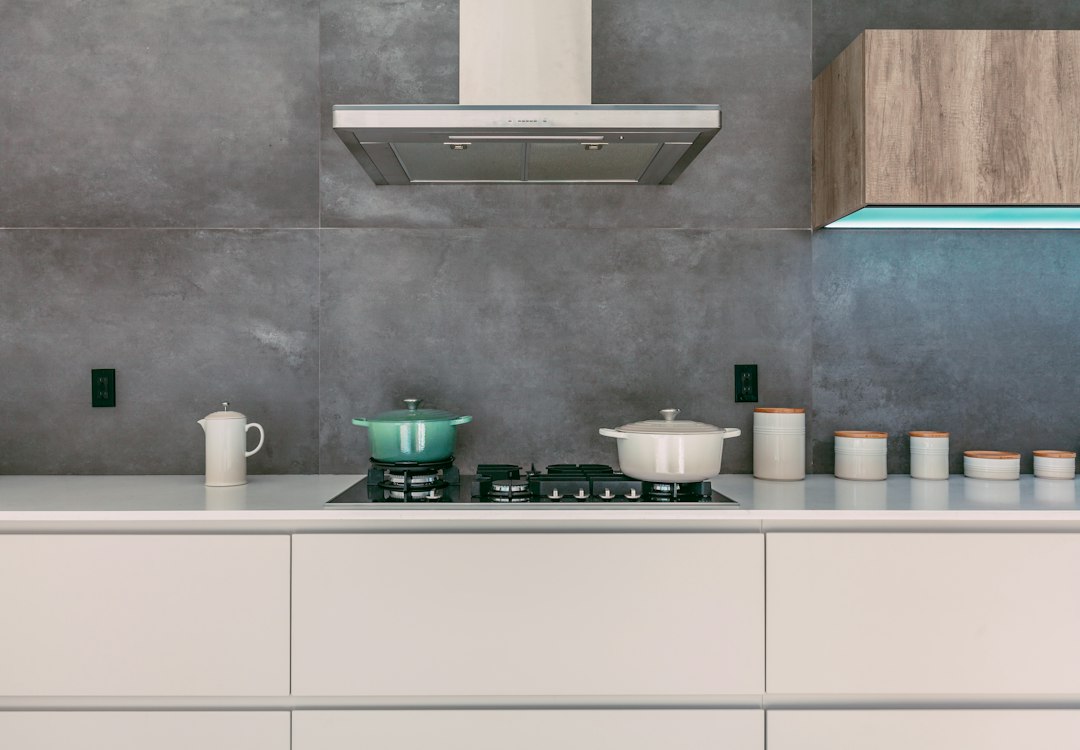
A kitchen hood, also called a cooker hood or range hood, is the appliance that captures the smoke, grease, steam and odour rising from the hob. In Singapore, where many households cook with high heat, woks and plenty of oil, it is one of the most important appliances in the kitchen and one of the most frequently under-designed. A hood that is the wrong type, mounted at the wrong height or connected to a long, crooked duct will be noisy and still leave grease on the cabinets.
This article explains how hoods work, the main types, the difference between ducted and recirculating operation, and the practical and regulatory points about routing ducting in HDB flats and condominiums. It treats the hood and its duct as one system, because that is how it performs.
How a kitchen hood works
Cooking produces a rising plume of hot air carrying grease droplets, water vapour, smoke and odour. The hood’s job is to capture that plume before it spreads into the room, then filter or remove it. It has three main parts: a canopy that collects the plume, grease filters that trap droplets, and a fan that draws air through and pushes it either out of the building or back into the room through further filters.
Capture depends on geometry as much as fan power. The hood should be at least as wide as the hob, ideally a little wider, and mounted at a height that balances capture with headroom and the manufacturer’s safety clearance above gas or induction hobs. Mounted too high, the plume spreads beyond the canopy before the fan can catch it. Cross-draughts from windows and fans next to the hob also pull the plume away, which matters in kitchens with a service yard window right beside the cooker.
Types of kitchen hood
Chimney hoods
Wall-mounted chimney hoods have a canopy with a vertical chimney cover concealing the duct. They provide good capture over a hob against a wall and are a common choice where there is height for the chimney.
Slim, telescopic and integrated hoods
Slimline and telescopic hoods fit beneath or within a wall cabinet, with a pull-out front that extends the capture area during cooking. Integrated or built-in hoods are concealed inside cabinetry. They save space and suit compact HDB kitchens, but their smaller canopies capture less of a heavy wok plume.
Island hoods
Island hoods hang from the ceiling over a hob on a kitchen island. With no wall behind to contain the plume, they need a larger canopy and stronger extraction, and the duct must run through the ceiling void, which is not always possible in a flat.
Downdraft and ceiling extractors
Downdraft units rise from the worktop behind the hob and pull air downwards; ceiling-mounted extractors sit flush in a false ceiling. Both are visually discreet but work against the natural rise of hot air, so they are generally less effective for high-heat cooking. They suit lighter cooking and open-plan layouts where appearance is the priority.
Ducted versus recirculating operation
A ducted hood expels air outside the building through a duct. It removes heat, moisture, grease and odour from the home, and is the more effective option for heavy cooking. Its performance depends on the duct: short, straight, smooth runs with few bends work well; long, flexible, corrugated ducts with several bends lose much of the fan’s capacity and become noisy.
A recirculating hood passes air through grease filters and then activated charcoal filters before returning it to the kitchen. It needs no external opening, which makes it a practical answer where ducting is not possible. It does not remove heat or moisture, and charcoal filters lose effectiveness as they load up, so they need replacing regularly. In a humid climate, returning warm, moist air to the kitchen also adds to condensation on surfaces.
The choice often comes down to whether a sensible duct route exists. Where cooking is heavy and a short route to the outside is available, ducted is usually worth pursuing. Where it is not, a good recirculating unit with a disciplined filter-change routine is better than a poorly ducted one.
Ducting in HDB flats
In HDB flats the hood is usually ducted towards the kitchen window or an external wall close to the hob, with the duct concealed in or above the wall cabinets. The simplest arrangement keeps the hob on or near an external wall so the duct run is short.
Any work that involves hacking or forming openings in walls in an HDB flat is controlled under HDB’s renovation rules, and some works need a permit before they start. External walls form part of the building’s envelope and appearance, and structural walls cannot be hacked. Before planning a duct route through a wall, owners should check the current requirements on HDB’s renovation guidelines and use a contractor from HDB’s Directory of Renovation Contractors; our guide to the HDB renovation permit explains the process. Where a new opening is proposed, it is far simpler to route through an existing window or opening than to create one.
Kitchens being reconfigured, for example when separating a wet and dry kitchen, should place the main cooking hob where a short duct run is possible, and keep the dry kitchen’s lighter cooking for an induction hob that may manage with a recirculating hood.
Ducting in condominiums
In condominiums, the façade and common property are managed by the Management Corporation Strata Title (MCST), and by-laws commonly restrict changes that affect the external appearance of the building, including new openings or visible vents. Some developments provide a designated exhaust point or a common kitchen exhaust riser; others expect recirculating hoods. The managing agent can confirm what is permitted and what approvals are needed before any work begins. Our article on condo renovation rules in Singapore sets out the usual approval steps.
Where a common exhaust riser is shared between units, the connection must suit that system; an oversized fan pushing into a shared riser can cause odours to back up into neighbouring units.
Good practice for duct routes
- Keep the run as short and straight as possible, with the fewest bends practical.
- Use rigid, smooth-walled ducting of the diameter the hood is designed for, rather than reducing it to fit a smaller hole.
- Seal joints so grease and air do not leak into cabinets or ceiling voids.
- Fit a non-return flap at the outlet to stop backdraught, rain and insects.
- Provide access for cleaning, because grease accumulates inside ducts over time and is a fire risk.
- Keep combustible cabinetry at the clearances the hood and hob manufacturers specify.
These details belong at the design stage of a kitchen renovation, before cabinets are fabricated, because the duct often has to pass through them.
Maintenance
Metal mesh and baffle filters should be cleaned regularly; heavy wok cooking loads them quickly. Charcoal filters in recirculating hoods cannot be cleaned and must be replaced on the manufacturer’s schedule. A noticeable drop in suction, dripping grease or a rise in noise usually means clogged filters or a duct problem rather than a failing motor.
Frequently asked questions
Is a ducted or recirculating kitchen hood better for Singapore cooking?
For heavy, high-heat cooking with woks and oil, a well-ducted hood is more effective because it removes heat, moisture, grease and odour from the home. A recirculating hood is a practical alternative where no sensible duct route exists, provided its filters are replaced regularly.
Can I make a new hole in my HDB wall for the hood duct?
Hacking and forming openings in HDB flats are controlled under HDB’s renovation rules, structural walls cannot be hacked, and some works require a permit. Check HDB’s current renovation guidelines and use a registered renovation contractor before planning any new opening; routing through an existing window is usually simpler.
Are kitchen hood vents allowed in condominiums?
It depends on the development. Condominium by-laws often restrict changes to the façade, and some buildings provide a designated exhaust point while others expect recirculating hoods. Ask the managing agent what the MCST permits before buying a hood.
How high should a kitchen hood be above the hob?
Follow the hood and hob manufacturers’ installation instructions, which set minimum clearances for gas and induction hobs. Within those limits, a lower hood captures the plume better than a higher one.
Why is my hood noisy but weak?
The usual causes are clogged grease filters or a restrictive duct, such as a long flexible duct with many bends or a reduced diameter. The fan works harder against the resistance, producing noise without moving much air.
Related reading
- LED Strip Lights in Interior Design: A Practical Guide
- Acoustic Panels: How They Work and Where to Use Them
- Wallpaper Types Explained: Choosing for Humid Homes
- Acrylic Cabinet Finishes: Gloss, Edges, Wear and Care
Reconfiguring a kitchen and need to know whether a wall can take a new opening for ducting? Talk to our consultancy or get in touch.