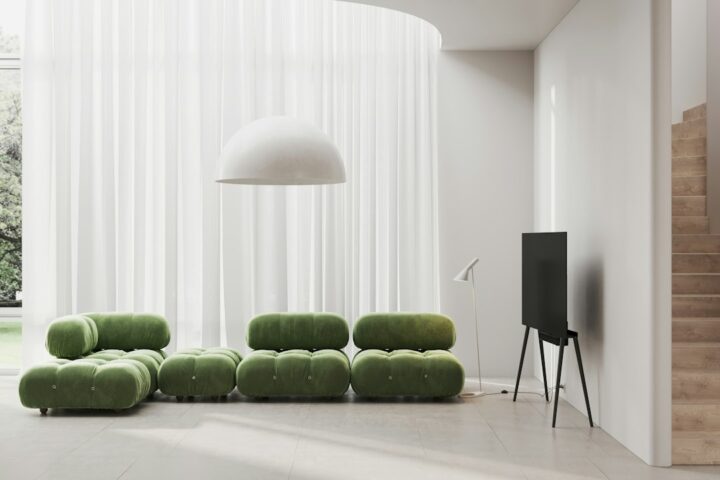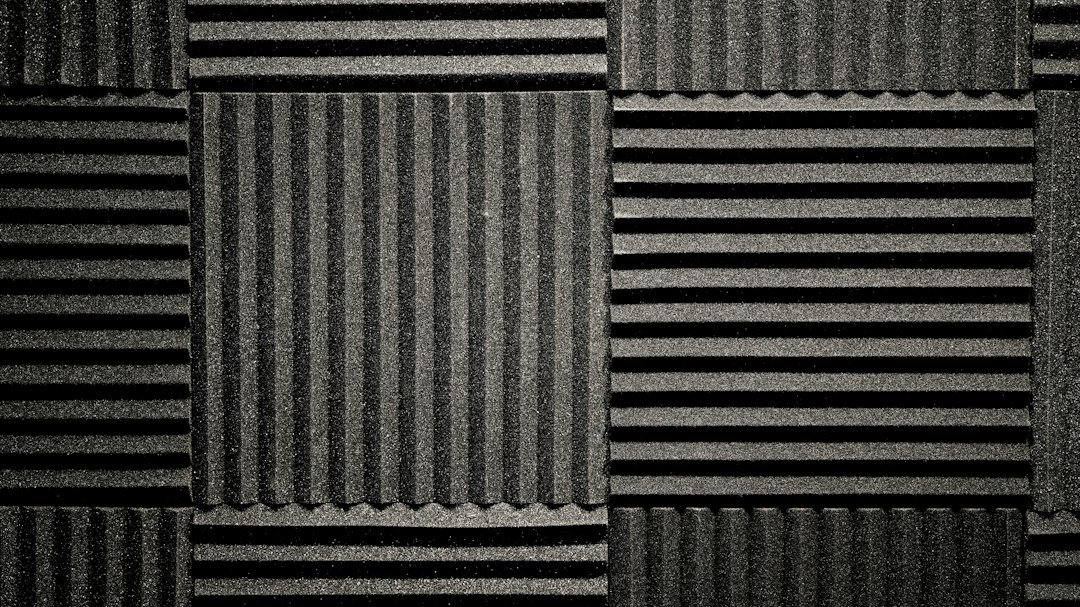
Hard, minimalist interiors look calm but often sound anything but. Bare plaster, glass, stone and timber floors reflect almost every sound back into the room, so speech blurs, music turns harsh and a dinner for six feels like a canteen. Acoustic panels are the most direct remedy: soft, porous surfaces that soak up a share of that reflected energy and shorten the time a sound lingers in the space.
This article explains how acoustic panels actually work, how to read the ratings printed on product sheets, where they make the most difference, and the one thing they cannot do, which is the most common reason people are disappointed with them. It closes with the practical points that matter in Singapore homes and offices: fixing, fire performance and humidity.
Absorption versus insulation: the distinction that matters
Room acoustics deals with two different problems that are easily confused. The first is how sound behaves inside a room: echo, reverberation and the general liveliness of the space. The second is how much sound passes between rooms or from outside: noise from a neighbour, a corridor or traffic. The first is controlled by absorption; the second by sound insulation.
Acoustic panels are absorbers. They are usually lightweight, porous and open-celled, and they work by letting sound waves enter the material, where the air movement in the fibres or foam converts a small amount of acoustic energy into heat. That is excellent for taming reverberation. It does very little to stop sound travelling through a wall, because insulation depends on mass, airtightness and decoupling, which a light, porous panel does not provide. If the complaint is a neighbour’s television, the answer is a properly built soundproof wall, not a set of fabric panels.
Keeping this distinction clear saves money. A room that sounds hard and echoey benefits greatly from absorption. A room that is quiet inside but hears everything next door needs construction work on the separating element and its junctions.
How acoustic panels absorb sound
Most panels fall into a few families, each suited to a different part of the frequency range:
- Porous absorbers — mineral wool, glass wool, polyester fibre or open-cell foam, often wrapped in fabric. They are most effective at mid and high frequencies, which covers most of speech. Thicker panels, or panels mounted with an air gap behind them, extend their effect to lower frequencies.
- Perforated or slotted panels — timber, MDF or metal faces with holes or grooves backed by an absorbent layer and a cavity. These behave partly as resonant absorbers and can be tuned by changing the perforation pattern and cavity depth. They suit interiors where a fabric finish is not wanted.
- Membrane or panel absorbers — a sealed panel over an air cavity that flexes at a particular low frequency. They are used where bass build-up is a problem, such as home cinemas and music rooms.
- Diffusers — shaped surfaces that scatter sound rather than absorb it. They keep a room lively while breaking up strong reflections and are mainly a specialist tool for listening rooms and studios.
Low frequencies are the hardest to absorb because the wavelengths are long. A thin decorative felt tile will do almost nothing for a boomy bass note, which is why panel depth and mounting matter as much as the material itself.
Reading the ratings: NRC, alpha-w and absorption class
Product data usually quotes one or more single-number ratings derived from laboratory tests in which the material is measured across a range of frequencies:
- Sound absorption coefficient — a value from 0 to 1 at each frequency band, where 0 means everything is reflected and 1 means everything is absorbed.
- NRC (Noise Reduction Coefficient) — an average of the coefficients at four mid-range frequencies, common in American-referenced data.
- Weighted absorption coefficient (alpha-w) and absorption class — the European approach, which grades products from class A (most absorbent) down to class E.
Two cautions apply. First, a rating is tied to the mounting used in the test; a panel tested with a deep air gap behind it will not perform the same glued flat to a wall. Second, single-number ratings hide the shape of the curve. Two panels with similar NRC values can behave very differently at low frequency. When the application is speech, mid-frequency performance is what counts; for music, look at the full table, not the headline figure.
Where to use acoustic panels
Placement usually matters more than quantity. Sound reaching a listener arrives first directly from the source and then as reflections from the nearest hard surfaces. Treating those first reflection points gives the largest improvement for the least area.
Homes
Open-plan living and dining areas with hard floors and high ceilings are the classic problem. Panels on the ceiling above the dining table, or on one or two large walls facing each other, reduce the clatter noticeably. Rugs, curtains, upholstered furniture and full bookshelves are absorbers too, and in many homes the right furnishing does much of the work. Home offices benefit from treatment behind and beside the desk so that video calls sound less hollow. Home cinemas and music rooms need a more deliberate design that balances absorption, bass control and some diffusion.
Offices, studios and hospitality
Meeting rooms with glass walls are often the worst performers in an office: parallel hard surfaces create flutter echo and poor speech clarity. Ceiling treatment, such as absorbent tiles, baffles or rafts, combined with a few wall panels usually solves it. Restaurants and cafés with exposed concrete soffits rely on suspended baffles or absorbent ceilings to keep conversation comfortable. In open offices, absorption reduces the distance over which conversations carry, but it does not create privacy on its own; screens, layout and sound masking also play a part.
Where panels are integrated into a ceiling system, it is worth coordinating them with lighting, sprinklers and services from the start. Our article on false ceilings in Singapore covers the support and access issues that come with suspended systems.
How much treatment a room needs
Acousticians judge a room by its reverberation time, the time it takes for a sound to decay by a set amount after the source stops. The target depends on use: a classroom or meeting room should be relatively dry so speech is clear, while a music room may be allowed to sound a little livelier. Reverberation time depends on the room volume and on the total absorption of every surface and object in it, so the same panel area has a bigger effect in a small room than in a large hall.
For most homes a formal calculation is unnecessary. A practical approach is to treat the most obvious reflective surfaces first, live with the result for a while, and add more only if needed. Over-treating a room is a real risk: a space with too much high-frequency absorption sounds dull and muffled while still booming at low frequency. For commercial spaces, studios or rooms where speech intelligibility is critical, a calculation by an acoustic consultant is worthwhile before ordering.
Fixing, fire and humidity in Singapore
Panels are light individually but add up across a ceiling. Suspended rafts and baffles must hang from fixings that suit the substrate: anchors into a concrete soffit, or into the framing of a board ceiling where the system is designed for the extra load. Avoid hanging panels from light-gauge ceiling grids that were not designed for them. Where a large ceiling installation or a heavy feature wall is planned, a structural engineering consultancy can confirm the fixing design and the capacity of the soffit before work starts. On walls, panels can be fixed with clips, Z-bars or adhesives; a mechanical fixing is easier to remove later and avoids damaging plaster. On lightweight walls, check the stud positions; our guide to partition walls in Singapore explains the different wall types and what they can carry.
Fire performance matters, particularly in offices, shops and common areas. The SCDF Fire Code sets requirements for the surface spread-of-flame performance of wall and ceiling linings, which vary with the type of building and the location within it. Foam and fabric products differ widely, so ask for test certification and confirm with your Qualified Person or fire consultant that the product suits the location. In a private home the regulatory demands are lighter, but choosing a non-combustible or fire-tested core is still sensible.
Singapore’s humidity is the other practical issue. Porous materials can absorb moisture and harbour mould in poorly ventilated rooms. Prefer inorganic cores or treated fibres, avoid installing panels on walls with damp problems, and leave a small gap behind panels on external walls so air can move. Fabric facings collect dust, so choose removable or vacuum-friendly finishes for kitchens and dining areas.
Frequently asked questions
Will acoustic panels stop noise from my neighbours?
Generally no. Acoustic panels absorb sound inside a room and reduce echo, but blocking sound between rooms depends on mass, airtightness and decoupled construction. Noise from neighbours is addressed by improving the separating wall, ceiling or floor and sealing gaps and flanking paths, which is a construction task rather than a decorative one.
Are foam panels as good as mineral wool panels?
Both are porous absorbers and can perform well at mid and high frequencies if thick enough. Mineral wool and glass wool products usually offer better fire performance and stability, while some foams are lighter and easier to cut. Compare tested absorption data at the thickness you intend to use and check fire certification before choosing.
How many acoustic panels does a living room need?
There is no fixed number because it depends on the room volume, the existing finishes and furnishings, and how the room is used. A practical starting point is to treat the main reflective surfaces, such as the ceiling over a dining table or one of two parallel bare walls, then assess the result before adding more.
Can I install acoustic panels in an HDB flat or condo?
Fixing panels to internal walls and ceilings is ordinary interior work, but you should avoid drilling into the household shelter, follow your renovation permit conditions in an HDB flat, and respect MCST by-laws in a condominium. Heavy suspended ceiling elements should be fixed to suitable anchors in the slab rather than to light ceiling grids.
Do acoustic panels work for home studios?
Yes, but a studio needs more than mid-frequency absorption. Thicker panels, bass traps in corners and some diffusion are usually required to control low frequencies and keep the room natural. If the studio must also keep sound in or out, the room construction itself needs sound insulation work.
Related reading
- Types of Ceilings: Designs, Materials and Practical Uses
- Coffered Ceilings: History, Design and Construction
- Bauhaus Interior Design: Principles, Furniture and Colour
- Modular Kitchens Explained: Pros, Cons and Planning
Planning a renovation that involves suspended ceilings, new partitions or heavy fixtures? Talk to our consultancy or get in touch for accountable advice on what your structure can carry.