Cabinets cover more surface in a kitchen than anything except the floor, so their colour sets the mood of the room for a decade or more. Choosing kitchen cabinet colours is therefore less about following a season’s trend than about reading the room: how much light it gets, how it connects to the living area, what the worktop and floor are doing, and how much wear the surfaces will take.
This guide offers a calm, practical method for making that choice. It covers light and room size, the interaction between colour and finish, proven palettes, two-tone schemes and the maintenance realities of Singapore kitchens, where heat, oil and humidity are constant.
Start with light and room size
The same colour behaves very differently under different light. A pale grey that reads crisp in a bright showroom can look flat and cool in a galley kitchen lit only by a service-yard window. A deep green that feels enveloping in a large open kitchen can make a small one feel cramped.
As a general principle, compact and dimly lit kitchens benefit from lighter, warmer tones that reflect light and soften shadow. Larger kitchens with generous daylight can carry darker or more saturated colours, which bring depth and help a long run of cabinets recede. The colour temperature of your artificial lighting also matters: warm white lamps flatter warm woods and creams, while cool white light can make the same tones look yellowish. Our guide to home lighting design covers colour temperature and layering.
Always view samples in the actual room, at different times of day, and beside the actual worktop and floor samples. A small chip in a catalogue is not a reliable guide.
Finish matters as much as colour
Kitchen cabinet doors in Singapore are commonly finished in laminate, lacquer or paint, melamine, timber veneer or solid timber, and each treats colour differently. Our broader guide to kitchen cabinet design in Singapore covers carcass construction and hardware; here the focus is on how each finish carries colour.
- Laminate offers a wide range of solid colours and wood patterns, is durable and easy to clean, and is widely used in local carpentry. Matt and textured laminates hide fingerprints better than high gloss.
- Lacquer and spray paint give a smooth, seamless colour in any shade, including custom matches, but chips are harder to repair invisibly.
- Timber veneer brings natural grain and warmth; its colour shifts over time with light exposure, which is part of its character.
- High gloss reflects light and suits compact rooms, but shows smudges, scratches and imperfections in the wall behind.
Sheen changes perceived colour. A matt surface absorbs light and reads slightly darker and softer; a gloss surface reflects and reads brighter and more intense. When comparing samples, compare like with like.
Palettes that age well in kitchen cabinet colours
Some colour families recur because they work with a wide range of worktops, floors and changing décor.
Warm whites and off-whites
Soft whites with a hint of warmth are forgiving, brighten compact spaces and pair with almost any worktop. Pure brilliant whites can look clinical under cool light; a slightly warmer white usually feels calmer.
Greige and stone tones
Mid-tone greys with a warm undertone, and stone or sand colours, sit comfortably beside both timber and stone and hide everyday marks better than white. They suit the restrained aesthetic many readers associate with Japandi and minimalist interiors.
Natural wood
Light oak and similar tones add warmth and texture, especially in open-plan flats where the kitchen is visible from the living room. Wood-grain laminate gives a similar effect with easier upkeep.
Deep accents
Navy, forest green, charcoal and deep terracotta can be striking, but they are best used where light is good or on a limited area such as an island or lower cabinets. Dark matt finishes can show dust and grease marks, so they require more frequent wiping.
Two-tone schemes and how to balance them
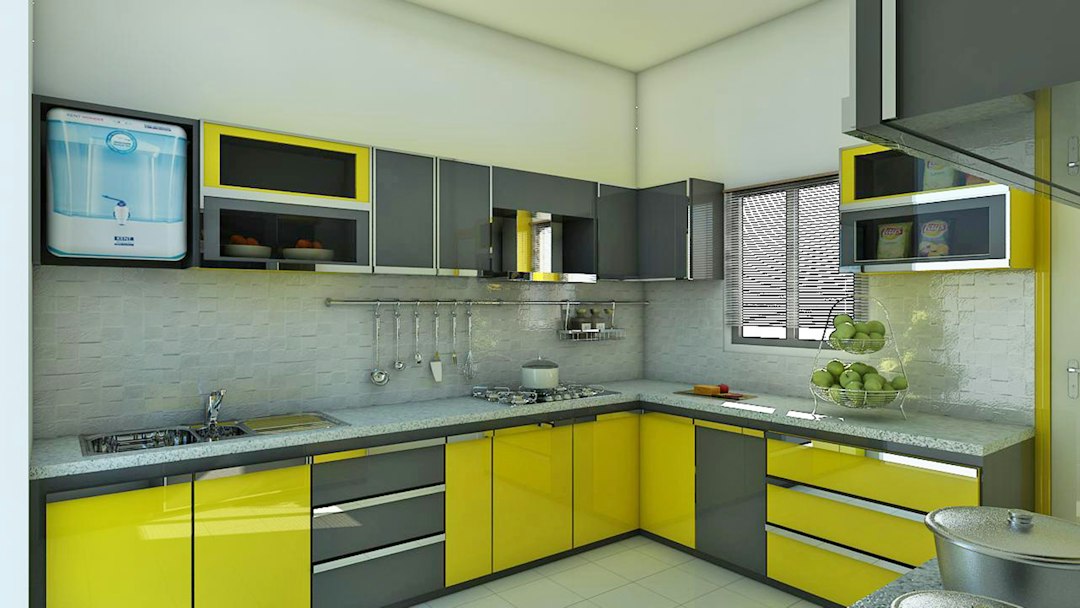
A two-tone kitchen pairs different colours on upper and lower cabinets, or on the island and the perimeter. The usual logic is to place the darker colour low, where it grounds the room and conceals scuffs from feet and bags, and the lighter colour high, where it keeps the space airy.
Keep the scheme disciplined. Two cabinet colours plus a worktop and a backsplash is already four surfaces competing for attention; adding a third cabinet colour or a strongly patterned backsplash often tips the room into busyness. Use one element, usually the worktop, as the link between the two cabinet colours, and repeat one of them elsewhere in the home so the kitchen feels connected rather than separate. Our article on building a whole-home colour scheme explains how to carry a palette between rooms.
Coordinating with worktops, backsplash and hardware
Cabinet colour never stands alone. Choose it with the worktop and floor in hand, because these are harder and more expensive to change. Quartz and solid-surface worktops often carry subtle veining or flecks; picking up a tone from that pattern in the cabinets ties the scheme together.
The backsplash sits at eye level and is seen at close range, so its colour and pattern can either complement the cabinets or compete with them. Hardware is the finishing touch: brushed steel and black suit cooler, modern palettes, while brass and bronze warm up greens, navies and woods. Handle-less designs with recessed grips let colour read as a single plane, a look popular in compact flats.
Practical upkeep in Singapore kitchens
Local cooking, with its high heat, oil and steam, places real demands on cabinet surfaces. Very pale matt finishes beside the hob can show grease staining over time, and very dark finishes show dust and water marks. Mid-tones with a light texture are the most forgiving in heavy-use areas.
Humidity is the other factor. Edge banding and door finishes near the sink and dishwasher take the most moisture, so good-quality materials and sealed edges matter more there than colour. Where the kitchen has a separate wet zone for heavy cooking, the dry kitchen facing the living area can carry lighter, more delicate kitchen cabinet colours, while the wet zone uses more robust finishes.
Finally, consider longevity. Cabinets often outlast several changes of wall paint, curtains and furniture. A restrained cabinet palette, with stronger colour carried by easily changed elements, gives the most flexibility over time.
Frequently asked questions
What kitchen cabinet colours make a small kitchen look bigger?
Lighter, warmer tones such as soft whites, pale greige and light wood reflect more light and help compact kitchens feel more open. Keeping upper and lower cabinets in similar tones, using handle-less doors and choosing a worktop close in value to the cabinets also reduces visual breaks and makes the room read as larger.
Are dark kitchen cabinets a good idea?
They can be, especially in kitchens with good daylight or as lower cabinets and islands in a two-tone scheme. Dark finishes bring depth and hide scuffs, but they can make a small or dim kitchen feel heavy, and dark matt surfaces tend to show dust, water spots and fingerprints, so they need more regular cleaning.
Which cabinet finish is easiest to maintain?
Good-quality laminate in a matt or lightly textured finish is generally the easiest to clean and most resistant to everyday wear in Singapore kitchens. High-gloss surfaces show smudges readily, and painted or lacquered doors look excellent but are harder to repair invisibly if chipped.
Should cabinet colour match the worktop?
It does not need to match exactly, but the two should relate. A common approach is to pick up an undertone or fleck from the worktop pattern in the cabinet colour, or to create deliberate contrast in value, such as light cabinets with a darker worktop, while keeping the overall palette limited.
Related reading
- Interior Design Styles: The Complete Guide for Homes
- Composite Decking vs Timber Decking in the Tropics
- Venetian Plaster: Types, Application and Durability
- Limewash Walls: How Lime Paint Works and Where It Fails
Renovating a kitchen that involves wall changes, heavy stone worktops or relocated services? Talk to our structural engineering consultancy or get in touch for accountable advice.