If you have ever added a room, closed off a study, or divided an open space in a Singapore home or office, the wall you built was almost certainly drywall. It is the default partition for modern renovations here — fast, affordable and flexible. This guide explains what drywall partitions are, how they are built, and how to get them right.
General guidance only — confirm current HDB and building requirements before any work.
What is a drywall partition?
A drywall partition is a non-load-bearing wall built from boards — usually gypsum (plasterboard) — fixed to a frame of light metal or timber studs. Unlike a solid masonry wall, it is hollow inside, which makes it light, quick to build and easy to run services through. It is a type of partition wall: it divides space but carries no structural load beyond its own weight, which is exactly why it can be added and removed so freely.
Why drywall is so popular in Singapore
Drywall has become the standard for good reasons. It is far quicker to install than brick or block, which keeps renovation timelines and labour costs down. It is light, so it adds little load to the structure — useful in apartments. Its hollow cavity neatly hides wiring, pipes and insulation. And it is easy to finish, paint and later modify. For dividing space in an HDB flat, a condo or an office, drywall is usually the most practical and economical answer.
How a drywall partition is built
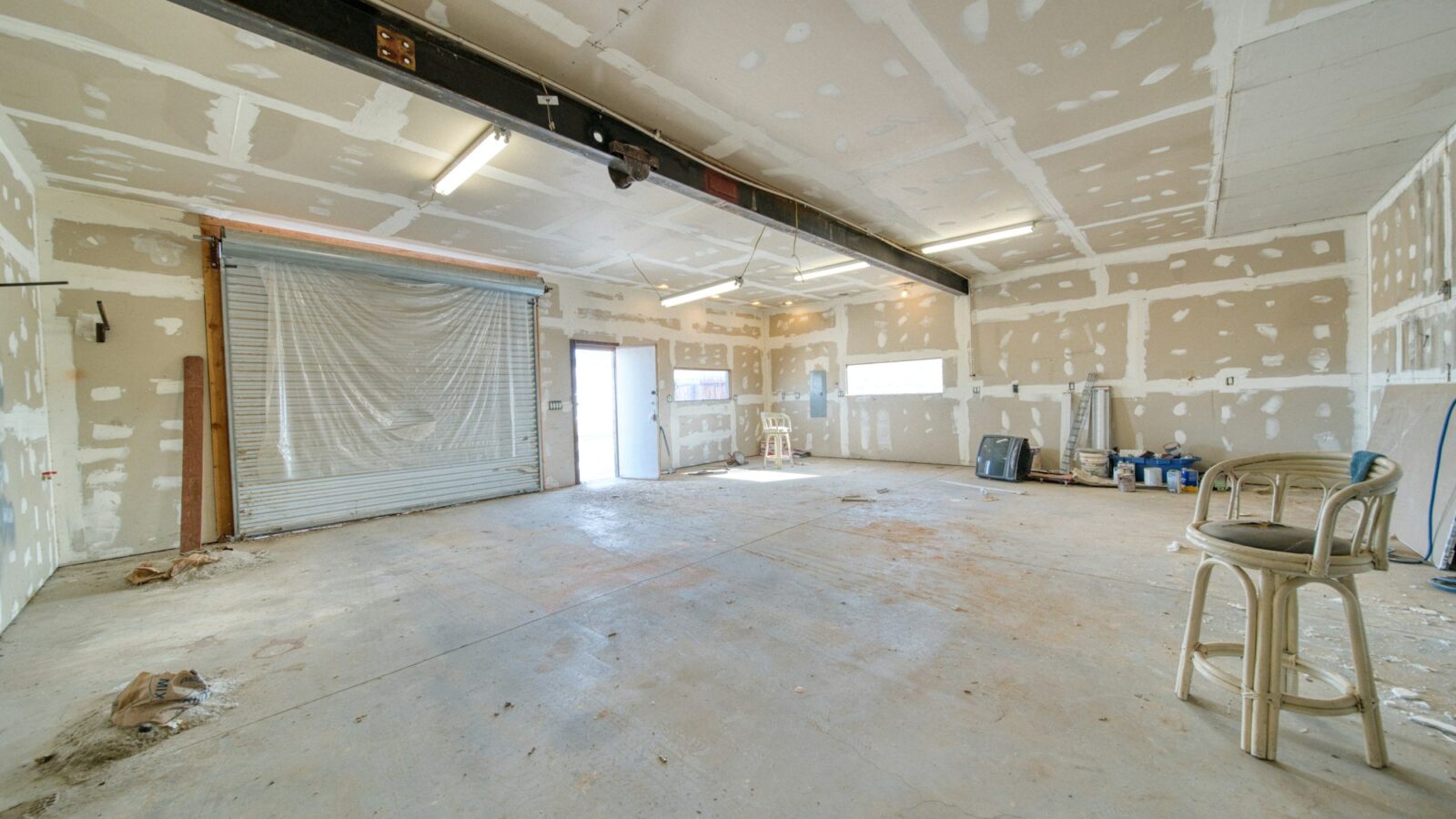
The build follows a clear sequence. A track is fixed to the floor and ceiling to set the line of the wall. Vertical studs are spaced along it to form the frame. Services — electrical conduits, data cables — are run inside, and insulation is added in the cavity if sound or fire performance is needed. Boards are then screwed to both faces of the frame, the joints are taped and filled, and the surface is sanded smooth and painted. The result looks like a solid wall but is quick to put up and, if needed, to take down.
Drywall versus masonry walls
The main alternative is a masonry partition in brick or block. Masonry feels more solid, handles wet areas and heavy fixings well, and offers good sound mass — but it is slower, heavier and messier to build. Drywall is faster, lighter, cleaner and cheaper, and easy to run services through, though it needs the right build-up for sound and special fixings for heavy items. For most dry, internal dividing walls, drywall wins on speed and cost; masonry holds its place where solidity, moisture or heavy loads matter.
Soundproofing a drywall partition
The most common complaint about drywall is sound, but that is usually down to a thin build rather than the material itself. Acoustic performance comes from the build-up: insulation in the cavity, more or denser boards, decoupled or staggered studs, and careful sealing of every edge and penetration, since sound leaks through the smallest gaps. A well-specified acoustic drywall can be genuinely quiet. If a bedroom, home office or meeting room needs privacy, ask for the acoustic build-up rather than assuming a standard partition will do.
Drywall in and near wet areas
Standard plasterboard does not like water, so wet and humid locations need moisture-resistant board (and, for some uses, fire-rated board). Around bathrooms and kitchens, the right board specification and detailing matter, and genuinely wet zones may still call for masonry or proper tanking. Matching the board type to the location is a small detail that prevents a damp, deteriorating wall later — and it is the kind of thing a good contractor specifies without being asked.
What drywall partitions cost
Drywall is generally the most economical partition option, which is part of its appeal. The cost depends on the area, the board specification, any acoustic or fire requirements, the finish, and how many services run inside. A simple dividing wall is inexpensive; an acoustic or fire-rated build with services costs more. As always, an itemised quote lets you compare like with like, and a slightly higher spec for sound or moisture is often money well spent.
Approvals for drywall partitions
Because drywall is non-structural, adding it is generally straightforward — but not always rule-free. In an HDB flat, certain works still need a permit through your registered contractor, and there are rules about loading and layout. In a condominium, the management corporation may have its own requirements. Adding a partition is far simpler than removing a structural wall — which is a different job entirely, covered in what you can and can’t hack — but it is still worth checking before you build.
Common drywall mistakes
Most disappointing drywall comes down to specification, not the material. The frequent mistakes are skimping on acoustic insulation and then being surprised by noise; using standard board in damp areas; fixing heavy items without proper backing or anchors so they pull out; and rushing the jointing so the seams later show. Each is avoidable with the right build-up and a careful installer. Drywall is only as good as how it is specified and built.
Frequently asked questions
Is a drywall partition strong enough?
For dividing space, yes — it is a non-load-bearing wall and not meant to carry structural load. Heavy items need fixing to the studs or with proper anchors, and a sturdier build-up can be specified where needed.
Is drywall soundproof?
A basic drywall is not, but a properly built acoustic drywall — with cavity insulation, denser or extra boards and well-sealed edges — performs well. Specify the acoustic build-up if privacy matters.
Hanging things on a drywall wall
A common worry is whether drywall will hold a TV, shelves or cabinets. The answer is yes, with the right approach. Light items can use proper plasterboard anchors, but anything heavy should be fixed into the studs behind the board, or to backing — a piece of timber or extra board built into the wall in the right place. The trick is to plan ahead: tell your contractor where a wall-mounted TV or heavy cabinet will go, so backing can be added while the wall is open. Fixed properly, a drywall wall carries everyday loads without trouble; the failures happen when heavy items are hung on the thin board alone.
Related reading
- HDB Renovation Packages: What’s Included and What to Watch
- Hacking and Demolition in a Singapore Renovation
- Inter-Floor Leaks in Singapore: Causes, Fixes and Who Pays
- BTO vs Resale Flat Renovation: What’s Different
See also partition walls in Singapore and operable walls. More in Renovation.