Cement board is a rigid building sheet made mainly from cement reinforced with fibres or mesh. Unlike gypsum board, it does not soften when wet, rot, or feed termites, which makes it the usual choice behind tiles in wet areas, for external cladding and soffits, and anywhere a board must tolerate moisture. In Singapore’s wet tropical climate, it is one of the most useful sheet materials on a building site.
This article explains the main kinds of cement board, how they differ from gypsum and calcium silicate boards, where they work and where they do not, how they behave in fire, and the asbestos history that still matters in older buildings. The angle is an engineer’s selection guide, so there are no brands or prices.
What cement board is made of
The term covers two related product families. Fibre cement board is made from cement, fine silica or other mineral fillers, and cellulose fibres, formed into sheets and often cured in an autoclave, a high-pressure steam vessel that improves strength and dimensional stability. Cement backer board is typically a cement and lightweight aggregate core faced with glass-fibre mesh on both sides, designed mainly as a substrate for tiles.
Both are heavier and harder than gypsum board, cut with scoring tools or dust-controlled saws rather than a knife, and fixed with corrosion-resistant screws suited to the board. Fibre cement flat sheets are commonly made to EN 12467 in markets following European standards, which classifies them by type, strength class and durability category, and exterior grades are tested for weathering. Check which standard a product is made to and what use it is declared for.
Cement board versus gypsum and calcium silicate board
Three board families are often confused on site:
- Gypsum board — light, easy to cut and finish, good in fire, but weakened by water. Best for dry internal partitions and ceilings. See our guide to gypsum board.
- Fibre cement and cement backer board — heavier, moisture tolerant, durable outdoors (for exterior grades), and a sound substrate for tiles.
- Calcium silicate board — made from lime, silica and fibres, autoclaved; light for its strength, moisture tolerant and widely used for ceilings, soffits and fire-protection linings. Often sold alongside fibre cement and sometimes loosely called cement board, although its chemistry differs.
The practical rule is to match the board to the exposure. Use gypsum in dry rooms, and cement-based or calcium silicate boards where moisture, weather or impact is expected.
Where cement board is used
Wet areas and tile backing
Cement board is the standard substrate for tiles on framed walls in bathrooms, shower enclosures and kitchens. It does not soften or lose bond when wet. It is not, however, a waterproofing layer: water can pass through cement board and its joints. In showers and wet zones, a waterproofing membrane must be applied over or behind the board, with joints and corners reinforced, in line with the waterproofing system. Our guide to waterproofing in construction explains how membranes are detailed.
External cladding, soffits and eaves
Exterior-grade fibre cement sheets and planks are used for cladding, eaves linings, soffits and fascia, either painted or with factory finishes. As with any cladding, performance depends on the system: a drained and ventilated cavity behind the boards, correct fixing spacing, movement joints, and sealed cut edges where the manufacturer requires it. Our overview of types of cladding places fibre cement among the alternatives.
Floors and other uses
Thicker high-density boards are used as flooring substrates over joists or steel framing, as permanent formwork, for mezzanine decks and for wet-area floors in lightweight buildings. Load capacity depends on board thickness, support spacing and fixing, and should be taken from the manufacturer’s span tables and checked by an engineer for anything beyond light domestic use.
Performance in Singapore’s climate
Cement board’s strengths match a hot, humid, rainy climate:
- Moisture — it does not rot or lose its strength when wet, though it absorbs some water and can move slightly as it wets and dries.
- Termites — the cement matrix offers nothing to termites, which is valuable in landed homes; our guide to termites in Singapore covers wider protection.
- Mould — less prone to mould growth than paper-faced boards, although surface mould can still grow on dirty, damp finishes.
- Weathering — exterior grades resist rain and sun, but coatings need maintenance like any painted surface.
Weaknesses are weight, brittleness and movement. Boards are heavier to handle and to support than gypsum, can crack if the framing deflects or if they are fixed too close to edges, and need movement joints over long runs. Framing should be stiff enough for the board, and fixing must follow the manufacturer’s edge distances and spacing.
Fire performance
Cement-based boards contain little combustible material, and many fibre cement and calcium silicate products are declared non-combustible or of the highest reaction-to-fire class under the European system (A1 under EN 13501-1) or equivalent tests. That is why they are widely used for soffits, fire-protection linings and external applications where combustibility matters.
As with gypsum, the reaction-to-fire class of a board is not the same as the fire resistance of a wall or ceiling built with it. Fire resistance belongs to a tested assembly. In Singapore, where fire-rated construction or non-combustible materials are required, products must meet SCDF’s Fire Code and carry the appropriate certification for the intended use. Always check the declared class and test report for the specific product rather than assuming all cement boards are equal.
Asbestos in older fibre cement
For much of the twentieth century, fibre cement was made with asbestos fibres, as asbestos cement. It was widely used for roofing sheets, flat sheets, pipes and soffits. In Singapore, the use of asbestos in buildings was banned in 1989, and the Ministry of Manpower notes that buildings completed after 1 January 1991 are unlikely to contain asbestos materials. Modern fibre cement uses cellulose and synthetic fibres instead.
In older buildings, any existing cement sheet should be treated as potentially containing asbestos until tested. Intact, undisturbed material is low risk, but cutting, drilling, breaking or removing it can release fibres. Work involving asbestos is regulated under the Workplace Safety and Health (Asbestos) Regulations, which require prior notification and competent contractors. Do not drill or remove old roof or ceiling sheets yourself.
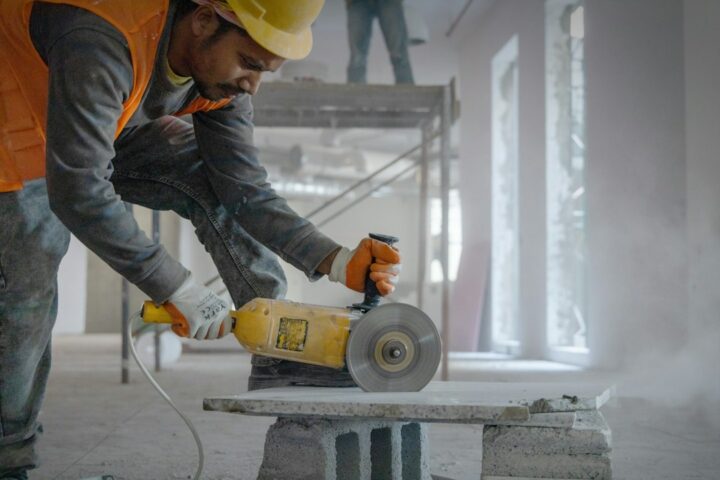
Cutting new fibre cement also needs care: it contains crystalline silica, and dry cutting produces fine dust. Score-and-snap methods, dust-extracting saws and respiratory protection are standard practice.
Frequently asked questions
Is cement board waterproof?
No. Cement board is water resistant in that it does not soften, rot or lose strength when wet, but water can pass through it and its joints. In showers and wet areas it must be combined with a waterproofing membrane.
What is the difference between cement board and gypsum board?
Cement board is heavier, harder and tolerant of moisture, making it suitable for wet areas, tile backing and exterior use. Gypsum board is lighter and easier to work but is weakened by water, so it suits dry internal walls and ceilings.
Is fibre cement board fire resistant?
Many fibre cement and calcium silicate boards are declared non-combustible, which makes them useful where combustibility matters. Fire resistance ratings, however, apply to complete tested wall or ceiling systems, so check the product’s certification for the intended use.
Does old cement sheet contain asbestos?
It may. Asbestos cement was common before asbestos use in buildings was banned in Singapore in 1989. Treat old sheets as suspect until tested, and use competent asbestos contractors, who must notify the authorities before work starts, for any removal.
Can cement board be used for external cladding?
Exterior-grade fibre cement is widely used for cladding, soffits and eaves, provided it is installed as part of a proper system with a drained cavity, correct fixings, movement joints and maintained coatings.
Related reading
- Fiberglass Insulation: Glass Wool for Tropical Buildings
- Risk Assessment Construction: Method and Singapore Rules
- Construction PPE: What Workers Need and Why It Matters
- Fire Pump Systems in Buildings: How They Work and Why
Dealing with old cement sheeting, or specifying board systems for wet or exposed areas? Talk to our consultancy or get in touch.