
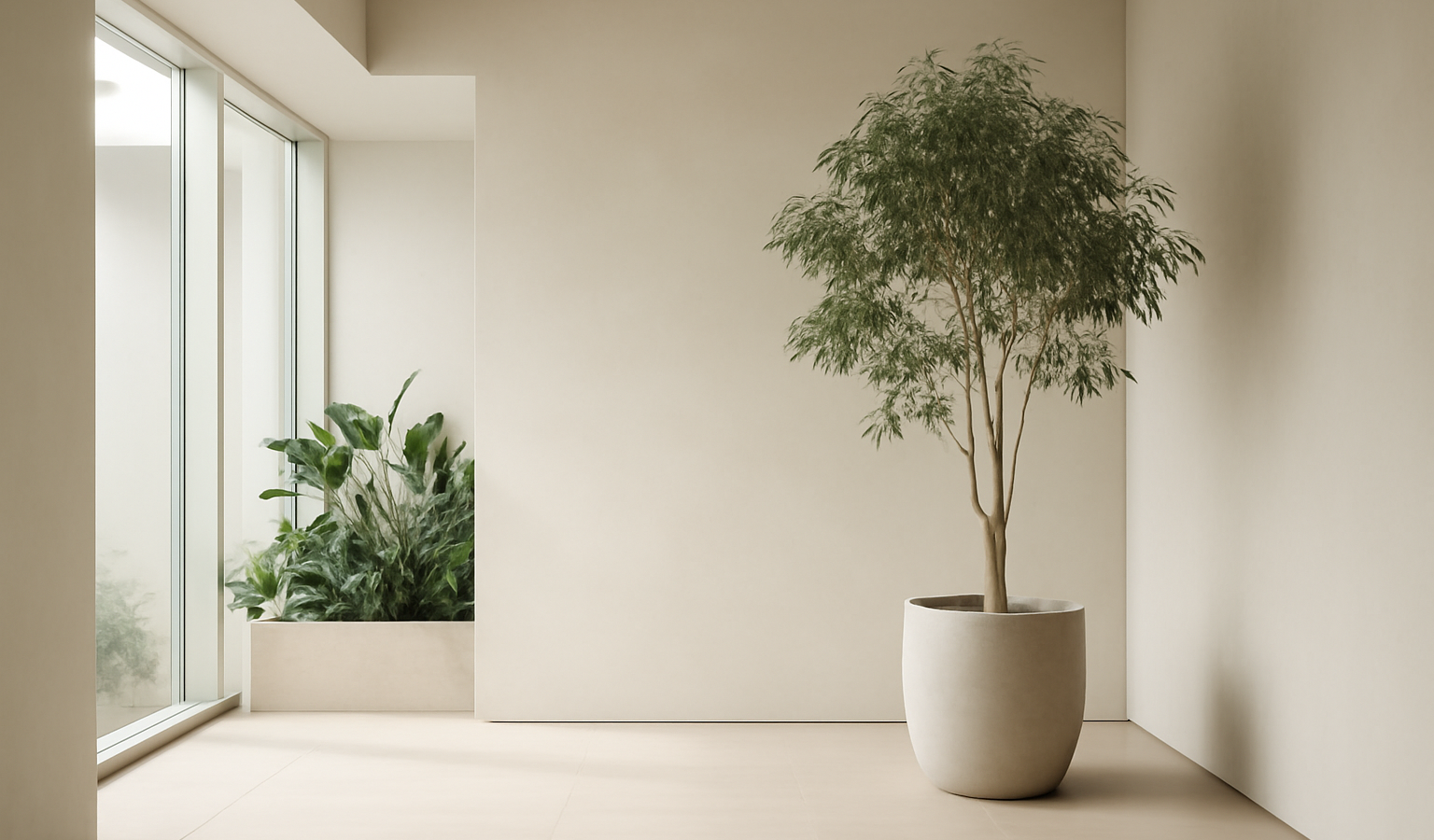
Biophilic design is the practice of bringing nature back into the buildings we spend most of our lives in. It is more than a few potted plants: it is a way of designing space around our deep, instinctive pull toward the natural world — and the evidence that it makes us healthier and happier is now hard to ignore.
What is biophilic design?
“Biophilia” means a love of living things. Biophilic design applies that idea to architecture and interiors — using nature, natural materials and natural patterns to make buildings feel alive. It draws on real human responses: we relax near greenery, daylight and water, and we tense up in sealed, artificially lit boxes.
Why it matters
Studies in homes, offices, schools and hospitals consistently link contact with nature to lower stress, better concentration, improved mood and even faster recovery from illness. For workplaces that translates into wellbeing and productivity; for homes, into spaces that simply feel good to be in. It is one of the few design moves that pays back in measurable wellbeing.
The main ways to design with nature
- Nature in the space — plants, green walls, daylight, natural ventilation, water, and views out to greenery.
- Natural materials and analogues — timber, stone, natural textures and organic patterns that echo the natural world.
- Light and air — generous daylight, a connection to the day’s rhythm, and fresh moving air rather than sealed, conditioned boxes.
- Space and refuge — a balance of open, prospect-rich areas and smaller, sheltered “refuge” spaces.
Biophilic design at home and at work
At home it can be as simple as maximising daylight, framing a view of a tree, using natural materials, and giving plants a genuine place rather than an afterthought. In the office, biophilic interior design pairs greenery and daylight with natural materials and views to soften the environment and support focus. The principle is the same at every scale: design with nature, not against it.
Beyond the token plant
Done badly, “biophilic” becomes a marketing label for a lobby with a few struggling ferns. Done well, it is woven into the architecture from the start — in orientation, openings, materials and the connection between inside and out. It also overlaps naturally with passive cooling (the same openings that bring in light and greenery bring in air) and with the restraint of minimalist architecture, where nature becomes the ornament.
Frequently asked questions
What is biophilic design in simple terms?
Designing buildings and interiors to connect people with nature — through greenery, daylight, natural materials, views and fresh air — because it makes us feel and function better.
Does biophilic design really improve wellbeing?
A growing body of research links it to lower stress and better concentration and mood. The effect is strongest when nature is integral to the design, not added on.
The 14 patterns of biophilic design
A widely used framework, Terrapin Bright Green’s “14 Patterns of Biophilic Design”, organises the field into three groups that make it practical to apply:
- Nature in the space — direct contact with nature: a visual connection with greenery, non-visual connections (sound, scent), natural light and thermal variation, the presence of water, and air movement.
- Natural analogues — indirect references to nature: natural materials and textures, organic forms and patterns, and the sense of complexity and order found in living systems.
- Nature of the space — spatial qualities we respond to instinctively: prospect (open views), refuge (sheltered spots), mystery, and a hint of risk or awe.
Used together, they turn “add nature” into a set of concrete, designable moves.
Biophilic design in the workplace
Offices are where biophilic design has been studied most. Daylight, views of greenery, plants, natural materials and access to fresh air are repeatedly linked to lower stress, better focus and fewer sick days. For employers, that is a rare win-win: a more pleasant place to work that also performs better. The key, as ever, is to design it in — orientation, openings and planting from the start — rather than scatter a few plants and call it green.
Biophilic design in dense cities
You might think nature and the high-rise city are at odds, but dense cities are where biophilic design matters most — and some have made it a signature. Singapore is the clearest example, weaving sky gardens, green walls, planted terraces and lush landscaping through its buildings and streets until greenery is part of the architecture rather than an afterthought. In a tight urban home, the same thinking scales down: a planted balcony, a green outlook, vertical planting, and daylight brought deep into the plan. Density is not an excuse to lose nature; it is a reason to design it in deliberately.
Simple biophilic changes for any home
You do not need a green wall or a major renovation to bring nature in. Maximise daylight and frame a view of greenery wherever you can. Add real plants and give them a genuine place, not a token corner. Choose natural materials — timber, stone, linen, rattan — over synthetic ones. Open windows for fresh, moving air rather than relying only on air-conditioning. Even natural sounds, scents and a connection to the rhythm of the day help. Small, honest moves repeated through a home add up to a space that feels alive.
Measuring the benefits
Biophilic design is unusual among design ideas in having a growing evidence base. Studies across offices, schools, homes and hospitals have linked contact with nature to lower stress, better concentration and mood, and faster recovery in healthcare settings. Workplaces report gains in wellbeing and productivity; patients with views of nature have recovered more quickly. The effect is strongest when nature is woven into the architecture rather than added on. That measurable payback is a large part of why biophilic design has moved from a nice idea to a mainstream priority.
Does biophilic design cost more?
It does not have to. The most powerful biophilic moves — orientation for daylight, framed views, natural ventilation and a good connection to the outdoors — are largely decisions, not expenses, when made early in design. Plants, natural materials and better daylighting are usually modest costs with an outsized effect on how a space feels. The more elaborate features, such as extensive green walls, do carry a price and ongoing maintenance, so they are worth choosing deliberately. But the heart of biophilic design is thoughtful design, not expensive add-ons — which is why it scales from a major building down to a small flat.
Related reading
- What Is a Pavilion? Architecture’s Most Experimental Building
- Small House Design: Making the Most of Every Square Metre
- Brutalist Architecture: Raw Concrete and the Eco-Brutalism…
- Sustainable Architecture: Designing Buildings for the Planet
New here? Start with our guide to architectural styles and principles, or explore more in Architecture.


