Bathrooms are small, reflective, wet and used at both ends of the day, which makes them one of the hardest rooms in a home to light well. Good bathroom lighting has to do several things at once: show your face accurately at the mirror, make the room feel calm, help you find your way at night and, above all, stay safe in the presence of water.
This guide covers the design side, including layers, colour temperature and placement, and the safety side, including electrical zones and the IP ratings that fittings must carry in each. The safety rules are summarised from the international framework for bathroom electrical installations; in Singapore, the electrical works themselves must be carried out by a licensed electrical worker, who will apply the local code to your specific room.
Layering light in a small room
Lighting designers think in layers, and the approach works just as well in a bathroom as in a living room. Three layers usually suffice:
- Ambient light fills the room, typically from ceiling downlights or a diffused ceiling fitting. It should be even and free of harsh shadows.
- Task light serves the mirror and vanity, where shaving, make-up and skincare need clear, shadow-free illumination of the face.
- Accent or night light adds atmosphere and low-level guidance: a cove above the mirror, an LED strip under a floating vanity, or a soft niche light in the shower.
Putting each layer on its own switch, or using a dimmer, lets the room shift from bright morning use to a softer evening mood and a gentle night setting that does not wake you fully. Our broader guide to home lighting design in Singapore explains layering across the whole flat.
Lighting the mirror properly
The mirror is where bathroom lighting most often goes wrong. A single downlight directly overhead casts shadows under the eyes, nose and chin, exactly where you need to see clearly. The better approach is to light the face from the front and sides.
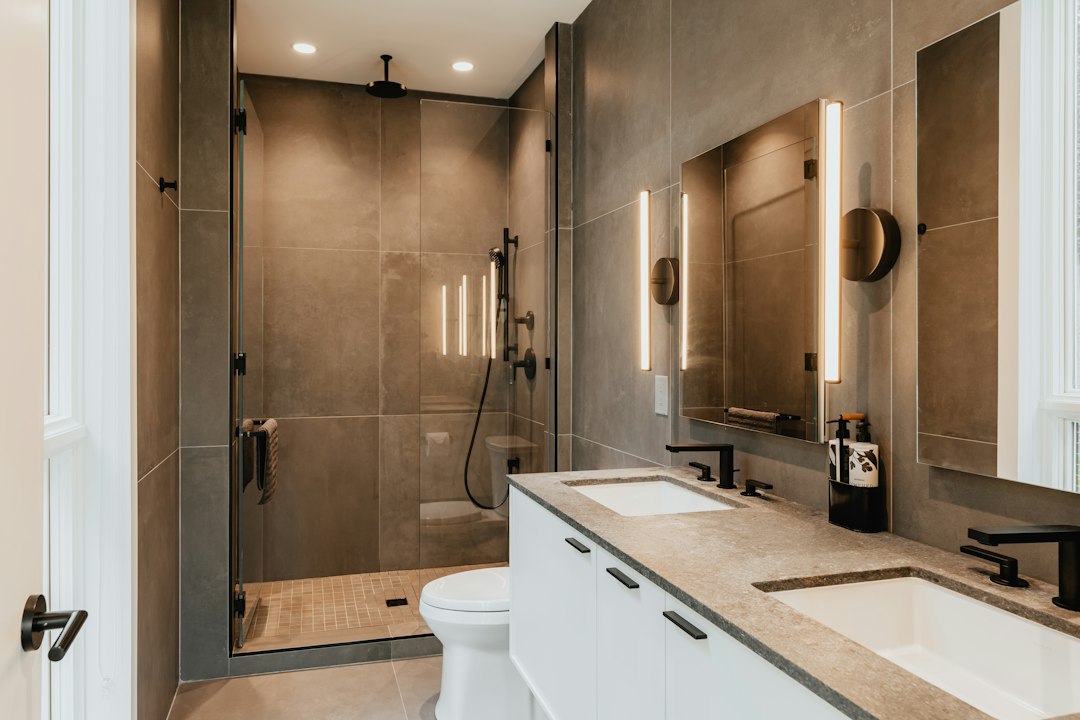
Options include vertical light bars or sconces on either side of the mirror at roughly face height, a backlit or edge-lit mirror that throws soft light forward, or a linear fitting above the mirror angled towards the face. Combining a front-facing source with ambient light from above gives the most even result.
Colour quality matters here too. A light source with a high colour rendering index (CRI) shows skin tones and make-up accurately. Neutral to warm white, broadly in the 3,000 to 4,000 K range, is a common choice: warm enough to feel comfortable, neutral enough for accurate grooming. Very cool light can feel clinical, while very warm light distorts colour.
Bathroom lighting zones and IP ratings
Water and electricity are a dangerous combination, so electrical installations in rooms with a bath or shower follow special rules. The international standard is IEC 60364-7-701, and many national codes, including the UK’s BS 7671, are based on it. These standards divide the room into zones according to how likely a fitting is to be splashed or immersed.
The zones in outline
- Zone 0 is the interior of the bath or shower tray, where water collects. Only equipment specifically designed for this location, at extra-low voltage, is permitted, and it must be rated at least IPX7 (protected against temporary immersion).
- Zone 1 is the space directly above the bath or shower up to a height of 2.25 m from the floor. Fittings here are required to be at least IPX4 (protected against splashing water from any direction).
- Zone 2 extends 0.6 m horizontally beyond Zone 1, also to 2.25 m high. Fittings here also need at least IPX4.
- Outside the zones, ordinary fittings are not prohibited by zone rules, but in a humid bathroom a moisture-resistant fitting remains sensible.
For showers without a tray, such as walk-in or level-access showers, the zone geometry is defined differently, typically measured from the fixed water outlet, so the extent of Zone 1 may be larger than people expect. Where fittings may be hit by jets of water, for example during cleaning with a hose or handheld spray, a higher rating such as IPX5 is often specified.
Reading an IP rating
IP stands for ingress protection, defined in IEC 60529. The first digit describes protection against solid objects and dust; the second describes protection against water. An “X” means that digit has not been tested. So IP44 means protection against solid objects over 1 mm and against splashing water, IP65 means dust-tight and protected against water jets, and IPX7 means protected against temporary immersion with no rating declared for solids. Check the rating on the fitting itself, not just on the packaging of a related product.
National implementations differ in details such as extra-low voltage limits and the treatment of walk-in showers. Treat this section as an explanation of principles, and let your licensed electrical worker confirm the requirements that apply to your installation.
Shower and wet-area lighting
Lighting within the shower area is one of the most effective ways to make a bathroom feel considered. A sealed, appropriately rated downlight over the shower prevents the user from standing in their own shadow, and a low-level LED strip in a tiled niche provides soft light for evening showers.
Recessed fittings in the shower ceiling must be suitable for the zone they sit in, and penetrations through a false ceiling should not compromise ventilation or create a path for moisture into the ceiling void. Avoid fittings that rely on silicone alone to keep water out over many years. Where LED strips are used, the driver should sit outside the wet zones in an accessible, ventilated position, and the strip itself must carry the right rating.
In walk-in showers, consider how light falls on the floor and the falls towards the drain. Grazing light across a textured tile shows its surface beautifully but also reveals any unevenness in laying, so it should only be used where the tiling is of high quality. Our guide to the walk-in shower covers falls and waterproofing in more detail.
Practical points for Singapore bathrooms
Many bathrooms in HDB flats and condominiums have low or modest ceilings, often with a false ceiling concealing pipes and the water heater. This limits the depth available for recessed fittings and sometimes their positions, since the ceiling void may be crowded. Check void depth and service routes before choosing downlights.
Ventilation and lighting interact. Many internal bathrooms have no window, so the exhaust fan runs often; linking it to the light switch, or to a humidity sensor where available, keeps moisture down and protects fittings and finishes alike. Windowless rooms also benefit from slightly brighter ambient light than one with daylight.
Finally, remember that electrical work must be carried out by a licensed electrical worker in Singapore, and changes to the bathroom often go hand in hand with re-tiling and waterproofing. Coordinating the lighting plan with the full renovation, as described in our guide to bathroom design ideas, avoids cutting into fresh tiles or membranes later.
Frequently asked questions
What IP rating do I need for bathroom lighting?
Under the international framework for bathroom installations, fittings in Zone 1 and Zone 2, the areas above and immediately around the bath or shower up to 2.25 m high, need at least IPX4, while equipment inside the bath or shower tray in Zone 0 needs at least IPX7 and extra-low voltage. Where fittings may be exposed to water jets, IPX5 or higher is often specified. Your licensed electrical worker should confirm the requirements for your specific room.
What colour temperature is best for bathroom lighting?
Neutral to warm white, broadly between 3,000 and 4,000 K, suits most bathrooms. It is comfortable for relaxing yet accurate enough for grooming, particularly when paired with lamps that have a high colour rendering index. Many people use a warmer, dimmed setting in the evening and brighter neutral light in the morning.
Is a single ceiling light enough for a bathroom?
A single overhead light will illuminate the room but usually casts shadows on the face at the mirror. Adding task lighting at the mirror, from the sides or front, gives far better results, and a low-level night light or accent layer makes the room more comfortable to use late at night.
Can I install LED strips in a shower?
Yes, provided the strip and its housing are rated for the zone in which they sit, usually with a high level of water protection, and the driver is located outside the wet zones in a ventilated, accessible position. Installation should be carried out by a licensed electrical worker and coordinated with the tiling and waterproofing.
Related reading
- Modular Kitchens Explained: Pros, Cons and Planning
- Headboard Design Ideas: Materials, Sizes and Fixing
- Small Bedroom Ideas: Space-Saving Layouts for HDB Homes
- Room Decoration Ideas That Actually Work in Small Homes
Planning a bathroom renovation that touches waterproofing, ceilings or services? Talk to our structural engineering consultancy or get in touch for accountable advice.