Almost every building rises with the help of a crane, but not the same crane. The types of cranes found on construction sites differ in how they are supported, how they move, how high and far they reach and how much they can carry. Choosing between them is one of the first logistics decisions on a project, and it shapes the site layout, the programme and, sometimes, the structure itself.
This guide sets out the main families of crane, explains the principle each one relies on, and describes how an engineer and a contractor decide which to use. It also outlines the safety and regulatory framework that applies to all of them in Singapore.
The common principle: capacity, radius and stability
Every crane is a lever. The load hangs at some distance (the radius) from the point about which the crane would tip, and the crane’s own weight, counterweight and support system resist that overturning moment. This is why a crane’s rated capacity is never a single number. It is a chart: the further the load is from the crane, the less it can safely lift.
Two things therefore matter as much as the crane itself. The first is the radius at which the heaviest lift must be made, including the placing position, not just the pick. The second is what the crane stands on. Outrigger pads, crawler tracks and tower-crane bases all deliver large, concentrated loads into the ground or structure below, and a crane is only as stable as that support.
Tower cranes
The tall, fixed cranes that define city skylines are tower cranes. A lattice mast is anchored to a concrete base or the building structure, and a horizontal jib slews around the top, with a trolley running along it to change radius. Luffing-jib variants raise and lower the jib instead, which helps on tight urban sites where the jib must not oversail neighbouring property.
Tower cranes suit long-duration, high-rise work where the same area must be served for months. Their foundations and ties are engineered elements in their own right; our article on tower cranes covers them in more detail.
Mobile cranes and their variants
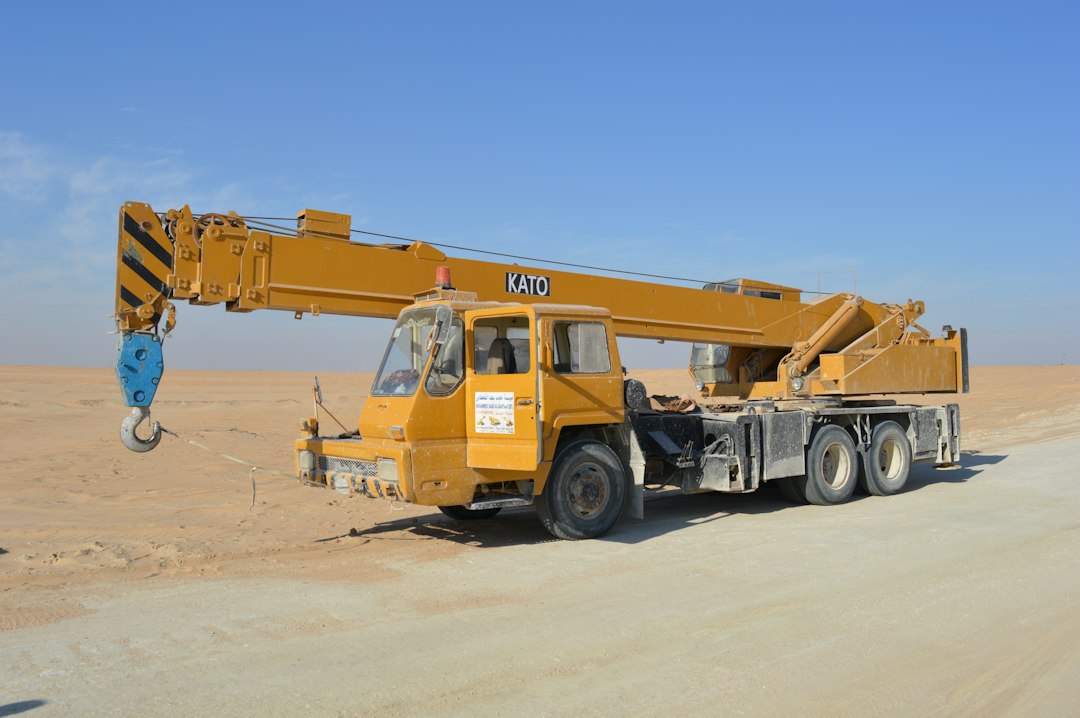
Mobile cranes travel to site on their own carrier and set up quickly, which makes them the default for short-duration lifts. The family includes several distinct machines:
- Wheeled mobile cranes, including all-terrain and rough-terrain types, with telescopic booms and outriggers. See our guide to the mobile crane.
- Crawler cranes, which run on tracks, spread their weight over a large footprint and can carry very heavy loads, often with lattice booms assembled on site. They are covered in the crawler crane article.
- Truck mounted cranes, or lorry cranes, where a knuckle or telescopic crane is fixed to a delivery lorry. See truck mounted cranes.
- Spider cranes, compact tracked machines with splayed outriggers that fit through doorways and work inside buildings or on podiums.
The trade-off across the family is between convenience and capacity. Small machines arrive and work within minutes; large crawlers need transport in parts, assembly space and carefully prepared ground.
Gantry, overhead and jib cranes
A second group of cranes runs on fixed structures rather than travelling freely. Overhead (bridge) cranes run on rails along the top of a building’s columns, typically in factories and precast yards, and the supporting runway beams and columns are designed for the crane loads. Gantry cranes carry the bridge on legs that run on ground-level rails, and are common in precast yards, ports and some infrastructure works. Jib cranes are smaller slewing arms mounted on a column or wall to serve a workstation or loading bay.
These are more often seen in fabrication and precasting than on the building site itself, but they matter to structural engineers because the crane is part of the design brief. A runway beam that carries a moving wheel load, with impact and lateral surge, is a different problem from a beam carrying a static floor.
How to choose among the types of cranes
Selection usually starts from the heaviest and furthest lift, then works through access, duration and space. A practical sequence is:
- Identify the critical lifts: weight including rigging, pick radius and place radius.
- Check access: can the machine reach the site, and is there room to rig and assemble it?
- Consider duration: a few days of lifting favours a mobile crane; months of repetitive lifting favours a tower crane.
- Check the ground and structure: where will outriggers, tracks or a base sit, and has that support been verified?
- Look at neighbours and airspace: oversailing, overhead lines and height restrictions near airports can rule out some options.
Often the answer is more than one machine: a tower crane for the frame, mobile cranes for heavy one-off lifts and lorry cranes for deliveries. Comparing the types of cranes against the real lift list, rather than habit, avoids both under-sized machines and oversized ones occupying space for no reason.
Safety and regulation in Singapore
All cranes used at workplaces in Singapore fall within the Workplace Safety and Health framework administered by the Ministry of Manpower. Cranes are lifting machines under the WSH (General Provisions) Regulations: they must be registered with MOM and tested and examined by an Authorised Examiner, a Professional Engineer approved by MOM for that purpose. The WSH (Operation of Cranes) Regulations 2011 add requirements for lifting operations, including a lifting plan and the appointment of a lifting supervisor, rigger and signalman who have completed training acceptable to the Commissioner. MOM updated the test and examination requirements for lifting equipment in 2025, so current intervals should be confirmed against MOM’s latest circular.
From the engineer’s side, the recurring concern is support: crane bases, temporary platforms, outrigger positions on slabs and cranes near excavations. These interfaces sit within the wider site regime discussed in construction safety.
Frequently asked questions
What are the main types of cranes used in construction?
The main construction cranes are tower cranes, wheeled mobile cranes, crawler cranes, truck mounted or lorry cranes and compact spider cranes. Overhead, gantry and jib cranes run on fixed structures and are more common in factories, precast yards and ports than on building sites.
Why does a crane lift less at a longer radius?
A crane resists overturning with its own weight and counterweight acting about a tipping point. The further out the load hangs, the larger its overturning moment, so the safe load must fall as radius increases. That relationship is captured in the manufacturer’s load chart.
When is a tower crane better than a mobile crane?
A tower crane suits projects that need the same area served repeatedly over months, especially high-rise frames. A mobile crane suits short campaigns of lifting, single heavy lifts or sites where a fixed crane cannot be justified. Many projects use both.
Who checks that a crane is safe to use in Singapore?
Cranes are registered with MOM as lifting machines and examined by an Authorised Examiner, a Professional Engineer approved by MOM. Day to day, the lifting supervisor and the crane operator check the set-up and lifting plan, and the contractor remains responsible for safe operation.
Related reading
- Dump Truck in Construction: Types, Uses and Site Safety
- Skid Steer Loaders Explained: Types, Uses and Safety
- Bulldozer Explained: Types, Blades, Uses and Safety
- Backhoe Loaders Explained: Types, Uses and Site Safety
Need a crane base, outrigger position or temporary works checked by an accountable engineer? Talk to our consultancy or get in touch.