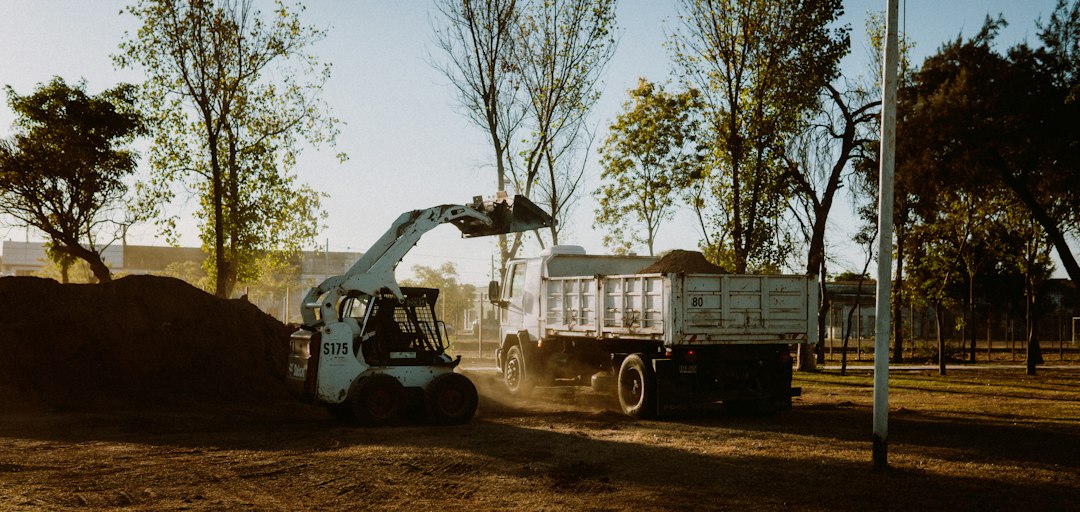
A skid steer loader is a small, rigid-framed machine with lift arms either side of the operator and a bucket or attachment at the front. It turns by driving the wheels on one side faster than the other, skidding round almost on the spot. That manoeuvrability, combined with a huge range of attachments, makes it a common sight on landscaping, demolition, interior strip-out and small earthworks jobs.
This guide explains how a skid steer works, the main variations, where it is used on a building project, and the safety points that matter most. Its compact size can make it look harmless, but the lift arm geometry creates one of the most serious crush hazards of any small machine.
What a skid steer loader is
The machine has a short wheelbase, a rigid chassis with no articulation, and fixed axles. The engine usually sits at the rear, acting as a counterweight. The operator sits in an enclosed cab between two lift arms that pivot behind the cab and reach forward to carry the attachment. On most machines the operator enters and exits through the front, over the attachment, which has important safety consequences discussed below.
The attachment plate at the front accepts a wide variety of tools: general-purpose and grading buckets, pallet forks, grapples, augers, hydraulic breakers, sweepers, trenchers, cold planers and more. In practice, the machine is often chosen for what its attachments can do rather than for its bucket.
How skid steering works
Each side of the machine is driven independently, usually by its own hydraulic motor. To go straight, both sides turn at the same speed. To turn, one side slows, stops or reverses while the other continues. Because the wheels cannot steer, they skid sideways across the ground during the turn, which is where the name comes from.
The benefit is an extremely tight turning circle, letting the machine work in spaces where a conventional loader could not turn. The cost is tyre wear and surface damage: skid turns scuff paving, tear up turf and can damage finished floors, which is why mats or tracked machines are used on sensitive surfaces.
Radial lift and vertical lift
- Radial lift arms pivot about a single point, so the attachment moves in an arc, travelling forward as it rises and then back towards the machine at full height. They tend to give good reach at mid-height, useful for digging, grading and pushing.
- Vertical lift arms use additional linkages so the attachment rises on a more vertical path, keeping more reach at full height. They suit loading high-sided trucks and handling pallets.
Wheeled and tracked versions
Wheeled machines are faster and cheaper to run on firm surfaces. Tracked versions, usually called compact track loaders, use rubber tracks that spread the load, giving better traction on soft or wet ground and causing less surface damage. Tracked machines are common in Singapore’s wet conditions and on landscaped sites.
Where the skid steer is used on a building project
- Interior demolition and hacking: removing broken concrete, tiles and debris from inside buildings, often alongside small breakers. Our guide to hacking and demolition in Singapore covers the wider rules for this work.
- Small earthworks and grading: levelling sub-base, spreading aggregate and backfilling.
- Material handling: moving pallets of blocks, tiles and bagged materials around the site with forks.
- Landscaping and external works: shaping planting beds, moving soil and preparing paving formation.
- Clean-up: sweeping and clearing hardstanding and roads around the site.
Skid steers are often paired with a mini excavator: the excavator digs and breaks, and the loader carries the material out of confined spaces to a skip or truck.
Safety: the lift arm crush hazard
The single most important safety rule for a skid steer is that nobody should ever be between the raised lift arms and the machine frame, or under raised arms, unless the arms are supported by the manufacturer’s lift arm support device. Operators have been crushed while trying to enter or leave the cab with the arms raised, or while reaching out of the cab to operate controls. A falling arm or an accidentally touched control can kill instantly.
Good practice, consistent with manufacturers’ instructions, is to lower the attachment to the ground, stop the engine, engage the parking brake and only then leave the machine. The seat bar or restraint system and the interlocks that disable the hydraulics when the operator is not seated must never be bypassed.
Stability and loading
Because the machine is short, carrying a heavy load high can tip it forward, and travelling on slopes with a raised load can roll it over. Loads should be carried low, travelling up and down slopes with the heavy end uphill, and the rated operating capacity in the operator’s manual should be respected for each attachment.
Site traffic, visibility and enclosed spaces
Visibility to the rear and sides is limited, and the machine spins quickly. The site’s traffic plan should separate pedestrians, and the WSH Council’s guidance on workplace traffic safety management emphasises segregation, reversing controls and trained operators. Indoors, diesel exhaust and silica dust from breaking concrete must be controlled through ventilation, water suppression or electric machines, and noise exposure is governed by the WSH (Noise) Regulations.
Lifting and suspended loads
Pallet forks are designed to carry loads on the forks, not to suspend them on chains. MOM has warned about the dangers of slinging loads from the forks of forklifts, and the same logic applies to compact loaders: hanging loads from forks or buckets turns a loader into an uncertified crane. Where suspended lifting is needed, use equipment designed, certified and registered for that purpose.
Working on slabs and structures
Skid steers are frequently driven onto suspended slabs and podiums during fit-out and strip-out, and the combination of machine weight, payload and the dynamic effects of skid turning can concentrate significant loads on the floor. Before a machine is used on a suspended structure, its axle or track loads should be checked against the slab capacity, and back-propping considered where needed. Our overview of types of concrete slabs explains why the same machine can be safe on one floor and not another.
If you are planning strip-out or demolition inside an existing building, a short structural review of plant loads and demolition sequence is time well spent. Our consultancy can carry out that review.
Frequently asked questions
Why is it called a skid steer?
The wheels cannot turn, so the machine steers by driving the wheels on one side at a different speed from the other, making the tyres skid sideways across the ground as it turns.
What is the difference between a skid steer and a compact track loader?
Both use the same skid steering principle and lift arms, but a compact track loader runs on rubber tracks that spread the load and give better grip on soft or wet ground, while the wheeled version is faster on firm surfaces.
What is the main danger with skid steer loaders?
The most serious hazard is being crushed between the raised lift arms and the machine frame, which is why the attachment must be lowered, the engine stopped and the arms supported before anyone enters, leaves or works near the arms.
Should I choose radial or vertical lift?
Radial lift suits digging, grading and pushing work with good mid-height reach, while vertical lift suits loading high trucks and handling pallets because it keeps more reach at full height.
Can a skid steer be used on a suspended slab?
It can be, but only after its weight, payload and wheel or track loads have been checked against the slab’s capacity by a qualified engineer, since concentrated and dynamic loads can exceed what the floor was designed to carry.
Related reading
- Overhead Crane (EOT) Explained: Types, Design and Safety
- Gantry Crane Explained: Types, Uses and Lifting Safety
- Crawler Crane Explained: Types, Uses and Lifting Safety
- Mobile Crane Types, Uses and Singapore Lifting Rules
Planning strip-out or plant on a suspended floor? Talk to our consultancy or get in touch.