
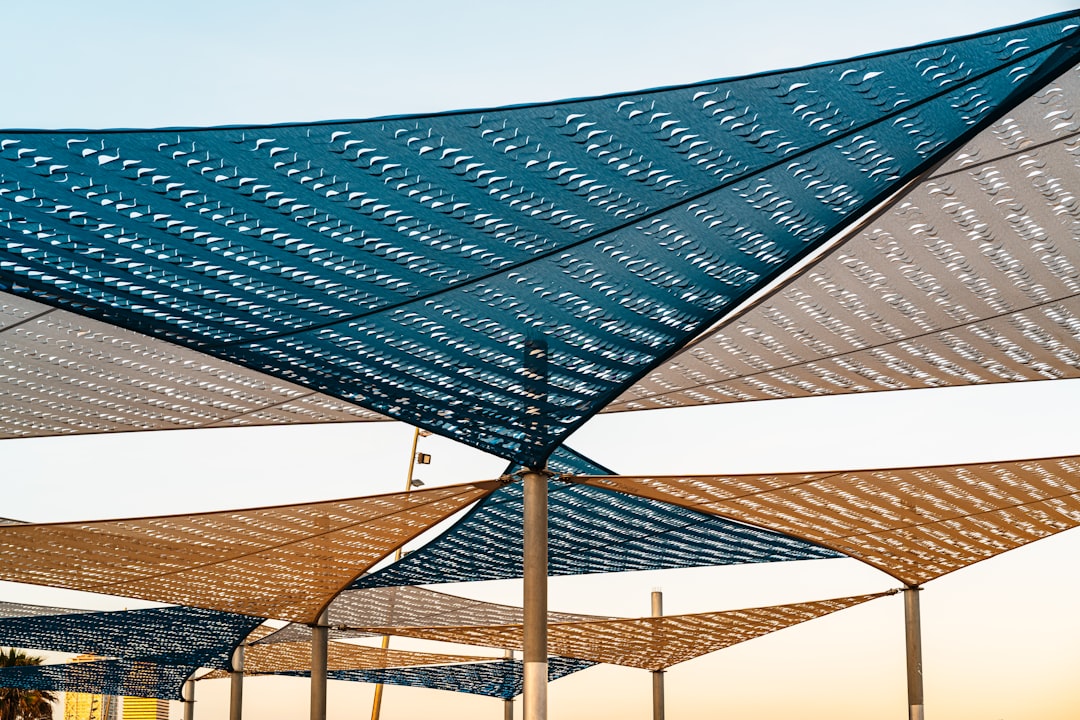
Stretch a fabric sheet tight between a few high and low points and you have the essence of a tensile structure: a roof that carries its load entirely by pulling, never by pushing. There is no bending and no compression in the membrane itself. That single property makes tensile and membrane structures among the lightest, longest-spanning and most sculptural forms available to an engineer, and it is also what makes them demanding to design.
This article explains how a tensile structure resists load, why its shape is found rather than drawn, the materials it is built from, and the trade-offs that decide when fabric is the right answer. The physics is unforgiving, which is precisely why these structures reward careful engineering.
How a tensile structure carries load
Most structures resist load through a mixture of bending, compression and tension. A tensile structure deliberately restricts the membrane to one of those: pure tension. A flexible surface cannot resist compression — it simply buckles and wrinkles — and it has negligible bending stiffness. So the only way it can carry wind, snow or its own weight is to pull against its supports.
That tension has to be balanced somewhere. Every cable and membrane in tension pushes back against masts, arches, beams or anchors that work in compression, and against ground anchors that resist uplift. The membrane is light and slender; the supports that hold it taut are stocky and grounded. Designing a tensile structure is largely the art of arranging that conversation between tension elements and compression elements so that the whole assembly stays in equilibrium under every load case.
Because the membrane has almost no stiffness of its own, it relies on prestress — a permanent built-in tension — to stay taut and stable. A slack membrane flaps; a properly prestressed one stays in shape and resists flutter. Getting that prestress right, and keeping it through the life of the structure, is central to the design.
Why double curvature matters
A flat or single-curved membrane is unstable: a load from one side has nothing to pull against and the surface inverts. The solution is double curvature, and the distinction between its two forms is fundamental.
- Anticlastic (saddle-shaped) surfaces curve in opposite directions along two axes, like a saddle or a Pringle. One set of cables sags downward and an opposing set arches upward, so whichever way the load pushes, one family of cables is always pulling back against it. This is the classic tensioned-membrane form, used for the cone, the saddle and the hypar tent.
- Synclastic surfaces curve the same way along both axes, like a dome or a bubble. A membrane cannot hold this shape by tension alone, so synclastic membranes are air-supported or air-inflated: internal air pressure pushes the fabric outward into a stable curve, as in inflated ETFE cushions and air-supported roofs.
This is why a tensioned fabric roof can never be flat. Its stability comes from its geometry, and the engineer’s first task is to find a shape that is in equilibrium under prestress before any external load is even applied.
Form-finding and analysis
You cannot simply draw a membrane shape and expect it to stand. The geometry of a tensile structure is governed by the balance of forces within it, so the form has to be found, not specified. Historically this was done with physical models — soap films, which naturally adopt the minimal-surface shape, and stretched fabric or chain models. Today it is done numerically, by setting the support points and the prestress and letting software iterate toward the equilibrium surface.
Once the form is found, the analysis must check it against several demanding conditions. Wind is usually the critical load: a light, curved roof generates large suction and pressure, and a poorly tuned surface can flutter dynamically, like a flag. Ponding is the other classic failure mode — if rainwater collects in a low spot, the added weight deepens the pocket, which collects more water, in a runaway loop. The geometry must shed water positively and the prestress must be high enough to prevent local inversion. These are subtle, coupled problems, and they are part of why tensile design is a specialist branch of what a structural engineer does.
Materials and detailing
The membrane itself is a coated fabric or a polymer foil. The common choices are:
- PTFE-coated glass fibre — durable, fire-resistant and self-cleaning, with a service life measured in decades; the premium choice for permanent roofs.
- PVC-coated polyester — cheaper and more flexible, widely used for tents, canopies and temporary or medium-life structures.
- ETFE foil — a thin transparent polymer, usually inflated into pillow-like cushions, prized for its lightness and clarity, as used on the Allianz Arena and the Eden Project biomes.
The fabric is supported and tensioned by a system of cables, masts and anchors, with edge cables along the boundaries and ridge and valley cables shaping the surface. The detailing of the connections — clamp plates, membrane plates, cable end fittings — is where tensile structures succeed or fail, because every junction must transfer tension without tearing the fabric or creating a leak. The translucency that makes these roofs so attractive also makes them an envelope problem, overlapping with facade engineering wherever the membrane forms part of the weather line.
Where tensile structures are used
Tensile and membrane structures suit large spans where lightness, translucency and a striking form are valued. The cable-net roof of the Munich Olympic Stadium remains the landmark early example of a large anticlastic tensioned roof, and ETFE cushion envelopes such as the Allianz Arena and the Eden Project biomes show how far the technology has since developed. Common applications today include:
- Stadium and arena roofs and grandstand canopies.
- Airport forecourts, transport interchanges and large entrance canopies.
- Shading structures, market roofs and public-realm canopies.
- Atrium and courtyard roofs where daylight is wanted.
The advantages are clear: very long spans for very little weight, abundant natural light through translucent fabric, and forms that are difficult to achieve any other way. The limitations are equally real. Fabric has a finite life and needs replacement; the detailing is unforgiving; fire performance, acoustics and long-term maintenance all demand attention; and the design effort per square metre is high. Whether a membrane roof is the right call depends on span, climate, lifespan and budget, which is the kind of trade-off our structural engineering consultancy is built to weigh.
Frequently asked questions
What is a tensile structure in simple terms?
A tensile structure is a roof or canopy made from fabric and cables that carries its load purely by pulling in tension, with no bending or compression in the membrane. The fabric is stretched tight between masts and anchors, which take the balancing compression and hold the surface in shape.
Why do tensile roofs have to be curved?
A flat membrane is unstable and would invert under load, so tensile roofs use double curvature. An anticlastic, saddle-shaped surface has one set of cables sagging and another arching, so whichever way a load pushes, one family of cables is always pulling back to keep the surface stable.
What is the difference between anticlastic and synclastic forms?
Anticlastic surfaces curve in opposite directions along their two axes, like a saddle, and are held in shape by mechanical tension. Synclastic surfaces curve the same way on both axes, like a dome, and cannot stand on tension alone, so they are inflated with internal air pressure, as in ETFE cushions.
What materials are membrane structures made from?
The common membranes are PTFE-coated glass fibre for durable permanent roofs, PVC-coated polyester for tents and medium-life canopies, and transparent ETFE foil, usually inflated into cushions. Each is held in shape by a system of cables, masts and anchors that apply and maintain the prestress.
What is ponding and why does it matter?
Ponding is when rainwater collects in a low spot of a flexible roof; the weight deepens the pocket, which collects still more water in a runaway loop that can overload or invert the membrane. Tensile roofs are shaped and prestressed to shed water positively and avoid any pocket where water could accumulate.
Related reading
- Structural Systems for Tall Buildings Explained
- Progressive Collapse Explained for Buildings
- Diaphragm Action in Structures Explained
- Structural Bracing Systems Explained
Considering a fabric or membrane roof and need it engineered to last? Talk to our consultancy or get in touch.


