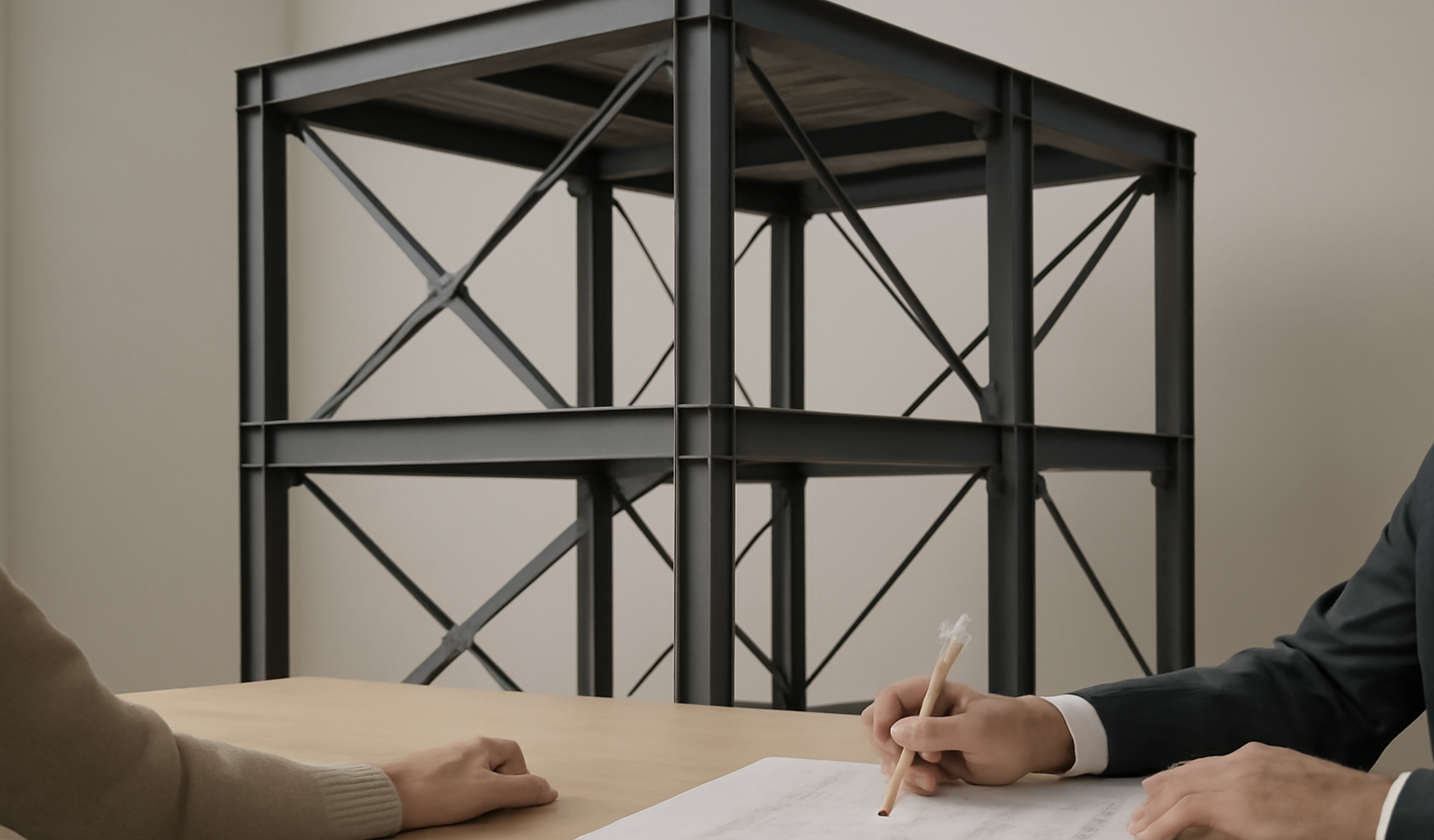
Steel makes possible the things concrete struggles with: long clear spans, slender members, rapid erection and the ability to take a structure apart again. But steel is unforgiving of poor detailing, and its behaviour — in connections, in fire, in fatigue, in stability — demands real expertise. A steel structure consultant is the engineer who brings that expertise, designing and advising on steel-framed buildings and structures so they perform safely and economically. This article explains what such a consultant does and when you need one.
Whether you are planning a steel-framed industrial building, a long-span roof, a mezzanine, a steel staircase, or the steel elements of an alteration, a steel structure consultant ensures the steelwork is properly engineered. In Singapore, structural steel design falls within the remit of a registered Professional Engineer, and steel’s particular demands reward an engineer who knows the material well.
What a steel structure consultant does
A steel structure consultant designs steel structures and advises on steel engineering problems. That means selecting the structural system, sizing the members, designing the all-important connections, and addressing the issues specific to steel — stability and buckling, fire protection, fatigue where loads cycle, and the practicalities of fabrication and erection. The consultant produces the design and documentation, endorses it as required, and often supports the project through fabrication and construction.
Good steel design is a balance of competing demands: strength, stiffness, economy, buildability and aesthetics. Steel is expensive per tonne but fast to erect and capable of elegant, slender forms, so the consultant’s job is to extract the most value from it. For the broader engineering context, our overview of what a structural engineer does sets the scene, and comparing steel with its main rival — covered across our structural content — helps clarify when steel is the right choice.
When you need a steel structure consultant
Steel earns its place in several common situations. Long spans — wide warehouses, halls, showrooms and roofs without intermediate columns — are natural steel territory, because steel spans efficiently where concrete would be heavy and deep. Fast-track construction favours steel, since members are fabricated off site and erected quickly. Structures that may need to be modified or dismantled later, such as some industrial buildings and mezzanines, suit steel’s bolted, demountable nature.
You also need steel expertise for the steel elements within otherwise conventional projects: a steel mezzanine inserted into a unit, steel beams forming large openings in an alteration, steel staircases, or steel strengthening of an existing structure. In each case the steelwork must be properly designed and, where the works are structural, endorsed by a Professional Engineer. Our guide to A&A works in Singapore covers the alteration scenarios where steel often features.
The connections are everything
If there is one truth experienced steel engineers repeat, it is that connections make or break a steel structure. Individual members are straightforward to size; it is how they are joined — bolted or welded, pinned or moment-resisting — that determines how the whole frame behaves and where it is vulnerable. A poorly designed connection can be the weak link that fails before any member reaches its capacity.
Connection design governs not only strength but also the structure’s stability and how loads flow through it. It also drives fabrication cost and erection ease, because complicated connections are slow and expensive to make and assemble. A skilled steel structure consultant designs connections that are strong, sensible to fabricate and quick to erect — which is exactly where buildability and engineering meet. This is detailed, exacting work, and it is the part of steel design most often underestimated by those new to the material.
Steel-specific design issues
Steel brings concerns that concrete does not. Stability and buckling are central: steel members are often slender, and a slender element can fail by buckling well before its material strength is reached, so bracing and restraint must be carefully designed. Fire is another: steel loses strength as it heats, so steel structures generally need fire protection — intumescent coatings, boarding or other systems — sized to the required fire resistance. Fatigue matters where loads cycle repeatedly, as in some industrial or crane-supporting structures.
Corrosion protection is essential too, particularly in humid conditions, through coatings or galvanising and good detailing that avoids water traps. None of these issues is insurmountable, but each requires deliberate design — which is why steel rewards a consultant who understands the material rather than a generalist treating it like concrete. A consultant who knows steel anticipates these issues from the first sketch rather than patching them in later.
Working well with your consultant
To get the best from a steel structure consultant, involve them early — ideally while the form of the building is still flexible — so the structural system, the grid and the spans can be set up to suit steel rather than forced onto it. Give them complete information about loads, intended use and any future changes you anticipate, since steel’s efficiency depends on knowing what it must carry. And value their input on fabrication and erection, because steel that is easy to make and put up is cheaper and faster to build.
Above all, choose a consultant who treats connections, stability and fire seriously and explains the trade-offs plainly. Steel done well is one of the most satisfying structural materials — economical, elegant and quick. Steel done carelessly is where problems hide. If you have a project with significant steelwork and want it engineered by people who know the material, our structural-engineering consultancy can help.
Frequently asked questions
What does a steel structure consultant do?
A steel structure consultant designs steel structures and advises on steel engineering, selecting the structural system, sizing members, designing connections, and addressing steel-specific issues such as stability, fire protection, fatigue and corrosion, then documenting and endorsing the design as required.
When should I use steel instead of concrete?
Steel suits long clear spans, fast-track construction, and structures that may later be modified or dismantled, because it spans efficiently, erects quickly and is demountable. It also features in alterations as beams for openings, mezzanines, staircases and strengthening within otherwise conventional buildings.
Why are connections so important in steel structures?
Connections determine how the whole steel frame behaves and are often where a structure is most vulnerable, since a poorly designed joint can fail before any member reaches its capacity. They also drive fabrication cost and erection ease, so good connection design is central to a sound, economical steel structure.
Does a steel structure need fire protection?
Steel loses strength as it heats, so steel structures generally need fire protection such as intumescent coatings or boarding, sized to the required fire-resistance period. The exact requirement depends on the building and the prevailing regulations, which the consultant designs to.
Do I need a Professional Engineer for steel works in Singapore?
Yes, where the steelwork is structural. Structural steel design falls within the remit of a registered Professional Engineer, who must design and endorse the work. This applies both to full steel-framed buildings and to steel elements such as mezzanines and beams within alteration projects.
Related reading
- Periodic Structural Inspection (PSI) in Singapore Explained
- How Much Does a Structural Engineer Cost in Singapore?
- Deep vs Shallow Foundations Explained
- Steel vs Concrete Structures: A Comparison
Planning a steel-framed building or steel elements in an alteration? Talk to our consultancy or get in touch.