Rockwool — the common name for stone wool insulation — is one of the most versatile materials in a building. It insulates against heat, absorbs sound and resists fire, often all at once. For rockwool soundproofing, it is the standard cavity fill in partition walls and ceilings; for fire protection, it is used where materials must not burn. Understanding how it works helps explain where it is genuinely effective and where it is expected to do more than it can.
This guide covers what stone wool is and how it is made, its role in sound insulation and absorption, its fire behaviour, its thermal use, and practical points of installation and handling. The name Rockwool is also a manufacturer’s trade name; here it is used in its everyday generic sense for stone wool.
What rockwool is and how it is made
Stone wool is made from volcanic rock such as basalt, often blended with other minerals and recycled material. The raw materials are melted in a furnace at temperatures of around 1,400 to 1,500 degrees Celsius. The molten rock is spun into fine fibres, much as candyfloss is spun from sugar, and a small amount of binder and water-repellent oil is added. The fibres are formed into a mat, compressed to the required density and cured into rolls, batts, slabs or boards.
Density and form vary with use. Light, flexible rolls suit lofts and cavities; medium-density batts fill stud walls; dense rigid slabs are used for fire protection, external insulation, acoustic panels and flat roofs. The tangled fibre structure traps air, which gives stone wool its thermal and acoustic properties.
Stone wool is closely related to glass wool, which is spun from molten glass. Both are mineral wools. Stone wool is generally denser, more rigid and more heat-resistant; glass wool is lighter and more compressible for the same thermal performance.
How rockwool soundproofing works
Stone wool on its own is not a sound barrier. It is light and porous, so sound passes through it relatively easily. Its value in soundproofing lies in what it does inside a construction.
In a cavity wall or ceiling — two layers of board on either side of a stud frame — sound striking the first layer sets it vibrating, and that vibration is transmitted across the air in the cavity to the second layer. Without fill, the cavity resonates and amplifies transmission at certain frequencies. Filling the cavity with a porous absorber such as stone wool damps those resonances and absorbs sound bouncing within the cavity. The result is a measurable improvement in the wall’s sound insulation, particularly in the mid and high frequencies. Our guide to sound insulation explains the mass-spring-mass principle behind this.
That is why rockwool soundproofing works best as part of a system: mass on each face, ideally decoupled frames, sealed edges and penetrations, and an absorbent cavity fill. Adding dense layers such as extra plasterboard or mass loaded vinyl addresses the mass side of the equation; stone wool addresses the cavity. Our guide to drywall partitions describes how such walls are built.
Absorption within rooms
Exposed or fabric-covered, dense stone wool slabs are also effective sound absorbers, reducing echo within a room. Many acoustic wall panels and ceiling rafts have a mineral wool core. Thickness and an air gap behind the panel improve absorption at lower frequencies.
Common misconceptions
Stuffing stone wool into a gap or pinning it to the face of a wall does little for transmission between rooms. It also cannot compensate for flanking paths — open ceiling voids, gaps around doors, unsealed sockets — through which sound bypasses the wall. Insulation is one component of a soundproof construction, not a solution on its own.
Fire performance
Fire performance is one of the main reasons stone wool is specified. Unfaced stone wool products are typically classified as Euroclass A1 under the European standard EN 13501-1, the highest reaction-to-fire class, meaning they are non-combustible and do not contribute to fire growth. Manufacturers state that stone wool fibres can withstand temperatures above 1,000 degrees Celsius without melting.
That makes stone wool central to passive fire protection:
- Fire-rated partitions and floors. Stone wool in stud walls and ceilings contributes to the fire resistance of tested systems, alongside fire-rated boards.
- Fire stopping and cavity barriers. Dense slabs and batts seal gaps and voids where services pass through compartment walls and floors, preventing fire and smoke spreading through hidden paths.
- Structural fire protection. Stone wool boards and sprayed mineral fibre systems protect steelwork from heat. Our guide to fire protection of structures explains why steel needs this protection.
- External walls. Non-combustible insulation is increasingly required in external wall systems of taller buildings in many jurisdictions.
Two cautions apply. First, facings such as foil or paper and some adhesives can change the classification of a product, so check the classification of the product as supplied. Second, fire resistance is a property of a tested system, not of the insulation alone: a wall’s fire rating depends on the boards, framing, fixings, joints and sealing used in the tested assembly. In Singapore, fire-safety requirements for materials and construction are set by the SCDF Fire Code, and fire-rated elements must match approved, tested systems.
Thermal insulation and moisture
Stone wool’s trapped air gives it low thermal conductivity, typically in the region of 0.035 to 0.040 watts per metre-kelvin depending on density and product. In Singapore, its main thermal use is in reducing heat gain through roofs and external walls, particularly in landed homes with pitched roofs. Our guide to roof insulation covers the options.
Stone wool is water-repellent rather than waterproof. Most products resist absorbing liquid water, but wet insulation loses much of its thermal performance and can trap moisture against other materials. In humid, air-conditioned buildings, the position of any vapour control layer and the avoidance of cold surfaces where condensation can form need careful thought. Insulation should be kept dry on site and replaced if it becomes saturated.
Installation, handling and health
For acoustic performance, stone wool should fill the cavity fully without being compressed so tightly that it bridges the two faces, and without gaps at studs, edges and services. Batts should be cut slightly oversize to friction-fit between studs. In ceilings, the added weight is modest, but heavy dense slabs must be supported by the framing rather than resting on tiles.
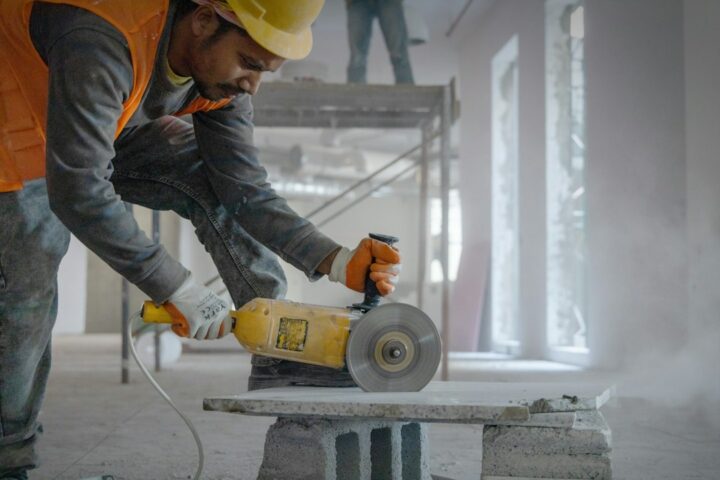
Mineral wool fibres can irritate skin, eyes and the respiratory tract during handling. Wear gloves, long sleeves, eye protection and a suitable dust mask when cutting or fitting it, and clean up with a vacuum rather than by dry sweeping. The International Agency for Research on Cancer re-evaluated insulation mineral wools in 2001 and placed stone wool and glass wool in Group 3, not classifiable as to carcinogenicity to humans, but sensible handling precautions still apply.
Frequently asked questions
Is rockwool good for soundproofing?
It is excellent as a cavity fill in walls and ceilings, where it damps resonances and improves sound insulation, and as the core of absorbent panels. On its own, without mass and sealing on either side, it does not block sound between rooms.
Is rockwool fireproof?
Unfaced stone wool is typically classified as non-combustible, Euroclass A1, and resists temperatures above 1,000 degrees Celsius according to manufacturers. A wall’s fire rating, however, depends on the whole tested system, not the insulation alone.
What is the difference between rockwool and glass wool?
Both are mineral wools. Stone wool is spun from molten volcanic rock and is generally denser and more heat-resistant; glass wool is spun from molten glass and is lighter and more compressible.
Which density of rockwool is best for soundproofing?
For stud wall cavities, medium-density batts that fill the cavity without compression work well. Denser slabs are used in acoustic panels and where rigidity or fire stopping is needed. The construction around the insulation matters more than small differences in density.
Is rockwool safe to use at home?
Yes, with sensible precautions. Fibres can irritate skin and airways during installation, so wear protective clothing and a mask when cutting, and keep insulation enclosed behind linings once fitted.
Related reading
- Sound Barriers and Noise Walls: How They Really Work
- Retaining Wall Blocks: How Block Walls Work and Fail
- Steel Buildings Explained: Systems, Design and Durability
- Truck Mounted Crane: How Lorry Cranes Work on Site
Planning a fire-rated or acoustic partition, or upgrading insulation in an existing building? Talk to our consultancy or get in touch.