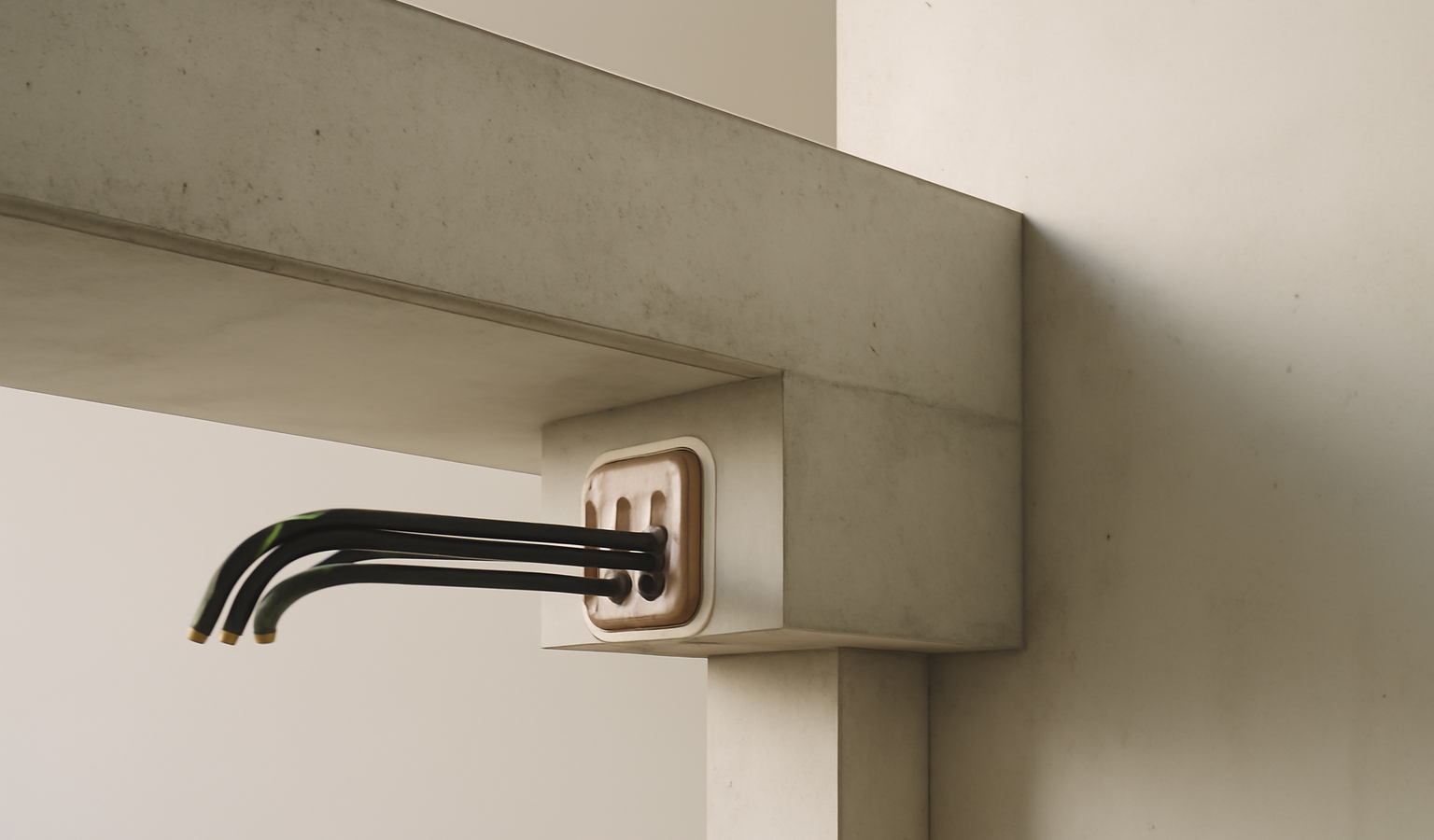
Post tensioned concrete is reinforced concrete in which high-strength steel tendons are tensioned after the concrete has hardened, squeezing the member and allowing it to span much further with less depth than ordinary reinforced concrete. It is the technology behind many long-span car park decks, slender flat slabs in towers, and bridges that cross large gaps without intermediate supports.
The idea sounds counter-intuitive: you deliberately compress the concrete so that, when load is applied, it resists bending far better. This article explains how post tensioned concrete works, how it differs from ordinary reinforcement, and why engineers choose it.
The basic idea: pre-compressing the concrete
Concrete is strong in compression but weak in tension. In an ordinary beam, the bottom fibres go into tension under load and rely on reinforcing bars to carry that tension once the concrete cracks. Post-tensioning takes a different approach: by stretching steel tendons and anchoring them against the concrete, the member is put into compression before any service load arrives.
When load is then applied, it first has to overcome that built-in compression before the concrete can ever reach its tensile limit. The result is a member that stays largely uncracked, deflects less, and can be considerably thinner. This builds on the same partnership between steel and concrete described in reinforced concrete explained, but uses the steel actively rather than passively.
Pre-tensioning vs post-tensioning
Both are forms of prestressed concrete, and the difference is in timing and method:
- Pre-tensioning stretches the tendons first, in a factory casting bed, and then casts the concrete around them. When the concrete has cured, the tendons are released and transfer their force by bond. This suits mass-produced precast units.
- Post-tensioning casts the concrete first, with hollow ducts running through it. After the concrete has hardened, tendons are threaded through, stretched with hydraulic jacks against the ends of the member, and locked off with anchorages. This suits large, cast-in-place elements such as floor slabs.
On building sites in Singapore and elsewhere, the post-tensioned flat slab is the most common form, because it lets floors be thinner and removes many downstand beams.
Bonded and unbonded tendons
Post-tensioned tendons come in two systems. In a bonded system, the tendons sit in metal or plastic ducts that are filled with cement grout after stressing, so the steel becomes bonded to the surrounding concrete. In an unbonded system, each strand is greased and sheathed in plastic and is free to move within the slab, transferring force only at its anchorages.
Bonded systems are more robust if a tendon is ever damaged, because the force is distributed along its length. Unbonded systems are simpler and faster to install, which is why they are widespread in flat slabs. The choice has real consequences for how a slab behaves and how it must be treated during any future alteration.
Why engineers use it
Post tensioned concrete is chosen for several practical reasons:
- Longer spans with fewer columns, freeing up usable floor area and parking layouts.
- Thinner slabs, which reduce the height of each floor and can add storeys within the same building height.
- Less cracking and deflection in service, giving better long-term performance.
- Material savings, since less concrete and conventional reinforcement are needed for the same span.
These advantages explain why the technology appears so often in modern commercial buildings and infrastructure. Deciding whether it is the right choice for a given project is part of the design judgement an engineer brings; you can read about that judgement in what a structural engineer does.
The critical caution: never cut into a PT slab blindly
This is the single most important thing a building owner should know. A post-tensioned slab contains tendons under enormous force. Coring, drilling or cutting into it — for a new opening, a staircase, services, or even heavy anchor bolts — risks severing a tendon. A cut tendon can release its stored energy suddenly and dangerously, and it removes structural capacity the slab was relying on.
Any penetration of a post-tensioned slab must be located using tendon-scanning surveys and signed off by an engineer before work begins. In Singapore, structural alterations of this kind also sit within the framework for works requiring professional endorsement, covered in A&A works in Singapore. If your building has PT floors and you are planning openings, our structural engineering consultancy can advise before anyone picks up a drill.
Maintenance and long-term behaviour
Post-tensioned structures are durable, but their anchorages and tendons need protection from corrosion over the building’s life. Water ingress at slab edges, where anchorages sit, is the main long-term threat, particularly in exposed decks. Good detailing of edge protection and waterproofing at the outset prevents most problems. Where corrosion is suspected in an older PT structure, specialist investigation is warranted rather than ordinary visual inspection.
Frequently asked questions
What is post tensioned concrete?
It is concrete that is cast with hollow ducts, then has steel tendons threaded through and stretched after the concrete hardens, putting the member into compression so it can span further with less depth.
What is the difference between pre-tensioned and post-tensioned concrete?
Pre-tensioning stretches the tendons before the concrete is cast, usually in a factory, while post-tensioning casts the concrete first and stretches the tendons afterwards on or off site, which suits large cast-in-place slabs.
Can you drill into a post-tensioned slab?
Only after the tendons have been located by scanning and an engineer has approved the work, because cutting a tendon can release dangerous stored energy and remove structural capacity the slab depends on.
Why is post-tensioned concrete used in car parks and towers?
Because it allows long spans with fewer columns and thinner slabs, which improves parking layouts, frees floor space, and can let a building fit more storeys within the same overall height.
Is post-tensioned concrete safe?
Yes, it is a well-established and reliable technology when correctly designed, installed and maintained; the main risks come from uncontrolled cutting of tendons and from corrosion at poorly protected anchorages.
Related reading
- Beams vs Columns: Their Structural Roles
- Shear Walls Explained: How They Resist Loads
- Retaining Walls Explained: Types and Design
- Raft Foundations Explained
Have a post-tensioned slab you need to alter or assess? Talk to our consultancy or get in touch.