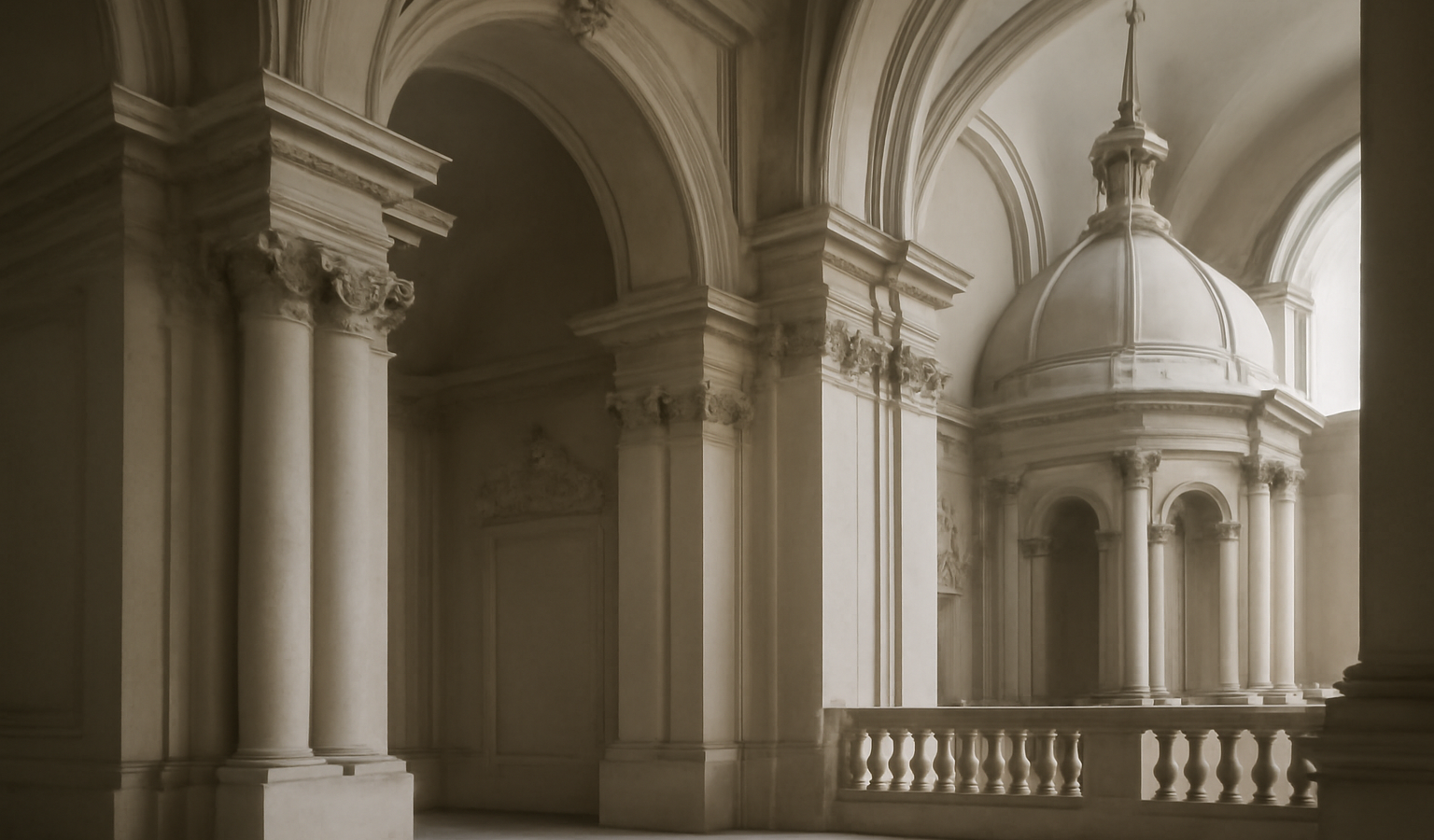
Baroque architecture is the style of movement, theatre and emotion. Emerging in early seventeenth-century Italy, it replaced the calm balance of the Renaissance with curved walls, dramatic light, swelling domes and richly modelled surfaces designed to move the viewer. Where the Renaissance sought serenity, the baroque sought awe.
This guide explains the origins of baroque architecture, the ideas that drove it, the features that define it, the architects and buildings that shaped it, and the regional variations and legacy that carried it across Europe and the wider world.
Origins: the Counter-Reformation and a new ambition
Baroque architecture developed in Rome around 1600 and flourished through the seventeenth and into the eighteenth century. It is closely tied to the Catholic Counter-Reformation. After the Protestant Reformation challenged the authority of the Church, the Catholic Church responded with art and architecture meant to inspire devotion through sensory power rather than restraint.
The style grew out of late Renaissance and Mannerist work but pushed every element further. Architects took the classical vocabulary of columns, pediments and domes that the Renaissance had revived and set it in motion — bending facades, layering elements, and exploiting the play of light and shadow to dramatic effect.
Defining features of the baroque
Baroque buildings share a recognisable set of devices, all aimed at energy and emotional impact.
- Curved and undulating forms. Walls bend and ripple; oval plans replace simple circles; facades advance and recede.
- Dramatic light. Hidden windows and contrasts of bright and shadowed surfaces (chiaroscuro) heighten the sense of drama, often directing light onto a focal point such as an altar.
- Grand scale and verticality. Large domes, sweeping staircases and tall spaces create a sense of overwhelming grandeur.
- Rich ornament. Sculpture, gilding, coloured marble and painted ceilings merge architecture, painting and sculpture into a single unified experience.
- Theatricality. Spaces are composed like stage sets, controlling how a visitor approaches and what they see at each step.
This integration of structure and decoration is one reason the baroque rewards study within the wider field of architectural styles and principles.
The masters: Bernini, Borromini and beyond
Rome produced the two architects most identified with the baroque. Gian Lorenzo Bernini was a sculptor and architect of extraordinary range. His colonnade enclosing St Peter’s Square — two great curved arms of columns that seem to embrace the visitor — is among the most famous urban gestures in architecture. Inside St Peter’s Basilica, his bronze baldachin over the high altar shows the baroque fusion of sculpture and structure.
Francesco Borromini took the style toward greater geometric invention. His church of San Carlo alle Quattro Fontane, with its undulating facade and complex oval dome, and Sant’Ivo alla Sapienza, with its spiralling lantern, show walls treated almost as a flexible, sculptural membrane. The two architects were rivals, and their contrasting temperaments — Bernini’s confident theatre and Borromini’s restless geometry — define the range of the Roman baroque.
Regional variations across Europe
From Italy the baroque spread and adapted. In France, it was disciplined into something grander and more controlled. The Palace of Versailles, expanded under Louis XIV by architects including Louis Le Vau and Jules Hardouin-Mansart, applied baroque scale and theatricality to royal power, though French taste kept a stricter classical order.
In Central Europe and the German-speaking lands, the late baroque and its lighter, more playful successor, the rococo, produced exuberant churches and palaces. Pilgrimage churches and abbey interiors dissolved the boundary between architecture and painting. In Spain and Latin America, the baroque became extraordinarily ornate, especially in the heavily decorated Churrigueresque style. In England, a more restrained baroque appeared in the work of Christopher Wren, whose St Paul’s Cathedral combines a great dome with classical clarity, and later in the monumental designs of John Vanbrugh at Blenheim Palace.
Structure behind the spectacle
It is easy to read the baroque as pure decoration, but its effects depended on serious structural ambition. Large domes, such as the one Wren engineered for St Paul’s, required careful thought about how to carry enormous weight and resist outward thrust — Wren famously used a hidden brick cone to support the lantern above the visible dome. Oval and curved vaults are geometrically more demanding than simple ones.
The baroque builders worked largely in masonry, and their grandest spaces pushed that material hard. Reading the loads in a complex vault or dome, and tracing how they reach the ground, is the same discipline a modern engineer applies to any large span, whether in stone or in reinforced concrete. The drama was real, but it rested on real structure.
The illusionism of the baroque deserves a note of its own. Painters and architects worked together to extend real architecture into painted architecture, so that a ceiling might appear to open onto the heavens, with painted columns and figures continuing the lines of the actual building. This fusion of disciplines — architecture, painting, sculpture and stagecraft — was central to the baroque ambition to create a single overwhelming environment rather than a collection of separate artworks.
Legacy and influence
The baroque eventually gave way to neoclassicism in the later eighteenth century, as taste turned back toward restraint and archaeological accuracy. But its influence never disappeared. The idea that architecture can choreograph movement, control light for emotional effect, and merge the arts into a total environment continued to shape opera houses, civic monuments and grand interiors into the nineteenth century and beyond.
Today, baroque churches, palaces and city squares are among the most visited heritage buildings in the world, and they remain demanding to conserve. Their curved masonry, heavy domes and elaborate surfaces require expert assessment whenever repair or alteration is considered, which connects directly to the kind of work explored in what a structural engineer does.
Frequently asked questions
What is baroque architecture in simple terms?
Baroque architecture is a dramatic, ornate style that emerged in seventeenth-century Italy, using curved walls, bold light, grand domes and rich decoration to create a sense of movement and emotional power, especially in churches and palaces.
When did baroque architecture begin?
It began in Rome around 1600 and flourished through the seventeenth century, continuing into the eighteenth century and overlapping with its lighter offshoot, the rococo, before neoclassicism replaced it.
Who are the most famous baroque architects?
The two most celebrated are Gian Lorenzo Bernini and Francesco Borromini in Rome, alongside figures such as Christopher Wren in England and the architects of the Palace of Versailles in France.
What is the difference between Renaissance and baroque architecture?
Renaissance architecture values calm balance, symmetry and clear geometry, while baroque architecture takes the same classical elements but bends and energises them, favouring curves, dramatic light and rich ornament to stir emotion.
What is the main purpose of baroque architecture?
Much of it was created to inspire awe and devotion as part of the Catholic Counter-Reformation, and to express power and prestige, using theatrical space and decoration to overwhelm and move the viewer.
What is the difference between baroque and rococo?
Rococo is a lighter, more playful offshoot of the late baroque, popular mainly in France and Central Europe in the eighteenth century. Baroque is grand, dramatic and weighty, with bold contrasts, deep colours and powerful curves. Rococo softens this with pastel colours, white and gold interiors, delicate asymmetrical shell and scroll ornament, and a more intimate, decorative mood.
Is St Paul’s Cathedral in London baroque?
Yes, St Paul’s Cathedral, designed by Sir Christopher Wren and built after the Great Fire of London, is the best-known example of English baroque. Completed in the early eighteenth century, it combines a restrained classical facade with a great dome and baroque spatial drama. English baroque is generally calmer than its Italian or Spanish counterparts, reflecting Protestant taste.
What is trompe l’oeil in baroque architecture?
Trompe l’oeil, French for deceive the eye, is a painting technique that creates a convincing illusion of three-dimensional space on a flat or curved surface. Baroque artists painted ceilings that appeared to open up into the sky, filled with clouds and figures, blurring the boundary between architecture and painting. Andrea Pozzo’s ceiling at the Church of Sant’Ignazio in Rome is a famous example.
Are there baroque buildings in Asia?
Yes, the best-known baroque buildings in Asia are the Spanish colonial churches of the Philippines, four of which are listed together as a UNESCO World Heritage Site. They are sometimes called earthquake baroque, because their thick walls and massive buttresses were adapted to resist earthquakes. Baroque influence also appears in Portuguese-era churches in Goa and Macau.
Related reading
- Romanesque Architecture: Round Arches and Mass
- The International Style in Architecture Explained
- Deconstructivism in Architecture Explained
- Bauhaus Architecture and Design Explained
Conserving or adapting a heritage masonry building and need senior structural advice? Talk to our consultancy or get in touch.