A scissor lift is a mobile elevating work platform that raises a guarded deck straight up on a set of crossed, folding supports. It is the workhorse of ceiling installation, mechanical and electrical fit-out, façade cleaning at low level and countless maintenance tasks, because it puts people and their tools at height with a stable, roomy platform and no need for scaffolding.
This article explains how the machine works, where it is the right tool and where it is not, the hazards that cause most incidents, and the regulatory position in Singapore, where scissor lifts are treated as lifting machines under the Workplace Safety and Health framework.
How a scissor lift works
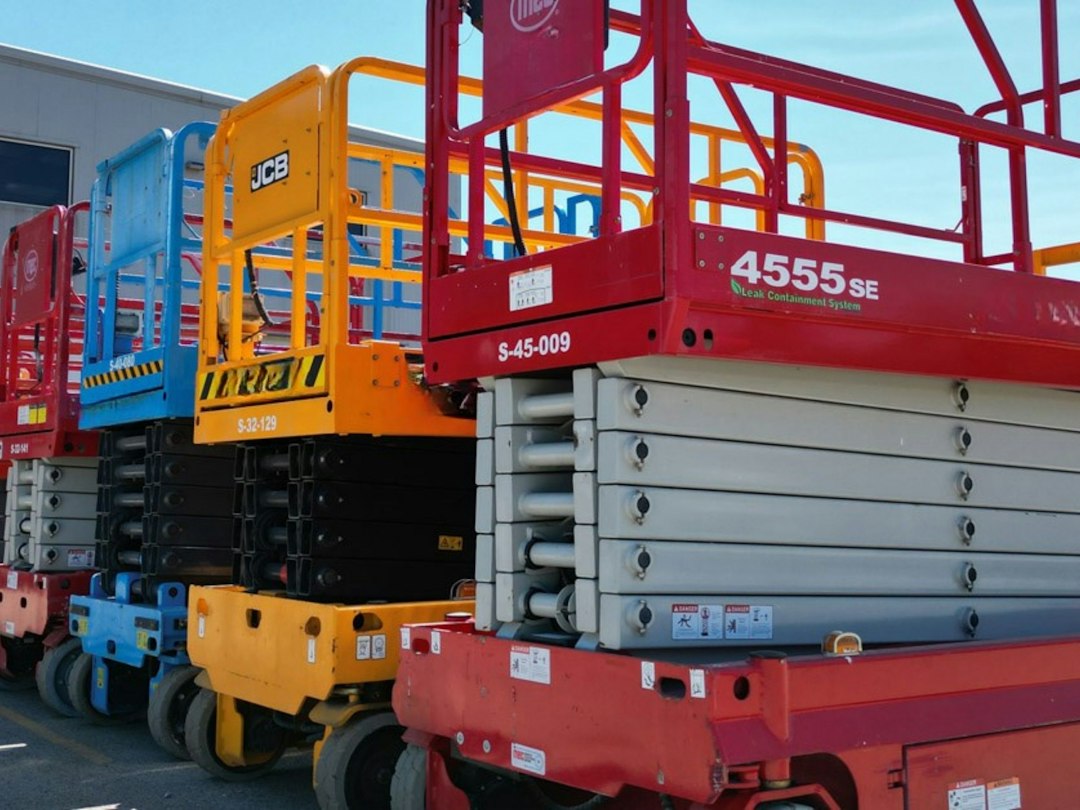
The lifting mechanism is a pantograph: pairs of steel arms pinned at their centres, stacked in tiers. When hydraulic cylinders (or, on some smaller units, an electric actuator) push the bottom tier apart, each crossed pair straightens and the platform rises vertically. Lowering reverses the process under controlled hydraulic valving. Because every tier extends together, the platform stays level as it rises.
The base is a compact chassis carrying the batteries or engine, hydraulic pump, drive motors and steering. Most units can be driven slowly while elevated, within limits set by the manufacturer, and are fitted with tilt sensors, overload sensing on many models, pothole guards that drop below the chassis when the platform rises, and emergency lowering valves. A guardrail with a self-closing gate surrounds the deck, and many decks have a roll-out extension to reach a little beyond the base.
Slab and rough-terrain models
There are two broad families. Slab scissors are electric, narrow and light, with solid non-marking tyres, designed for smooth, level, firm floors inside buildings. They fit through doorways and into lifts on some projects, and are the usual choice for ceiling and services work in fit-out.
Rough-terrain scissors are wider and heavier, often diesel or hybrid, with pneumatic or foam-filled tyres, four-wheel drive and sometimes levelling outriggers. They carry larger platforms and loads and work outdoors on compacted ground. Both are limited by the same basic constraint: a scissor goes straight up. If the work is over an obstruction or offset from where the machine can stand, a boom lift is usually the better choice.
Where scissor lifts suit the work
The machine is efficient where work is spread over a large area at a consistent height, and where the floor below is accessible. Typical uses include installing ceiling grids and boards, running cable trays, ductwork and sprinkler pipes, painting high walls, fixing signage, and inspecting soffits.
It competes with scaffold towers and full scaffolding. For short, repetitive tasks across a floor, a scissor lift is quicker and avoids repeated erection; for long-duration work on one elevation, or where the ground cannot carry the machine, a properly designed scaffold may still be better. Our guide to types of scaffolding covers the alternatives.
The main hazards
Incident investigations involving scissor lifts tend to point to a small set of causes:
- Overturning, usually from driving elevated over a slope, a step, an unprotected edge, a drain or soft ground, or from exceeding the rated platform load.
- Crushing against overhead beams, ceilings or services while raising or driving elevated, a hazard that has caused fatalities worldwide and has led to anti-entrapment devices on many machines.
- Falls from the platform, typically from climbing or leaning on the guardrails, or working with the gate open.
- Floor failure, where the wheel loads exceed what a raised floor, a ramp, a trench cover or a suspended slab can carry.
The floor issue is worth emphasising. Scissor lifts look light but concentrate their weight, plus the platform load, on four small tyre patches. Access floors, suspended timber floors, glazed roofs and some lightweight slabs may not be designed for that. Where there is doubt, the wheel loads from the manufacturer’s data should be checked against the floor’s capacity by a competent person.
Scissor lift rules in Singapore
Singapore’s Ministry of Manpower (MOM) treats a mobile elevating work platform, including a scissor lift, as a lifting machine under the Workplace Safety and Health (General Provisions) Regulations. MOM’s 2012 safety circular on MEWPs set out the main duties. The occupier must ensure the machine is registered with MOM as a lifting machine and thoroughly examined by an Authorised Examiner at intervals; that circular cited at least once every six months, and the current interval should be confirmed against MOM’s latest test and examination requirements. Authorised Examiners must verify that the required safety devices are in place and working.
Operators must be trained and competent. The circular states that an operator must attend and pass an MEWP course from an MOM-accredited training provider, specific to the type of MEWP, and must also be familiarised with the controls of each model by a competent person. It is an offence under the WSH Act to bypass or remove safety devices such as interlocks. Work at height more broadly is governed by the WSH (Work at Heights) Regulations, and the employer’s general duties under the WSH Act apply throughout. For how these duties fit together on site, see our overview of construction safety.
Using a scissor lift well
Practical discipline prevents most incidents:
- Check the floor and route before use: level, firm, free of holes, edges and covered openings.
- Carry out pre-use checks of controls, emergency lowering, guardrails, gate, tyres and alarms.
- Respect the platform load, including people, tools and materials.
- Keep feet on the deck: no ladders, buckets or standing on rails.
- Watch overhead when raising and driving; use spotters where structure or services are close.
- Ensure there is a rescue plan and a trained ground person who can lower the platform.
Frequently asked questions
What is the difference between a scissor lift and a boom lift?
A scissor lift raises its platform vertically on a folding pantograph, giving a large, stable deck directly above the base. A boom lift carries a smaller basket on an arm that can reach up and out, over obstacles or away from the machine. The choice depends on whether the work is directly above accessible floor or offset from it.
Do you need training to operate a scissor lift in Singapore?
Yes. MOM requires MEWP operators to pass a course from an accredited training provider specific to the type of machine, and to be familiarised with each model they operate. Employers must also provide adequate instruction and supervision.
Can you wear a harness in a scissor lift?
The guardrail is the primary fall protection on a scissor lift. Whether a restraint harness is also required depends on the manufacturer’s instructions, the risk assessment and site rules; where one is used, it should be a restraint system attached to the designated anchor points, not to the rails.
Can a scissor lift be used on a suspended slab?
Often yes, but only if the slab can carry the concentrated wheel loads. Lightweight floors, access floors, ramps and early-age slabs should be checked against the manufacturer’s wheel-load data by a competent engineer before use.
Related reading
- Overhead Crane (EOT) Explained: Types, Design and Safety
- Gantry Crane Explained: Types, Uses and Lifting Safety
- Crawler Crane Explained: Types, Uses and Lifting Safety
- Mobile Crane Types, Uses and Singapore Lifting Rules
Unsure whether a floor, deck or podium can take access equipment? Talk to our consultancy or get in touch.