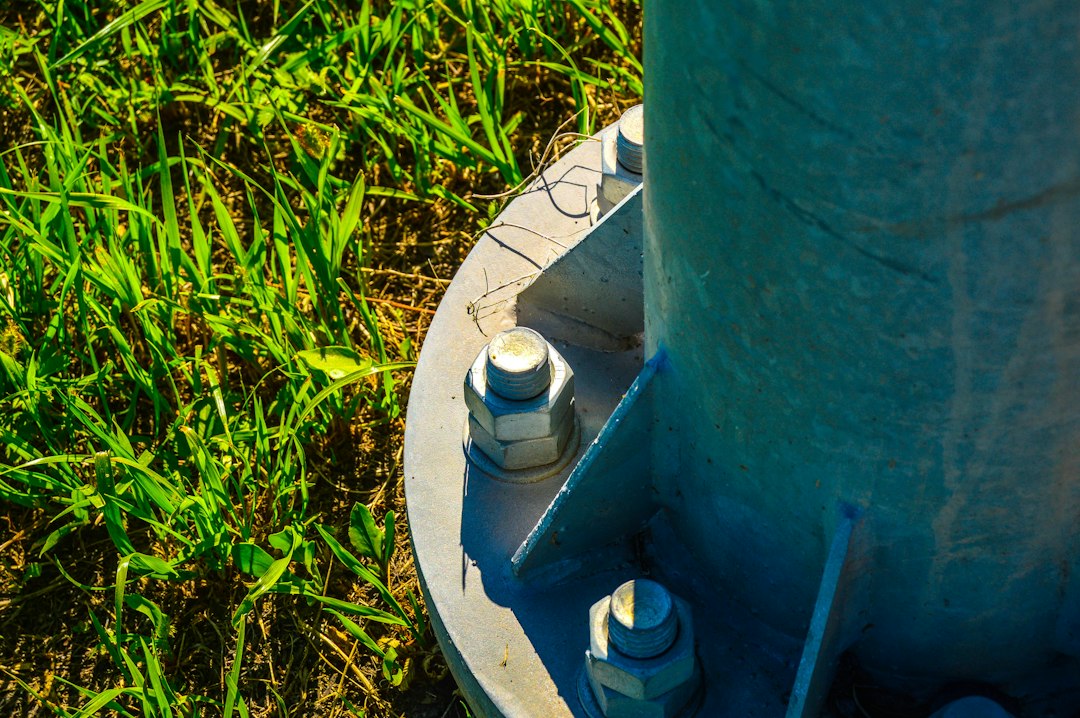
Helical piles, also called screw piles or helical anchors, are steel shafts fitted with one or more helix-shaped bearing plates that are screwed into the ground rather than driven or drilled. They install quickly with modest equipment, produce almost no spoil or vibration, and can be loaded immediately. That makes them attractive for light structures, extensions, boardwalks, solar arrays, towers and underpinning, particularly where access is limited or the ground is soft near the surface.
This article explains how helical piles work, how their capacity is designed and verified, where they suit and where they do not, and what to consider before specifying them. For a comparison with other systems, see our overview of pile foundation types.
A long history
The screw pile is older than most modern foundation systems. The Irish engineer Alexander Mitchell, who was blind, patented a screw pile in 1833 and used it to found lighthouses on soft sandbanks, among them the Maplin Sands lighthouse in the Thames estuary, begun in 1838. Screw piles were then widely used for lighthouses, piers and bridges in the 19th century.
The modern revival came with powerful hydraulic torque motors mounted on excavators, which made installation fast and controllable. Today screw piles are a mainstream foundation in North America, Australia and New Zealand, with product evaluation and design guidance well established in those markets, and are used selectively elsewhere.
How helical piles carry load
A helical pile has a central shaft, usually a square solid bar or a round steel tube, with one or more helical plates welded near the toe. As the shaft is rotated, the helices advance into the soil like a screw, with minimal disturbance to the surrounding ground.
Load is carried mainly by bearing on the helix plates. With several helices spaced along the shaft, engineers use one of two models:
- Individual bearing: where helices are widely spaced, each plate bears independently on the soil beneath (in compression) or above (in tension).
- Cylindrical shear: where helices are closely spaced, the soil between them acts with the plates as a cylinder, and capacity comes from shear along that cylinder plus bearing on the lead or top helix.
Shaft friction contributes little for slender square bars but can be meaningful for larger tubular shafts. Because the helices bear in both directions, screw piles resist tension almost as well as compression, which is why they are popular as anchors against uplift and overturning.
Torque and capacity verification
One of the defining features of the system is the relationship between installation torque and capacity. As the pile is screwed in, the torque needed to advance it reflects the strength of the soil around the helices. Empirical correlations, based on large numbers of load tests, relate final installation torque to ultimate capacity through a factor that depends mainly on shaft size and shape.
This gives a useful check on every pile installed: if the target torque is not reached at the design depth, the pile is extended until it is. However, torque correlations are empirical and do not replace good ground investigation or load testing. Good practice is to design from soil parameters using bearing theory, confirm with torque during installation, and verify with load tests on representative piles, particularly in unfamiliar soils or where loads are significant.
Where helical piles suit best
Screw piles are well suited to:
- Light to moderate loads: extensions, sheds, decks, walkways, signage, lighting poles, solar panel arrays and modular buildings.
- Tension and anchoring: guyed masts, retaining wall tiebacks, and structures subject to uplift.
- Restricted access: small installation rigs work in backyards, on slopes and inside buildings.
- Underpinning: brackets attached to existing footings transfer load to piles installed beneath them. Our guide to underpinning foundations covers the wider options.
- Temporary or removable works: piles can be unscrewed and reused.
- Sensitive or contaminated sites: no spoil to dispose of, no curing time, and minimal vibration.
Their speed is a major advantage: a crew can install many piles in a day, and they can be loaded immediately without waiting for concrete to cure.
Limitations and ground conditions
They are not suitable everywhere. Their main limitations are:
- Obstructions and hard ground: cobbles, boulders, rubble fill and rock can stop or damage the helices. They perform best in soils that can be penetrated by a screw.
- Very soft soils: slender shafts passing through deep soft clay may need checking for buckling and may require larger tubular shafts or grouting.
- Lateral load: slender shafts have limited lateral capacity unless larger shafts or battered piles are used.
- Corrosion: galvanising is standard, but corrosion allowance and the aggressiveness of the soil must be considered for permanent works.
- Heavy loads: large buildings usually need bored or driven piles with higher individual capacity.
In Singapore, screw piles are less common than in some other markets. Where deep soft marine clay lies over the bearing stratum, the depth to competent soil and the effects of consolidation and negative skin friction can make other pile types more practical. Where they are proposed, the design should be based on site-specific ground data and endorsed through the normal building control route; our article on soil mechanics basics explains why soil type matters so much.
Helical piles compared with other options
Compared with micropiles, helical piles are faster and need no grout, but are more sensitive to obstructions and generally carry lower loads. Compared with shallow pad footings, they avoid excavation and work in poor near-surface soils. Compared with bored piles, they are lighter, quicker and cleaner, but cannot match large-diameter bored piles for capacity.
The right choice depends on the loads, the ground profile, access, programme and the need for tension capacity. For small structures on soft surface soils, they are often a neat, economical answer. For heavy structures or difficult ground, other foundations are likely to be more appropriate, a balance discussed in our guide to deep versus shallow foundations.
Frequently asked questions
Are helical piles the same as screw piles?
Yes, the terms are generally used interchangeably. Helical piles, screw piles and helical anchors all describe steel shafts with helix plates that are screwed into the ground. “Anchor” is often used when the main load is tension.
How deep do helical piles go?
Depth is set by the design and by the torque achieved on site. Piles are extended with additional shaft sections until the helices are founded in soil strong enough to reach the target torque, so depth varies with ground conditions.
How much load can helical piles carry?
Capacity depends on the helix sizes, the shaft, the soil and the installation depth. They typically suit light to moderate loads, and capacity should be confirmed by design calculations, installation torque and load testing rather than taken from generic tables.
Do screw piles work in clay?
They can work in firm to stiff clays and in many sands. In very soft clay, slender shafts may buckle and capacity is low until the helices reach firmer ground, so the depth to competent soil and the shaft size need careful assessment.
Can helical piles be removed?
Yes. They can be unscrewed by reversing the installation process, which makes them useful for temporary structures and for sites where foundations may need to be relocated or removed in the future.
Related reading
- Hollow Core Slab Explained: Precast Floors and Spans
- Roof Truss Types: How Common Roof Trusses Carry Load
- Bored Piles: How They Are Built and When to Use Them
- H Beam vs I-Beam: Differences, Sizes and Uses Explained
Considering helical piles or another foundation for a light structure or extension? Talk to our consultancy or get in touch.