A concrete mixer combines cement, aggregates, water and admixtures into a uniform mix. The term covers everything from the small tilting drum mixer used on a renovation job to the truck mixer, the familiar rotating drum on a lorry that delivers ready-mixed concrete to most building sites in Singapore. How the concrete is mixed, transported and discharged has a direct effect on its strength, durability and finish.
This guide explains how mixers work, the main types, how ready-mixed concrete gets from the plant to the pour, and the quality and safety points that matter on site. It is written from the perspective of the engineer who specifies the concrete and has to accept or reject what arrives.
What a concrete mixer does
Concrete only works if its ingredients are evenly distributed. Every particle of aggregate must be coated with cement paste, the water must be distributed throughout, and admixtures must be dispersed evenly. A mixer achieves this by tumbling, folding or shearing the materials until the mix is uniform. Too little mixing leaves pockets of weak or dry material; excessive mixing or delay can cause loss of workability and, in some cases, segregation.
The mix itself is designed for a target strength and durability class, with the water-cement ratio being the single most important factor. Our guide to concrete grades and strength explains how that design is set.
Main types of concrete mixer
Drum mixers
Drum mixers have a rotating drum with internal blades that lift and drop the materials as it turns.
- Tilting drum mixers discharge by tilting the drum. Small portable versions are used for minor works and repairs.
- Non-tilting drum mixers discharge through a chute while the drum stays horizontal.
- Reversing drum mixers mix in one direction and discharge by reversing rotation, the same principle used in truck mixers.
Pan and twin-shaft mixers
Pan mixers have a stationary or rotating pan with rotating blades or paddles, and twin-shaft mixers have two horizontal shafts with paddles rotating in opposite directions. These forced-action mixers produce intensive, uniform mixing and handle stiff or high-performance mixes well, such as precast and self-compacting concrete. They are typical in batching plants and precast factories rather than on site.
Truck mixers
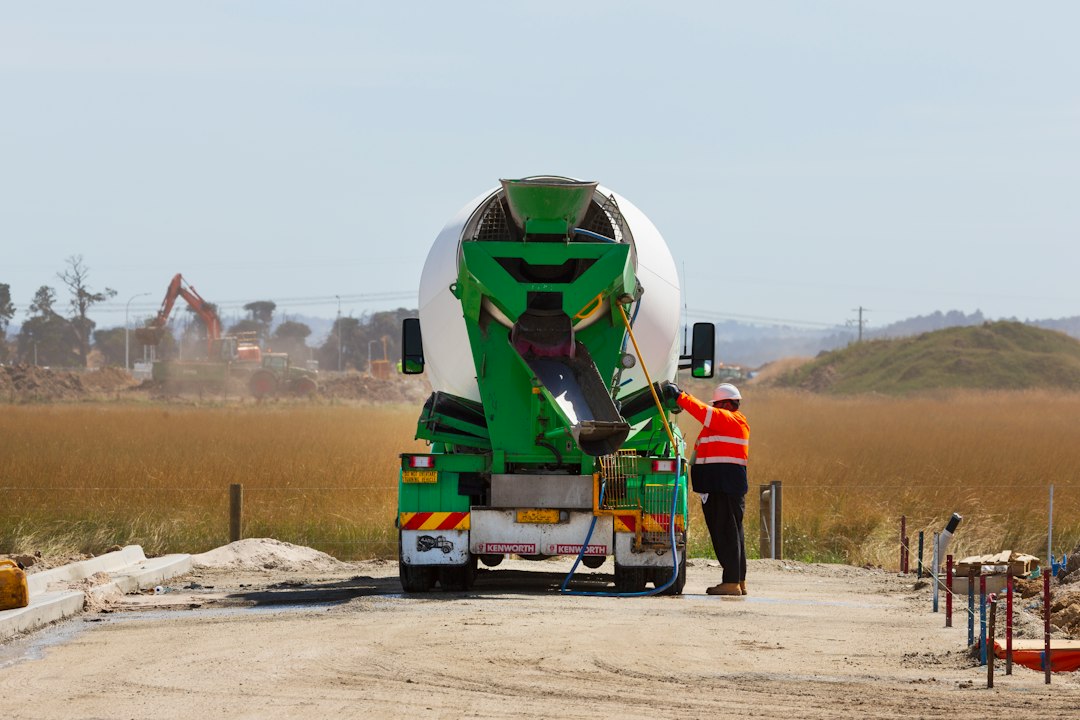
A truck mixer, also called a transit mixer or agitator truck, carries a large inclined drum with spiral blades inside. Rotating one way, the blades fold the concrete towards the bottom of the drum, keeping it mixed and agitated during transport. Reversing the rotation drives the concrete up the spiral and out through the discharge chute.
Volumetric and self-loading mixers
Volumetric mixers carry separate compartments of cement, aggregate and water and mix concrete on site to order, useful for small or intermittent pours. Self-loading mixers are compact machines with a loading shovel that batch, mix and transport concrete, more common on remote or rural sites than in Singapore.
How ready-mixed concrete reaches the site
On most Singapore projects, concrete is batched at a concrete batching plant and delivered by truck mixer. The sequence is straightforward but each step matters:
- Batching: materials are weighed and charged into the truck or a central mixer at the plant.
- Mixing and transport: the drum rotates to mix or agitate the concrete while the truck travels.
- Arrival and checks: the delivery ticket is checked against the order, and the concrete is checked for workability, often by a slump test, before acceptance.
- Discharge: concrete is discharged by chute, into a skip for a crane, or into a pump hopper.
- Sampling: test cubes are taken at the specified frequency for strength testing.
Time matters. Concrete starts to stiffen as the cement hydrates, and hot weather speeds this up. Specifications set limits on the time between batching and discharge, and on adding water on site. Adding uncontrolled water to restore workability raises the water-cement ratio and lowers strength and durability, which is why it is usually prohibited without the supplier’s and engineer’s agreement. The workability check itself is described in our guide to the concrete slump test.
Where mixers are used on a building project
Truck mixers serve almost every concrete element: piles, pile caps, raft foundations, columns, walls, slabs and toppings. For large pours, such as a raft foundation or transfer slab, many trucks must arrive in a steady sequence so the pour continues without cold joints. Pump placement, traffic control and truck scheduling are planned together, and our article on concrete pumping explains how trucks and pumps work as a system.
Small site mixers remain useful for minor works: bedding, small repairs, kerbs and non-structural infill. For structural work, a site-mixed concrete needs proper control of proportions, and ready-mixed concrete from a certified supplier is usually specified.
Site safety
Mixers and truck mixers bring a mix of plant, traffic and chemical hazards, all covered by the employer’s duties under the Workplace Safety and Health Act and the requirement to assess risks.
Truck movements
Truck mixers are heavy and frequently reverse into position at pumps and discharge points. Traffic routes, segregated walkways, reversing controls and ground guides are essential, consistent with the WSH Council’s guidance on workplace traffic safety management. The ground at discharge points must be firm enough for a loaded truck, and trucks must stay clear of excavation edges unless the temporary works design allows for them.
Rotating parts
Drums, chutes and the moving parts of site mixers can trap clothing and limbs. Guards must be in place, and no one should enter or reach into a drum unless it has been isolated and locked off. Cleaning out a drum is a high-risk task that needs a proper isolation procedure.
Cement burns and dust
Wet concrete is strongly alkaline and can cause serious chemical burns to skin and eyes. Workers need suitable gloves, boots, eye protection and clothing, and should wash off any concrete promptly. Cement dust from site mixing is also an irritant.
Washout and the environment
Washing out mixers and chutes produces alkaline slurry that must not enter public drains. Washout should be done in designated areas with settlement and treatment, part of the site’s environmental controls under PUB requirements.
Frequently asked questions
How does a concrete mixer truck work?
The drum has spiral blades inside; rotating it one way folds and agitates the concrete during transport, and reversing the rotation drives the concrete up the spiral and out through the discharge chute.
Why does the drum keep turning during transport?
Continuous rotation keeps the concrete uniform and workable and prevents segregation, where heavier aggregate settles out of the cement paste.
Can water be added to concrete on site?
Adding uncontrolled water raises the water-cement ratio and reduces strength and durability, so it is usually prohibited unless the supplier and engineer agree and the amount is controlled within the mix design.
What is the difference between a drum mixer and a pan mixer?
A drum mixer tumbles materials in a rotating drum, while a pan or twin-shaft mixer forces paddles through the mix, producing more intensive mixing that suits stiff and high-performance concretes.
Is site-mixed concrete acceptable for structural work?
Structural concrete is normally specified as ready-mixed from a certified supplier because batching control is better, and site-mixed concrete should only be used structurally where the engineer has accepted the method and testing.
Related reading
- BIM Software Compared: Authoring, Coordination and IFC
- Civil 3D Explained: Roads, Grading and Drainage Design
- Navisworks and Clash Detection: How Models Are Coordinated
- Construction Surveying Explained: Control to As-Built
Planning a large pour or questioning concrete quality on site? Talk to our consultancy or get in touch.